
The team was all smiles as we returned to shore after a successful week of science. I am in the second row, third from the right in the Fishermen’s Alliance hat. (Credit: Haley Synan)
By Mel Sanderson
From May 17 to 22, I was a member of the science team aboard Woods Hole Oceanographic Institution’s R/V Neil Armstrong. The team was part of the Future Fisheries Alliance, a collaboration aiming to help fishermen adapt to a rapidly changing ecosystem by leveraging the latest technologies, real-time data, and climate models at WHOI. You can read more about the research trip in Fish Tales.
Come along for a full day of scientific research at sea!

06:00 – The morning science team starts active sampling at 6 a.m. One of the primary environmental sensors used is a CTD, which measures conductivity (salinity), temperature, and depth. I controlled the CTD rosette deployments from the lab’s command center, providing target depths to the winch operator and firing the niskin bottles to capture water samples at specific depths. The command center also tracks location, speed, current, winch payout, EK80 multi-frequency sonar, acoustic doppler current profiler, thermosalinograph, and video of key areas onboard. (Credit: Noelle Olsen)
06:10 – At each station, the CTD rosette is dropped to the desired depth, usually close to the bottom. The ring of cylinders are niskin bottles which capture water samples. Inside the ring are several sensors to measure key physical, chemical, and biological properties of the water in real time as it is lowered. Measurements include conductivity (salinity), temperature, depth, chlorophyll- a (algae = food!), dissolved oxygen, turbidity, and available light. It has an altimeter to measure exact distance from the sea floor, which we monitor carefully so we don’t accidentally crash into the bottom.
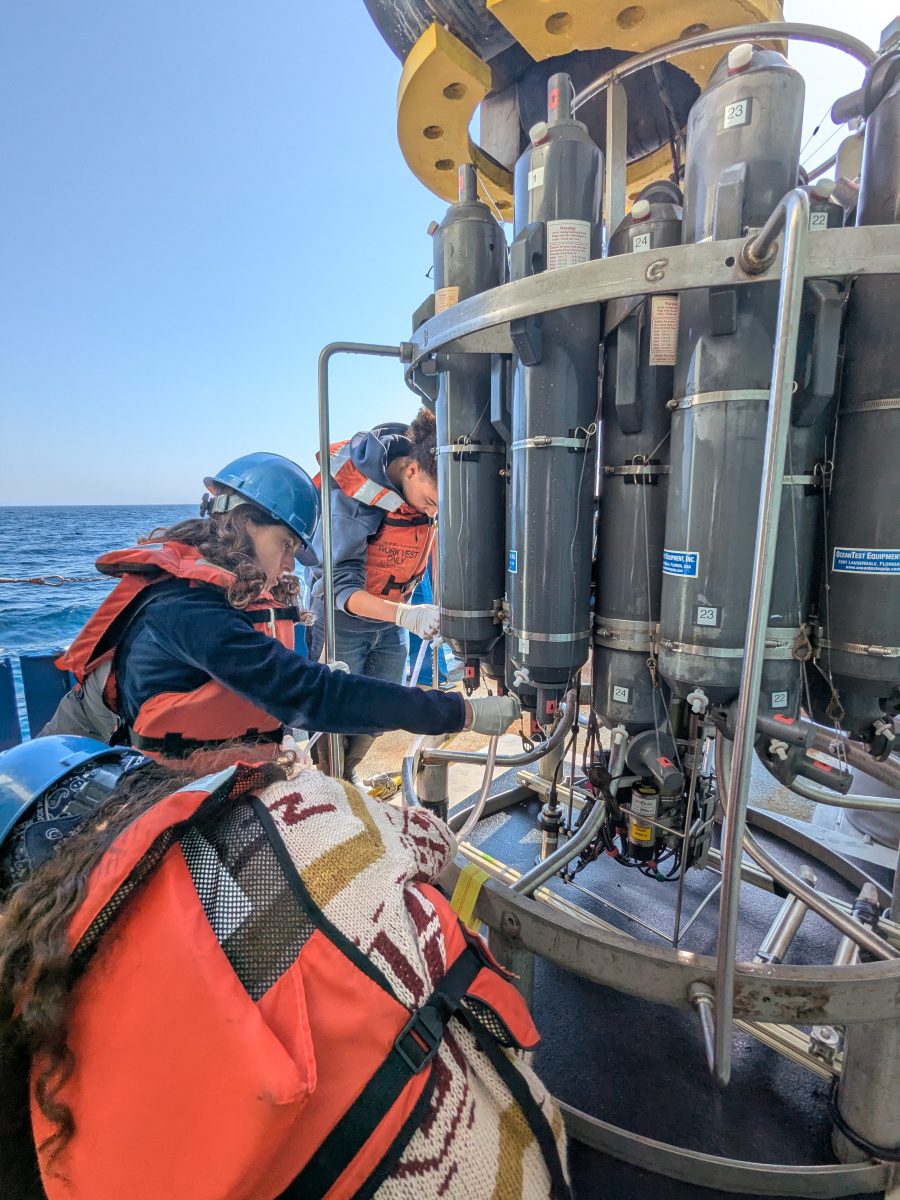
07:00 – Students Catherine Quinty, Ashley Lasinsky, and Jos Buffington (left to right) collecting water samples from niskin bottles on the CTD rosette. They are filtering the water as it leaves the bottle so it can be analyzed for nutrients. Before deployment, each niskin bottle is open at the top and bottom so the water can flow through. At the desired depth, the bottles are closed to capture the water sample.
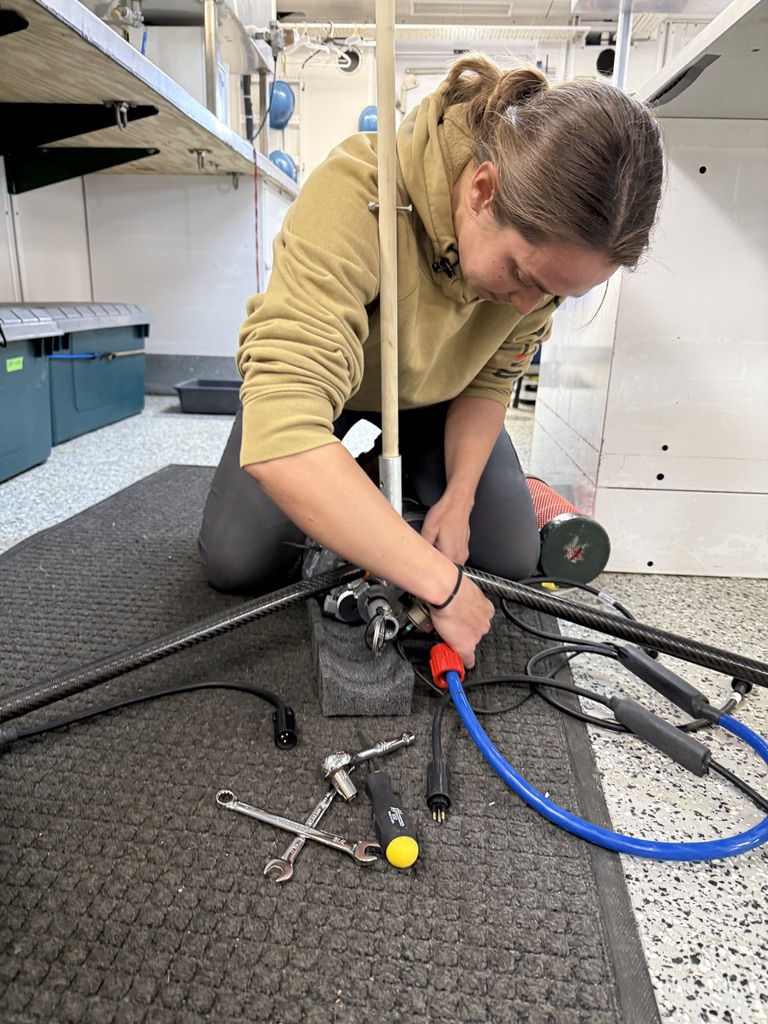
09:00 – Shark scientist Christine de Silva is making adjustments to the BRUV (baited remote underwater video) she designed to record shark behavior. The Neil Armstrong crew are always on hand to help modify the equipment, making sure it can be safely deployed and retrieved before we drop it to the bottom of the ocean. (Credit: Samantha Alaimo)

10:00 – A screenshot of the backscatter readings from the EK-80 multi-frequency sonar. The EK-80 ran 24/7 with five different frequencies, recording biomass of marine life, from plankton to tuna. The recordings will be analyzed onshore after the trip by WHOI scientist Mei Sato and results will be compared to the physical oceanography.
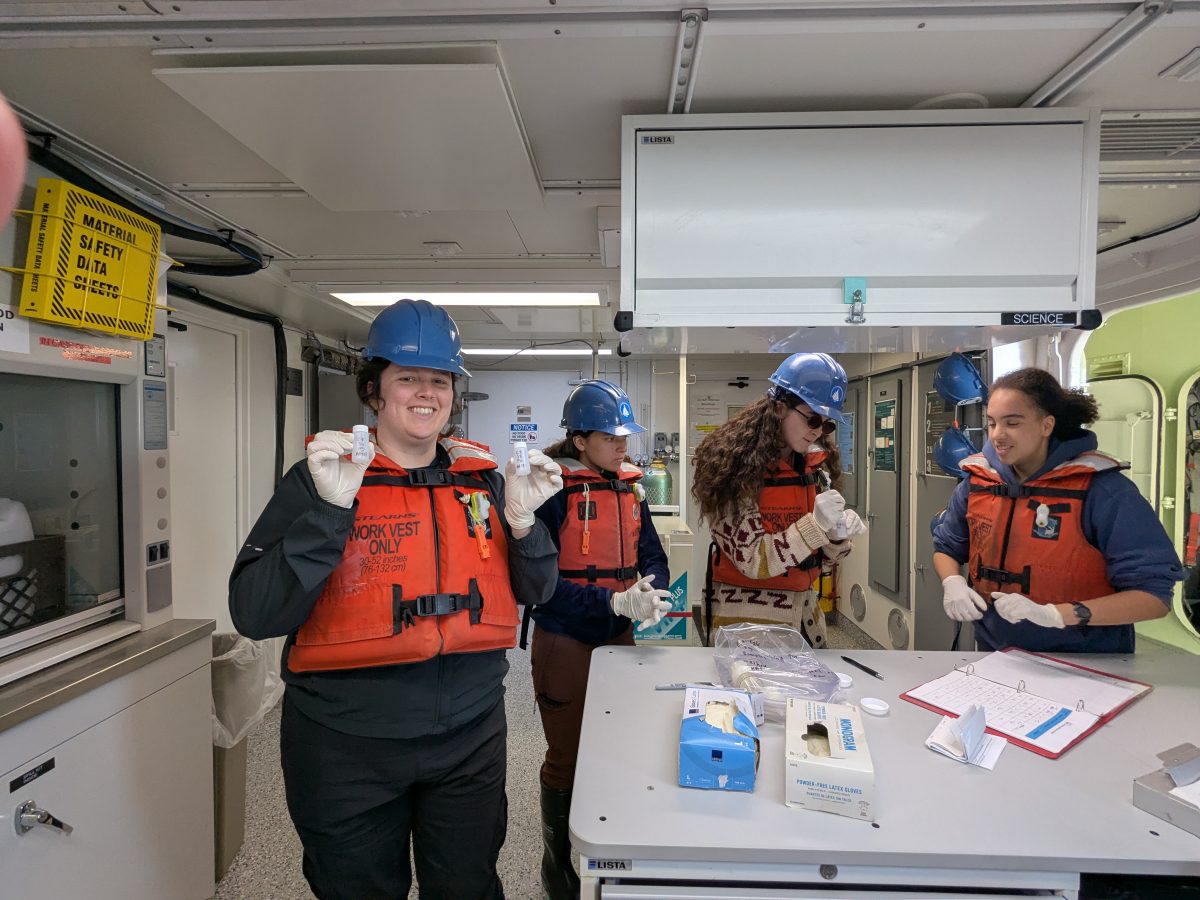
11:00 – Noelle Olsen (the other fishery liaison from Commercial Fisheries Research Foundation), Ashley, Catherine, Jos (left to right) prepare acid-washed bottles to collect water for nutrient samples, to measure nitrate, nitrite, phosphate and other chemical building blocks for marine life. We took samples at different depths, but always at the depth where the sensor recorded the largest amount of chlorophyll (the plant matter that is the base of the food web.)
12:00 – Christine and the Neil Armstrong crew use the a-frame to safely lift the BRUV (baited remote underwater video) off the deck and into the water. A cinderblock is used as a weight to bring the camera system to the bottom of the ocean, where we hope to see sharks and squid. The system has lights for the camera and a bait bag to attract marine life. We leave the BRUV in the water for at least five hours before returning to collect it.
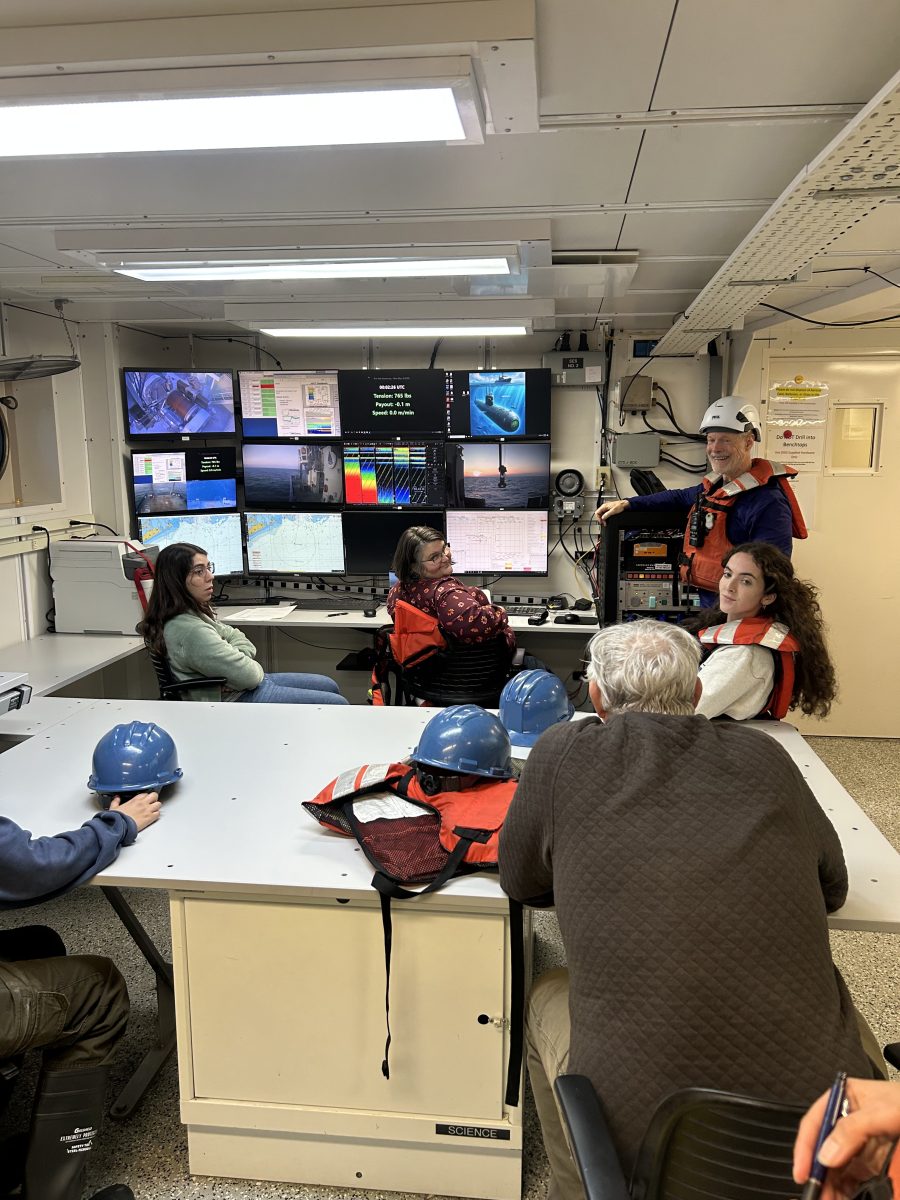
14:00 – After eight hours of research activities, the morning watch is handed off to the afternoon watch, led by Samantha Alaimo. This is a time to review progress, interpret data, and make plans for the rest of the day. Samantha, Mel, Howie Johnson (Neil Armstrong Shipboard Scientific Services Group), Catherine, and chief scientist Glen Gawarkiewicz (clockwise, starting upper left). (Credit: Noelle Olsen)
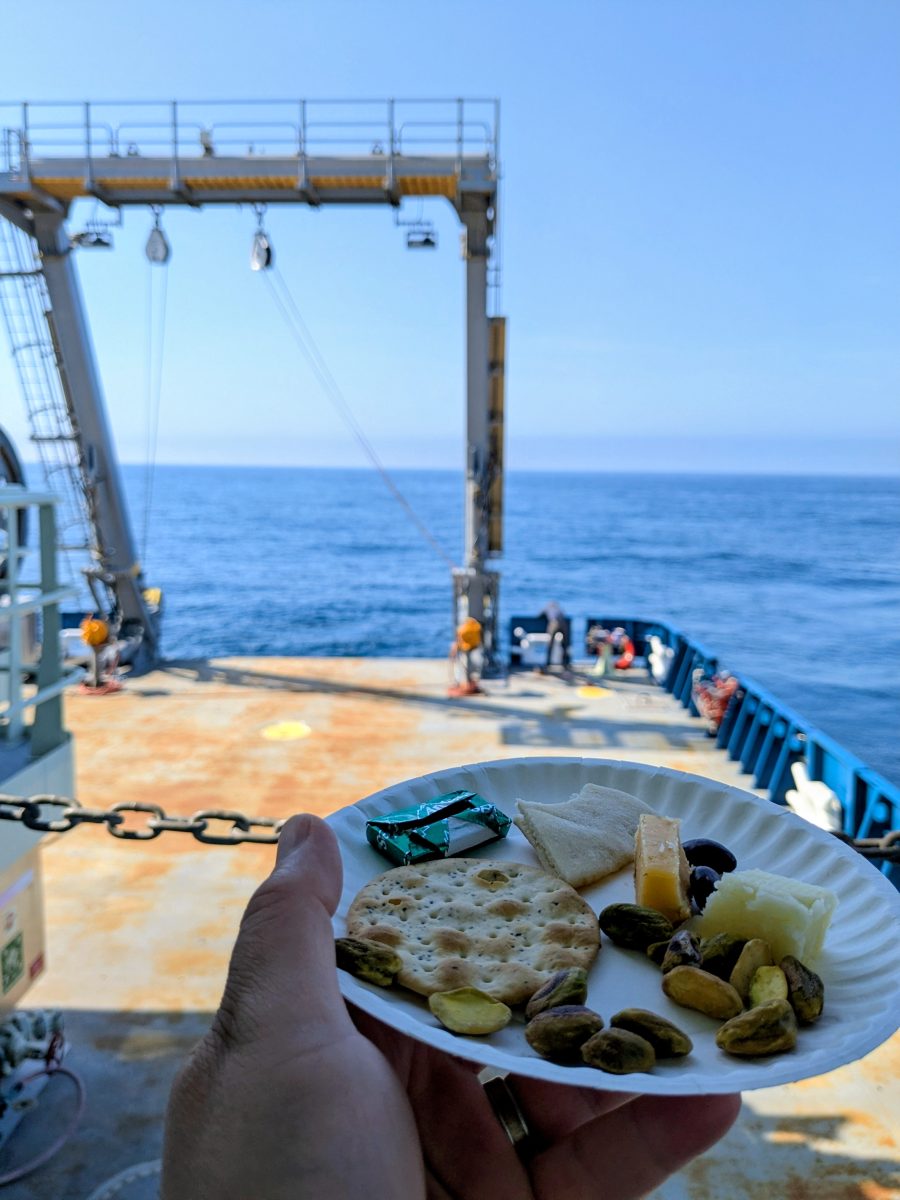
15:00 – Each afternoon the amazing galley team set out an afternoon snack. I took my 2:30 or “cheese-thirty” break topside for an unbeatable view off the upper deck.
16:00 – Throughout daylight hours, marine life spotter Nicholas Metheny was on the bow scanning the horizon for whales, dolphins, birds, and other marine life. The special Big Eyes binoculars let him see all the way to the horizon. Given where we were along the edge of a warm core ring, we expected to see a lot of marine life, but were mostly disappointed.
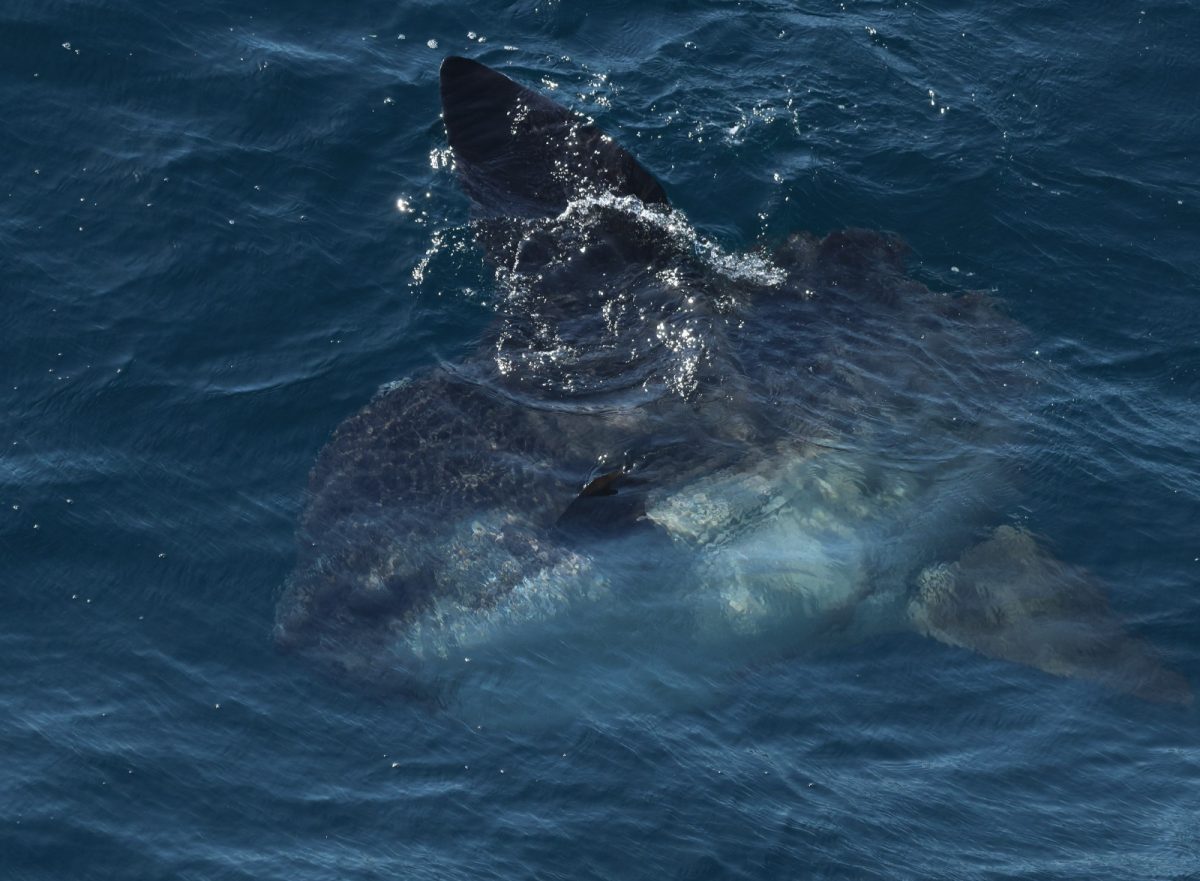
17:00 – Our most abundant marine life spotted, besides jellyfish, appeared to be ocean sunfish (Mola mola). They are the world’s heaviest bony fish, growing up to 5,000 pounds. (Credit: Nicholas Methney)

18:00 – Working both morning and afternoon shifts, Andrea Fusco filtered water samples from the depths of the ocean to collect cellular material shed by marine life, also referred to as environmental DNA (eDNA) samples. Each sample took about one hour to filter and will undergo genetic sequencing and genetic matching to determine if squid were present in the area.
19:00 – As the sun was setting, we returned to where we released the BRUV. It has a timed release which triggers it to float back to the surface for recovery. The BRUV is designed to be used by smaller commercial and sports fishing vessels, who can nimbly pull alongside it and pluck it from the water – the yellow float is about 18″ across. The Neil Armstrong crew demonstrated adept skill in recovering the small BRUV in 5 to 7 foot swell. (credit: Noelle Olsen)
20:00 – NOAA Fisheries also sent two scientists from the Narragansett Lab who are working with the commercial squid fishing industry to better understand how ocean conditions and processes influence the variability of shortfin squid catch in the Mid-Atlantic. Mary Kate Munley and Haley Synan towed bongo nets several times in the hopes of catching squid larvae in the plankton sample.
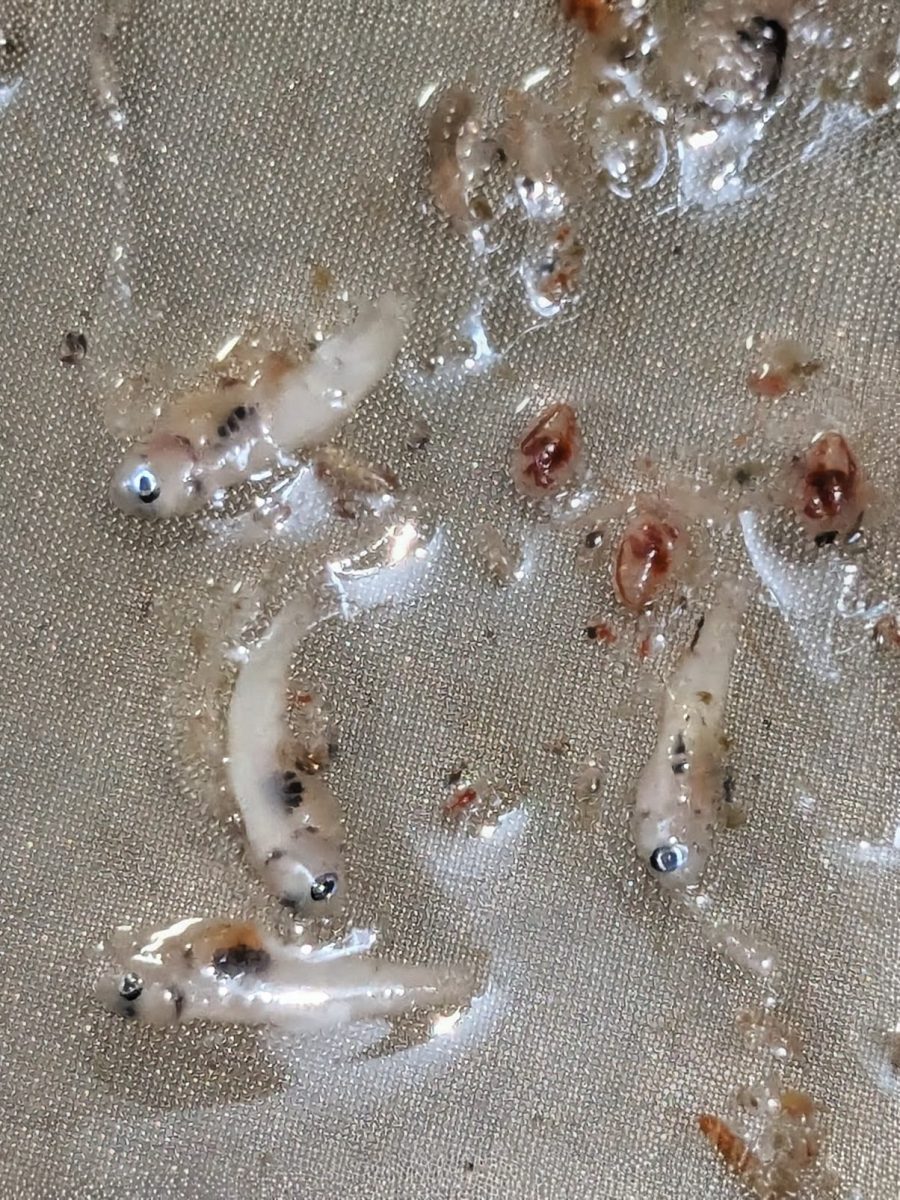
21:00 – We might have caught some larval tuna in the bongo nets. Identification is pending. The plankton samples were preserved and brought home for careful microscopic review and sorting of species by NOAA Fisheries.
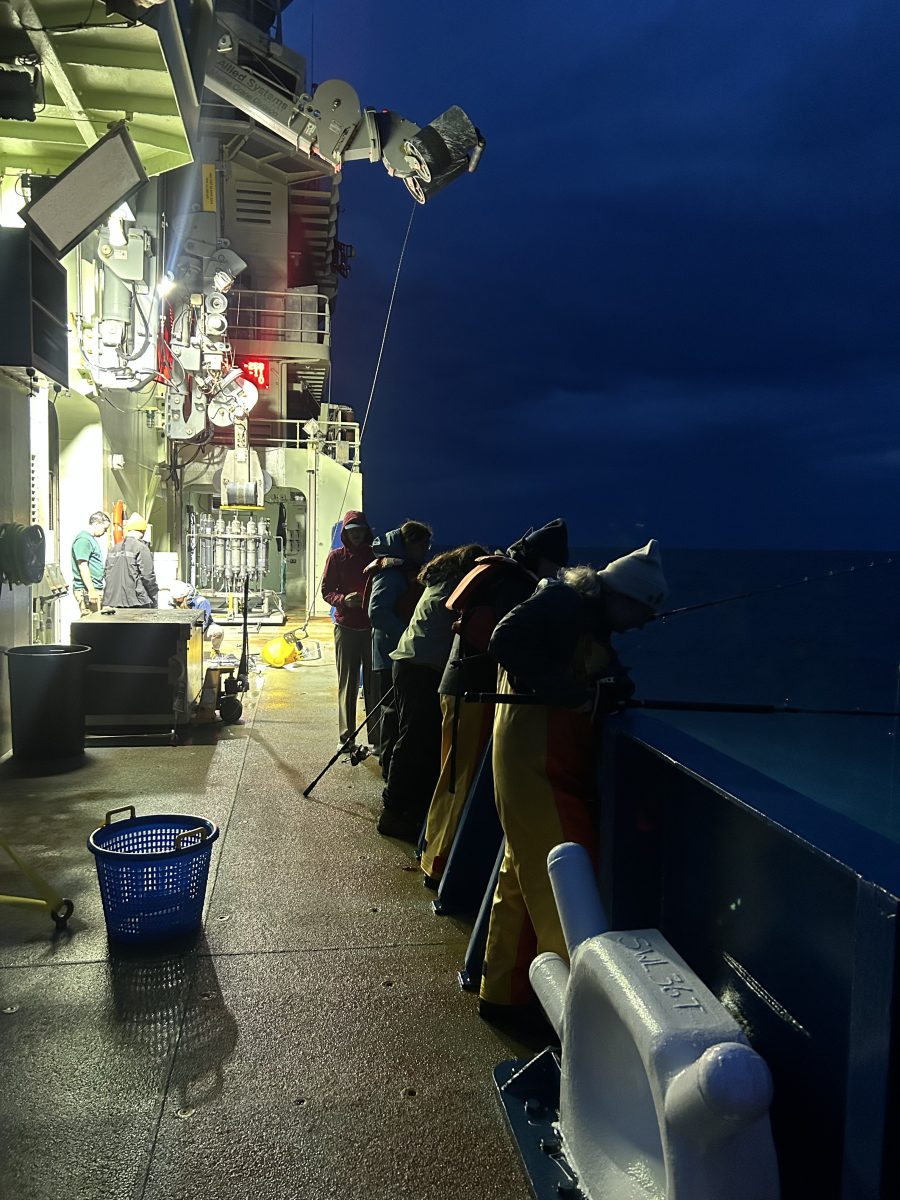
22:00 – After 16 hours of science, we went fishing. Our last night (Thursday, May 21), we jigged for squid in 50 fathoms and saw a few dozen squid up near the surface, attracted to our lights. We caught 12 squid in 30 minutes, a record for the cruise. (Credit: Noelle Olsen)
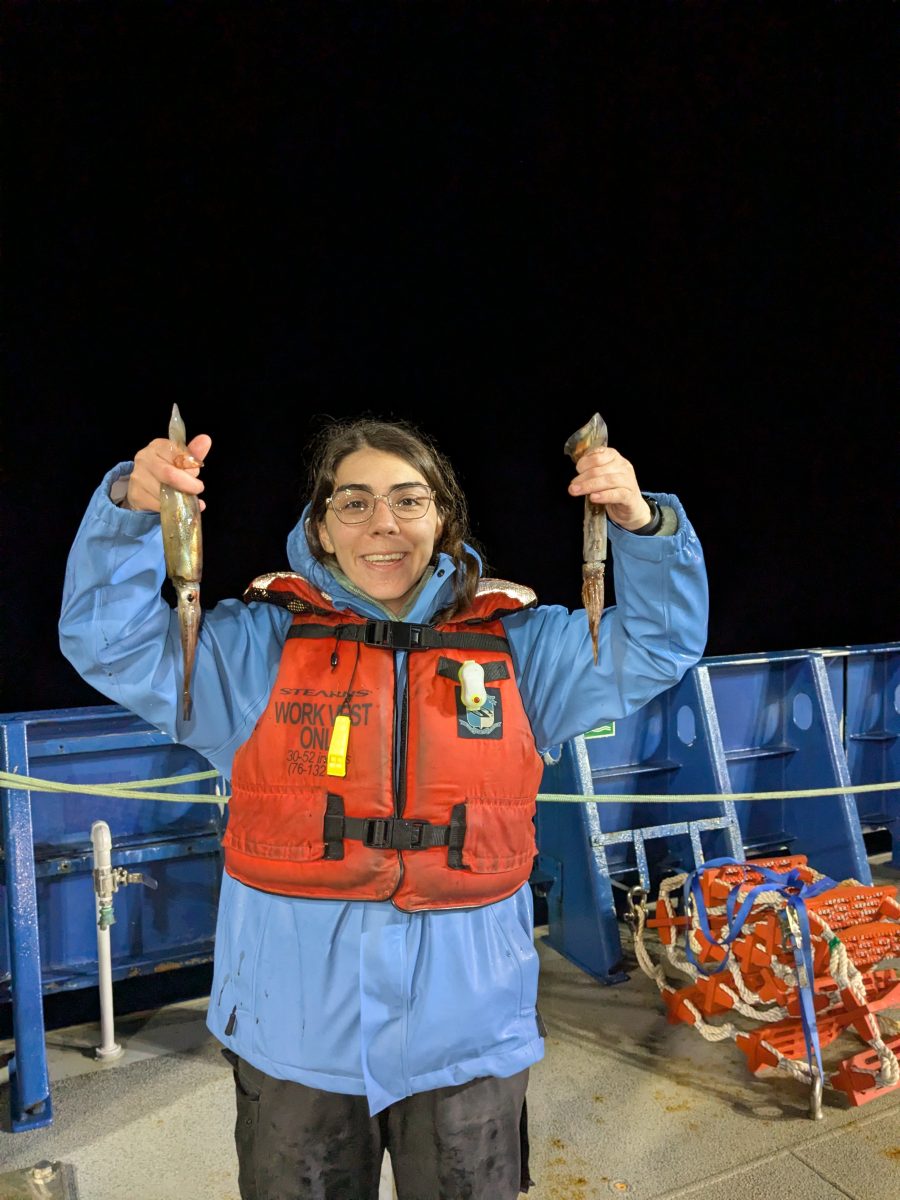
22:30 – Samantha Alaimo, our afternoon watch leader, joyfully holding the squid she caught. Squid were frozen and brought back to the Northeast Fisheries Science Center Narragansett Lab for Mary Kate to dissect and remove the statoliths to age the squid.

23:00 – The ship’s Acoustic Doppler Current Profiler was sampling 24/7 to map the current’s direction and speed throughout the water column. This data (the grey arrows) was combined with salinity from the CTD casts, resulting in this neat visualization of the area we sampled and the sources of the different layers of water.