
By John Pappalardo
Most of us don’t realize that Barnstable County, aka Cape Cod, is the only part of Massachusetts that has a department with public employees and heavy-duty equipment to accomplish what the old saying says is nigh on impossible (with a one-word substitution):
Shovel sand against the tide.
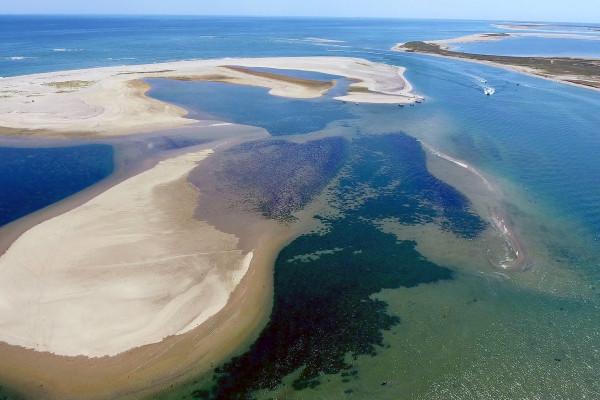
The county dredge is not glamorous, but its contribution to the well-being of a sandy, shifting peninsula is profound. Without it, what’s essential to our economic, historic, and recreational ways of life and self-image, often taken for granted, would be lost or far more expensive to maintain:
Access to the sea.
Every person who casts off from a dock or mooring, commercial or recreational, skiff or yacht, should tip a hat to the county dredge crew. Think of their work as the maritime equivalent to snowplowing after winter blizzards, though they move sand that does not melt. Without them, pretty much every harbor and channel on Cape Cod would be impassable or much more dangerous.
This is the time of year when the dredge needs to go as hard as possible. Bad winter weather is behind us, and this being Cape Cod dredging in the middle of the summer is tough – a lot of boats in the channels, a lot of beach blankets where sand otherwise could be deposited, not a lot of sympathy from people on two-week vacations who might see closed access. So this, and post-Labor Day, are the best windows.
Just a few weeks ago two of the Fishermen’s Alliance’s great team, outreach coordinator Ray Kane and summer intern Sara Cornell, jumped onboard the dredge as it was working in Harwich. Both came ashore impressed and enthusiastic about what they witnessed, thanks to Ken Cirillo who runs the program and his team who moved 1000 cubic yards of sand out of the mouth of Wychmere Harbor. And then moved on.
We’ll hope to share a photo essay next issue that gives you a good sense of what they do, a handful of pics worth thousands of words.
People immersed in this underwater corner of county government and public policy know many complications, frustrations, and roadblocks. There are permits galore, local to state to fed. There are environmental concerns, where to dredge and where to dump. That includes what they call TOY, “time of year” restrictions, meant to be sure spawning, from flounder to horseshoe crabs, is not disrupted. Of course the weather has plenty to say about where and when work can happen. Plus this is hard on machines, which need repair now and then.
Then there are competing priorities; every town (except maybe Brewster?) can benefit from dredging, but time and money are finite.
All that said, we have proof positive the county dredge works; just watch boats come and go. This also means we have proof positive county government works; no way could each town, solo and siloed, accomplish what’s necessary without a lot more money and headaches.
We’re glad that local support seems to remain strong. We’re also trying to convince state and even federal officials that our county dredge deserves more funding, whether that be thought of as “economic infrastructure,” “climate adaptation and resilience,” or even “environmental protection.”
To pursue that, a suggestion:
The county should invest short money in an economic analysis of the dredging program, quantifying its rippling impact. Our good friends from the Urban Harbors Institute at UMass Boston do this kind of thing all the time, have looked at many Cape’s harbors already, and would deliver eye-opening stats and analysis.
We’d love to use that power tool to keep constructing the argument, and spreading the word.
(John Pappalardo is CEO of the Cape Cod Commercial Fishermen’s Alliance.)