
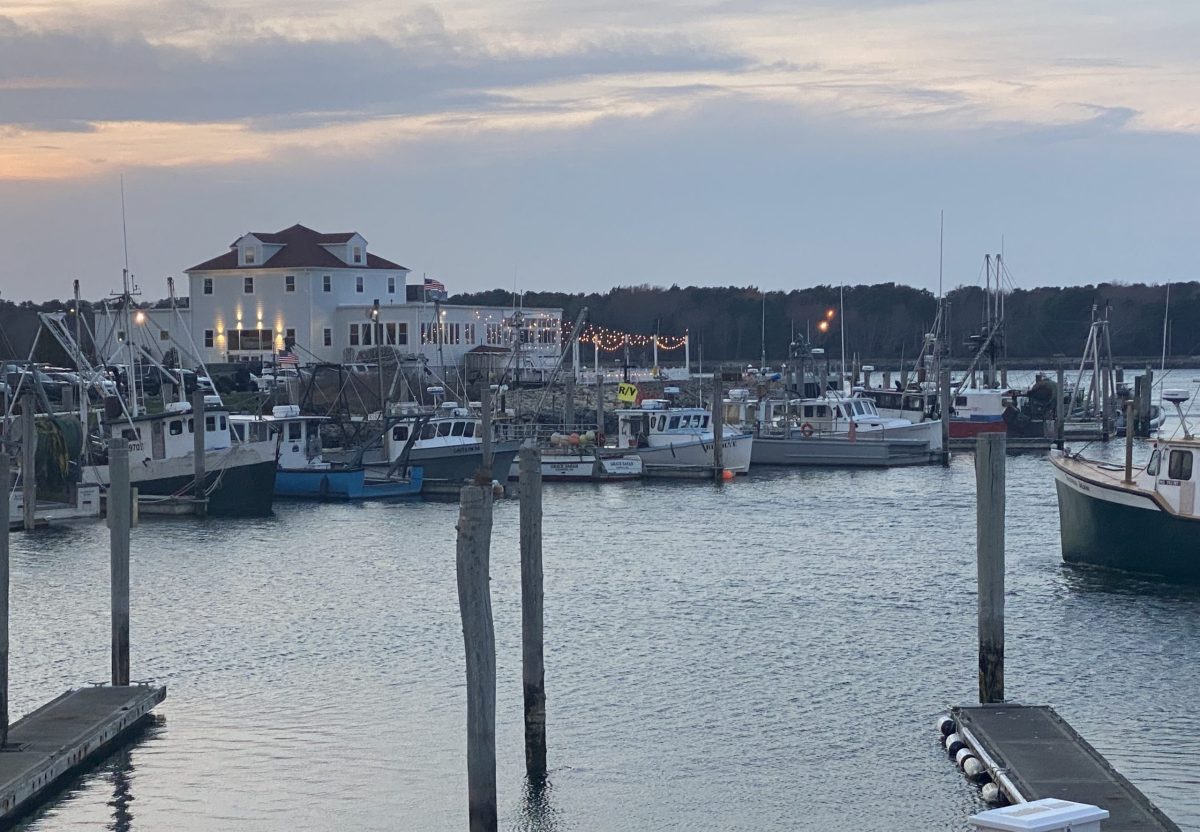
The commercial slips at Sandwich Marina are filled year-round.
By Doreen Leggett
On a chilly late April night, half of Sandwich Marina was quiet, empty docks waiting for summer visitors, pleasure boats with names like Knot Working filling the parking lot.
The other half was packed with commercial fishing boats, flags flying, names like Resolve and Southpaw.
Next to the harbormaster’s shingled office, in a maintenance building with garage doors facing the parking lot, the smell of fuel heavy in the air, more than a dozen folding chairs were organized in a circle on the concrete floor.
They were filled with members of the East Boat Basin Commercial Fishermen’s Association, a nearly 40-year-old group and one reason Sandwich has a strong commercial presence.
Association members range in age from 20s to 80s and were meeting with Harbormaster Nick Giordano to talk about rules and regulations that could protect the fleet.
“I think this wouldn’t be happening without a united front, particularly in the times we are in,” said Dean Karoblis, a lobsterman. “Dave realized it years ago.”
Dave is Dave Casoni, also there that evening, dressed in a green sweatshirt with the Massachusetts Lobstermen’s Association logo.
He isn’t an original member, but knows the origin story of the group, which formed in 1987.
“Fishermen were concerned about what was going to constitute as ‘commercial,’” recalled Casoni, the captain of the Margaret M.
When the marina, owned by the US Army Corps of Engineers and leased to the town, was expanding it wasn’t clear if the fleet would keep 43 slips fishermen built their business plans around.
“We were making sure we weren’t going to be displaced,” he said.
Even farther back, the group’s roots reach to Edwin Moffitt.
Moffitt became harbormaster in 1972. Moffitt helped transform the harbor and by 1987 there were 55 commercial fishing vessels. Town income had increased from $3000 to $48,500.
“In my opinion the commercial fleet is one of the biggest assets for the town of Sandwich,” Moffitt was quoted as saying at the time.
When selectmen decided to lease the marina directly from the Army Corps of Engineers, which still owns the property, Moffitt left. Commercial fishermen lobbied to have one of the roads in the marina named after him.
The town was moving forward on plans, a decade in the making, to add another 88 slips and two 30-foot docks, among other improvements. There was concern that commercial fishermen would lose their spots, and the emphasis would be on profitable recreational vessels.
The commercial group funded a study which found that the annual value of the catch at the first point of sale was $5 million, with that money rippling and multiplying through the local economy.
The association stepped forward to speak out against commercial slips going to bid, cautioned against having the marina become a major tourist attraction with Keiko, the Orca star of Free Willy, and advocated for direct sales.
Published reports said that of 43 commercial boats in the harbor, all but three joined the association. The membership represented about 85 people, about half Sandwich residents.
Casoni, with several other fishermen who make up the group today, lives in Plymouth. They moved their businesses over the bridge in part because their harbor in Ellisville is dry at low tide.
He and others moved their vessels to Sandwich in September every year anyway. In Ellisville they tied their boats to posts they hammered into soft sand, which worked well in the summer but not year-round.
“When the recreational (boats) left Sandwich we used to move down. We used to give Ed a jug of whisky,” said Casoni, who is 83.
One who made the switch was Dean Karoblis’ dad, also from Ellisville and a member of the fishermen’s association.
“I remember going to meetings as a little kid,” Karoblis said. “It’s just my time to carry the torch.”
“All it takes is a couple people to care and for other (fishermen) to not want to pull the ladder up behind them,” Karoblis said.
Other members such as Scott Torrey, Dave Crowley and Phil Michaud are Sandwich residents. Michaud is a self-described “wharf rat;” he spent his childhood running around at the marina with his brother Lenny.
“My dad was a draggerman. My brother and I are still fishing out of there,” he said.
Michaud’s perspective extends close to 60 years, when there were four fish houses, plenty of bait and ice.
“We have lost a lot of ground over the years,” he said. “It’s become more of a tourist destination.”
During COVID, rents at the marina went up close to 40 percent, he said, making it difficult for younger fishermen to afford access, adding to rising costs of permits, insurance, and fuel.
Recreational fishermen also compete for space.
“Younger people want to pursue commercial fishing and someone with a playboat takes their spot,” Michaud said.
Protecting town access is vital as working waterfronts are lost. Fishermen can pay more than $20,000 for a few months for a mooring at a private marina as some recreational users can cover that cost. Sandwich marina has lower rates for commercial vessels than recreational; several other towns do as well.
As some private marinas are bought by corporations, fishermen who once hauled out and repaired their boats in traditional working yards now find they can’t to do the work themselves and must pay marina staff. There is also less and less room at town marinas.
That cold night in April, Michaud, who was up at 3 a.m. the day before fishing in a gale, spoke about earlier successes.
“When we speak in one voice and show up in numbers, we get results. We inform managers of our needs, and we offer solutions to the challenges,” Michaud said. “That’s the best way fishermen can move forward.”
He told the story of a fishermen’s group in Provincetown paying an attorney $130,000 to advocate on their behalf. Michaud said the attorney worked hard, but fishermen found they were far more effective when they had 40 fishermen pack the room.
Protecting access is one of the reasons why the group met with Giordano. They are trying to enshrine access so the industry is sustainable, while allowing harbormasters limited discretion.
“We have seen a lot of harbormasters come and go,” Michaud said. “They don’t know the challenges we have.”
Since Moffitt left there have been about half a dozen harbormasters. Crowley said the group is typically re-invigorated when a new harbormaster starts.
Crowley, captain of F/V Caitlin Victoria, has been hanging around the docks since he was 15. He got his first commercial job in 1980, working out of Fairhaven. When he got out of the service, he trailered his boat for seven years before getting a 20-foot slip in 1993. As his flounder-fishing business grew he was able to move to a larger slip.
Karoblis had to wait about 15 years to get a permanent site. He remembers sleeping in his truck so he could be the first one there when the wait list opened. He couldn’t get his father’s slip because slips can only be passed to a spouse.
Even now, fishermen often don’t buy a larger boat and expand their businesses because there is no guarantee they’ll get a slip.
Crowley is under no illusions that the industry will get more space; he is worried about losing what they have.
“That is a huge problem in the whole industry,” he said. “Another concern is that they will get rid of us by increasing the prices.”
Crowley said they have a good relationship with Harbormaster Giordano, who has been in the position a little over a year. He has worked to make infrastructure investments for a fleet that brought in catch worth $15 million at point of sale in 2024.
Giordano has worked with the group on those improvements, which include rebuilt hoists, dock resurfacing and a new crane. He also regularly seeks advice from veteran fishermen.
Michaud recalled how fishermen and Giordano cooperated to repair a broken unloading winch that otherwise would have lost thousands of hours and significant income during the season. That type of cooperation isn’t a given, he said.
The fishermen’s association has their work cut out for them. Casoni said he has gotten calls from social scientists who want to measure negative effects on communities as commercial fishermen get pushed out.
They might be able to quantify what he already knows.
The archives of the Village Broadsider and Sandwich Broadsider were used for this story.