
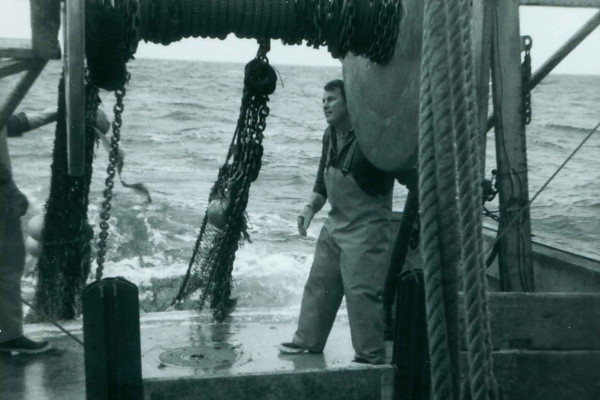
Fred Bennett in his younger years.
By Doreen Leggett
Fred Bennett remembers the first fish he caught more than 80 years ago. He tells the story with a smile.
He was seven or eight and fishing with his family off Menemsha, Martha’s Vineyard. He lived in Marion, but his dad went fishing whenever he could and that weekend they were after swordfish.
Bennett was on deck by himself when he caught a flounder.
“I woke everyone up of course. I was screaming and hollering,” Bennett said. “I have lots of great memories of fishing as a kid.”
Mike Anderson, Bennett’s longtime friend and a longtime fisherman, said Bennett was in a class by himself, especially when it came to striped bass, which had a cult-like following in the 1970s when catches of 300 pounds a day in Pleasant Bay were common.
“Fred was the best fishermen I ever saw,” said Anderson.
Bennett said it wasn’t always that way.
He arrived on Cape in 1964 and started work at Ryder’s Cove boatyard as a marine mechanic, but fished every chance he got. Bennett remembers he got no help from the established fishermen.
“No one would tell me anything the first year,” he said. “I’d go in the morning before work and after work.”
His second year, he was scouting around for places and happened to find a sweet spot inshore by Minister’s Point.
He was catching 12 to 14 fish a night and when he heard people coming he would hide, lay down flat in the boat so they would think it was a moored, empty skiff.
“I did that for two weeks!” he said. He became adept at finding places that had a lot of bass but not a lot of fishermen.
Bennett began to branch out and built a boat to go longlining for cod weekends off Nantucket.
“The place was lousy with codfish,” he said.
Soon more established fishermen such as the late Tiggie Peluso were taking time to help him out and give him advice.
“He took me under his wing. He taught me so much,” Bennett said.
Bennett had bought into Old Harbor Marine and was working there full-time.
“I was making money, but I really wasn’t happy,” he said.
So in the early 1970s, he sold the business and went fishing full time on his boat the Kim Barb, named after his daughter and wife. Bennett would have a succession of boats, a few named Sea Bag after his first basset hound; the one by his side today is named Pocahontas.
Just as he started fishing, markets got worse. The price was never very good for cod, but it plummeted. In 1965, fishermen went on strike because they were getting two or four cents a pound for codfish. It got up to 12 or 14 cents 10 years later; still too low.
“Back then there was no price and no place to go (sell),” said Bennett. “I was going longlining and having a hard time making boat payments, so I put the boat up for sale.”
Fortuitously in 1976, there was a big scallop bonanza off Chatham.
“I paid everything off, including the house,” he said.
Bennett was fishing out of Chatham, Harwich and Hyannis and the scene was very different than today. He had someone running a steel dragger he built and he was hook fishing on a 31-foot Blue Hill Marine, considered the pickup truck of work boats. During the 1970s into the 80s there were close to 90 boats landing in Chatham and another 30 landing at Wychmere in Harwich.
“We had 4,000 or 5,000 pounds every damn trip,” Bennett said emphatically.
Fishermen were working without modern technology. Bennett said old-time fishermen had a wind-up clock and a compass. When the clock ran out of time, Bennett would use a sounding lead to see the type of bottom and how deep it was. Once that was ascertained, they knew they had to go east or west depending on where they were.
Heading home could be tricky. They would return in the dark and Chatham was notorious for thick fog; some say there were no beach days in Chatham in the 1970s, tourists only came for fishing.
Fishermen knew home was about 20 minutes from the Pollock Rip and when they got close, they would shut their engines down, listen for the sound of a specific buoy and adjust course. After that they would listen for the waves crashing on the Chatham Bar.
He explained the Cape’s fisheries began to change with the introduction of gillnets, which he considers more farming than fishing, and also large draggers with rock hopper gear which could go into areas previously off limits because of rough terrain on the bottom.
By 1991, Bennett had joined with other fishermen to protect the fisheries and their livelihoods, and started the Cape Cod Commercial Hook Fishermen’s Association, which became the Fishermen’s Alliance.
“Basically, it was about habitat,” Bennett said. Seals also did great harm to groundfish populations.
Habitat loss, seal predation, regulations, warming waters and other factors have meant that the historical catches of cod, pollock, haddock and striped bass have been replaced with scallops, lobster, skates, monkfish and dogfish.
“It is a young man’s game that is for sure,” Bennett said. His two grandsons both fish.
When Bennett got older, he began quahogging. Initially he was only making $40 or $50 a day, but he got better at it.
When he hit his mid-80s he built his own 17-foot skiff and still went over the Chatham Bar to go lobstering, and kept fishing until very recently.
“It’s in my blood. I love fishing. I can’t stop. I should be in a nursing home probably,” he said with a laugh.
Bennett turns 90 this summer.