
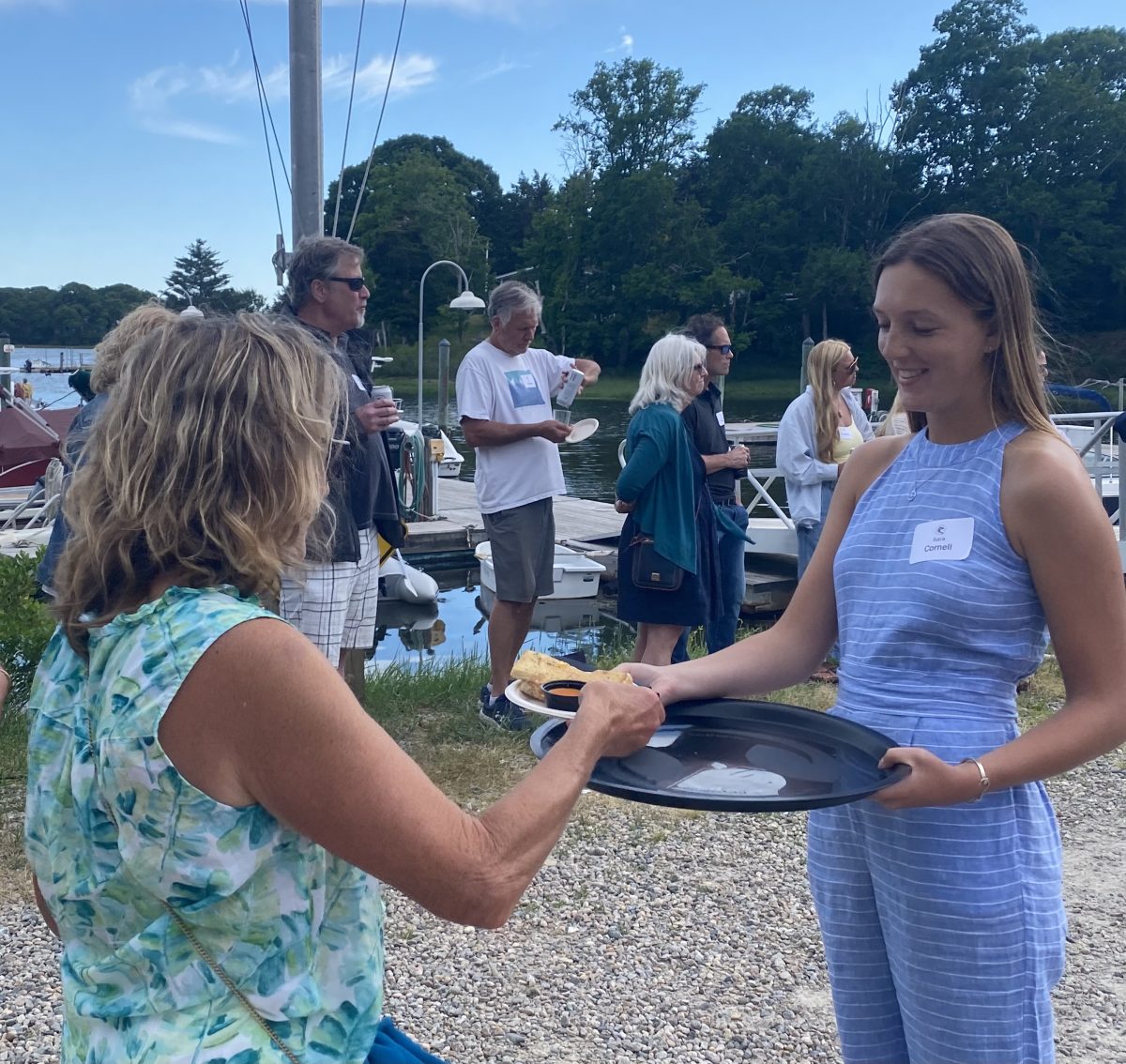
Sara Cornell, an intern at the Fishermen’s Alliance, hands out one of the last lobster grilled cheese sandwiches to a grateful attendee.
By Doreen Leggett
On a beautiful summer night on Pleasant Bay, close to 100 people gathered to hear a talk on lobsters by Captain Chris Townsend — and sample the delicacy as well.
A woman in the audience, who grew up in Maine, impressed the crowd with her tale of how to hypnotize a lobster and make it do a headstand, but it was Townsend who had a litany of relatively unknown lobster lore:
Lobsters’ teeth are in their stomachs; they are right or left-handed; of eggs that hatch only .03 reach legal harvesting size and during its first year a lobster will shed its shell 10 times.
And perhaps the hungry audience’s favorite fact: A two-and-a-half-pound lobster has the highest meat-to-shell yield.
“I’m a bit of a lobster nerd,” Townsend told the crowd gathered for the Fishermen’s Alliance Meet the Fleet at Nauset Marine East in Orleans.
Townsend said lobsters were a trash crustacean before New York socialites summering in Bar Harbor, Maine developed a taste for them and wanted lobsters shipped to their homes. Provincetown, a much easier steam to New York, worked hard to feed the new market. Townsend said fishermen in Provincetown used to tow “smacks,” vessels that had holes, live tanks of sorts, so the lobsters could enjoy the ride.
“It all began in little old Provincetown, Mass.,” he said.
Townsend’s long career began at the Cape’s tip as well.
He is a third-generation fishermen and got his start 43 years ago.
“I’ve fished with everyone who would take me and finally I got to my own boat,” Townsend said.
While the crowd listened to Townsend’s tales, they enjoyed lobster grilled cheese prepared by Chef Tyler Hadfield, Owner/Operator of The Rail, The Barley Neck and Polka Dot Panini. Hadfield said he matched cheeses to the taste of the lobster, pairing it with cheddar, Monterey Jack and Gruyere on sourdough bread with a side of lobster and tomato bisque for dipping. Hadfield also gave some cooking tips to the crowd who peppered him with questions. He noted some sushi chefs say a lobster tastes better if you kill it before boiling and that after you cook them, shocking them in cold water helps get the meat out easier.
Townsend added a tip of his own; a big lobster is a like a big potato, you can’t tell the difference from small ones if you cook them correctly.
Townsend is a “full gang” fisherman, meaning he has 800 traps, the limit allowed. June through December he and his crew on the Heidi Lyn will haul 200 to 400 traps a day.
Although they are only fishing six months a year – and only three months are real money makers – the job is year-round.
“Lots of months we make 0 dollars,” he said.
In the months off the water, they do gear work and boat and engine repair. If you don’t take care of your gear, he said, it fishes like a guitar out of tune.
Townsend said lobster traps are like mouse traps, fishermen are always trying to build a better one.
He brought one to the event and described components to the crowd gathered in the gravel parking lot and ringing a fence that looked out at the boats docked in the marina.
The entrance of the trap, or the kitchen, is where a bait bag is located. The type of bait depends on the lobsterman’s preference – Townsend uses fish skins.
If the lobster is in the kitchen, he can eat and run, Townsend said. The shelled bottom dweller isn’t trapped – which is why he jokingly calls his traps “feeding stations.” Lobsters typically become trapped when another lobster enters the trap.
“Lobsters are territorial,” he said, rather like lobstermen.
The first lobster then enters the next section, the parlor, and drops into the bedroom. Because of the narrowness of the entry way, and the netting, lobsters will stay in the bedroom until they are harvested.
Some lobster traps only have two sections and others are rounded. Rounded traps are more likely to land flat on the bottom, but don’t stack neatly.
Townsend also had highflyers with him, specific to his gear, to help him locate on the water. On one end he has a mermaid, on the other a skull and crossbones.
The lines Massachusetts lobstermen use are designed to be “whale-safe,” meaning every 60 feet there needs to be break-away line so whales do not get entangled. Lobstermen splice in the weaker rope, so Townsend does that for 90,000 feet of line.
Massachusetts has had strict regulations in place to protect whales for close to decade. In addition to gear modifications and closed areas, there are dynamic management areas where, if activated, fishermen must remove their gear within 48 hours.
“I could go on for hours about lobster regs,” he said. “Canadian fishermen don’t have these rules.”
Even the traps are meant to degrade, so if lost whatever is inside can escape.
He fishes 20 traps linked in a trawl, he said, and records which ones are doing well in a log.
“I essentially draw a map of where I’m catching lobster,” Townsend said, adding he will chase them east of Stellwagen Bank.
When they go beyond the bank he’ll stop. They have to start pulling traps in January anyway because Cape Cod Bay is closed to lobstermen to protect North Atlantic Right Whales until the beginning of May.
Townsend likes to have two crew. He’ll drive the boat, haul traps and put them on the rail; the next crew member will take the lobsters out, band them and the last mate will bait and run – drop the traps back over the open stern.
But because of economics he typically only has a stern man, unless he can ‘Tom Sawyer’ another person into coming.
Townsend or his mate will use a gauge to measure the length of the carapace. There is both a minimum size and a maximum size. They also have to v-notch, put a mark in the tail of females with eggs. They can’t harvest “eggers” and they also can’t harvest females who have the v-notch.
“We keep a small fraction of what we handle,” he said. “That is why it has been so sustainable for so long.”
But regulations aren’t the only thing affecting lobsters, waters are getting warmer and lobsters are moving farther north. Nitrogen-loading from human activities is also causing low oxygen areas where lobsters can’t survive, Townsend said, referring to a notorious “blob” sometimes detected in Cape Cod Bay.
“Used to be that the southern border of their range was Virginia, now it’s Cape Cod Bay,” he said.
Even before spikes in fuel prices and lessening demand overseas due to tariffs, Townsend had to diversify his revenue stream to maintain his lobster “habit,” he said. Lobster rolls may be close to $40 but he is still getting $7 a pound.
He has captained yachts in the Virgin Islands in the winter and supplements his income by working as a marine surveyor and running several lobster experience tours. Townsend was also recently appointed to a lobster management committee.
“I can’t imagine not being a fisherman,” he said. “It was a very good fishery for me and my goal is to sustain this fishery so others can have the quality of life I did.”
Townsend sells lobsters from his home in Truro and operates Townsend Lobster. He has another claim to fame: He is the father of Caitlin Townsend, working waterfront organizer at the Fishermen’s Alliance.