
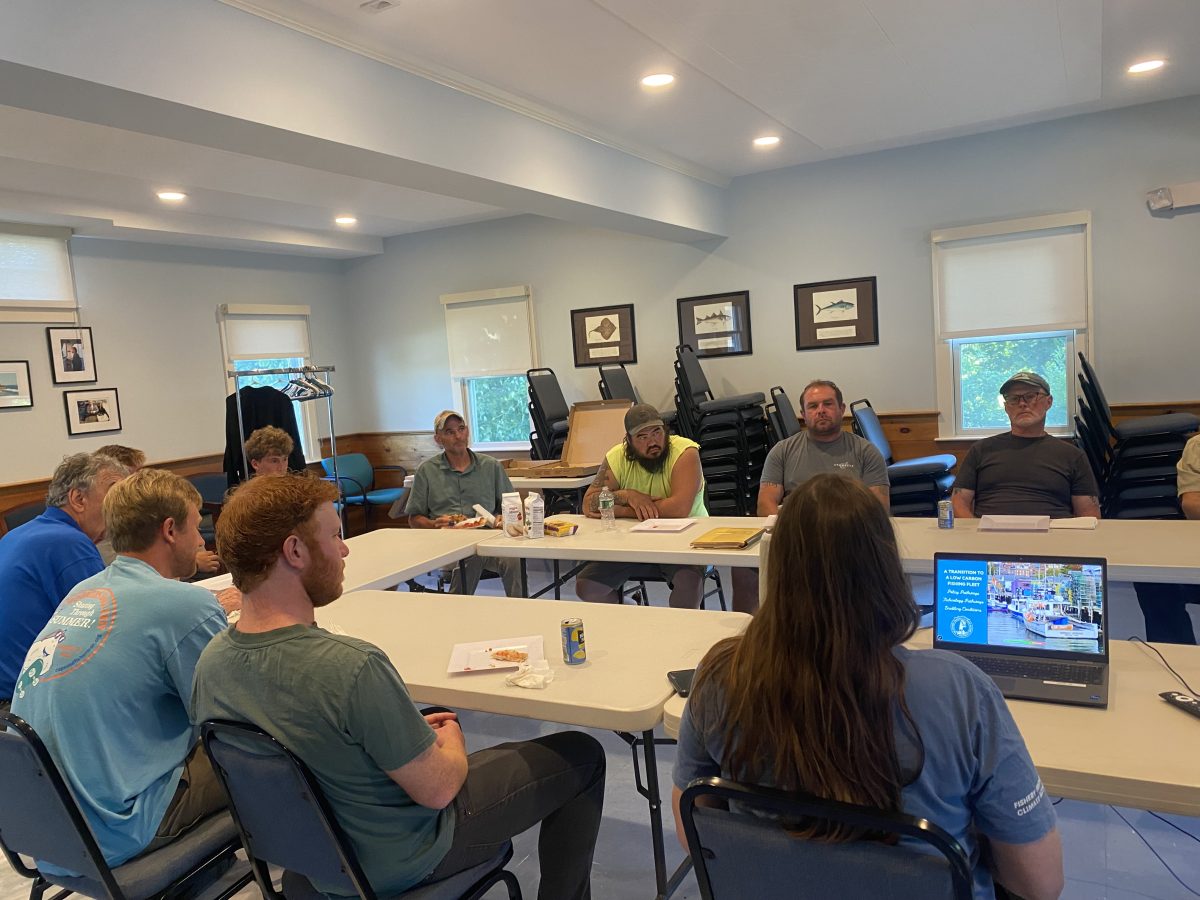
Fishermen gather at the Fishermen’s Alliance to talk about high fuel prices.
By Doreen Leggett
Andrew Spalt has been paying about $1.50 more a gallon for fuel since April, about $40,000 a vessel, more than $100,000 across his three boats.
“You have to go fishing; you can’t really negotiate the price. It just hurts more,” said Spalt, working on his boats in New Bedford on a June day.
Spalt, a member of the Fishermen’s Alliance, zoomed into “Fueling the Future of Fisheries,” an informal discussion about high fuel prices plaguing the industry, held at the non-profit’s office in Chatham.
“I wanted to listen and hear about ideas that could possibly help the fleet,” Spalt said. “More information gathering.”
The meeting, organized by Sarah Schumann and Dean Karoblis, fishermen and members of the Fishery Friendly Climate Action Campaign, brought together fishermen from Provincetown to Sandwich, ranging in ages from 18 to 83 and participating in a variety of fisheries including gillnetting and lobstering.
Schumann, who started the campaign in 2022, worked with a team to publish an 18-volume compendium titled “Transition to a Low Carbon Fishing Fleet.” The work relies on interviews with 148 fishermen across eight states, including a half dozen from Cape Cod.
The volumes detail experiences, motivations, and barriers to adoption for energy conservation strategies, as well as next-generation power systems such as electric propulsion, alternative liquid and gaseous fuels.
She said the work was in part prompted by rocketing fuel prices after Russia invaded Ukraine. Before that, fuel spiked in 2008 and then the recent Iran War raised them yet again. Before the mid-2000s, fuel prices had generally been under $1.25 for more than a decade, according the U.S. Energy Information Administration.
Alex Brown, who has the oldest oyster farm in Provincetown, said the pain isn’t only felt at the pump. He said much of the gear they use is made from petroleum-based products.
“It compounds,” Brown said, adding the problem is particularly acute at the far end of the Cape where prices for everything are higher.
Fishermen are dealing with different fuel prices depending on their port. In New Bedford, fuel hovered around $4.50, in Sandwich it was $5.60 and in Chatham $5.07.
The group talked about different ways to reduce cost in the immediate future, perhaps co-operatives where fishermen joined together to get a reduced price and advocating for federal emergency aid, given to farmers in the past. Others mentioned that fisheries have low daily catch limits that require fishermen to burn more fuel per pound landed; changing that to a weekly limit would ease expense.
Fishermen also spoke about tax rebates, effective in the past.
“I thought rebates were the most viable,” said Spalt, “the most attractive option to me.”
The Fishermen’s Alliance reduced fuel prices for commercial fishermen during COVID by using grant funding to provide discounts on fuel bills.
The group also discussed long-term solutions.
The United States Department of Agriculture has a program, Rural Energy for America Program, REAP, which has benefited fishermen who want to make energy-saving upgrades.
Spalt said it could be an option as he invests in a new fish hold and bait freezer.
However, it can’t be used on propulsion.
After the round table in Chatham, and another in Rhode Island, the committee created a policy platform for fishermen to sign onto.
The platform includes expanding fishery access to REAP through the Farm Bill by including fishing businesses in the program’s definition of “agricultural producers.” Another ask is to make propulsion-related efficiency upgrades eligible for support.
Another tier on the platform asks to amend the Environmental Protection Agency’s Diesel Emissions Reduction Act, to make it easier for fishermen to replace diesel with newer, cleaner-burning engines.
A trawler in Alaska, F/V Mirage, has been generating press, equipped with new hybrid diesel-electric propulsion. The system uses diesel engines to generate electricity, which then powers electric motors to turn the propellers.
The upgrade was funded through a U.S. Department of Energy grant awarded to the Alaska Longline Fishermen’s Association.
There have been other conversions, especially at small scale.
Dale Leavitt of West Island Oysters said his company has been operating a fully electric work skiff on the farm for the past year, the first in Massachusetts.
“It certainly is nice to be able to plug in to recharge rather than schlep fuel cans to the dock and transfer expensive gasoline into our work skiffs,” he wrote in an email.
Differences in vessels make it difficult to find a solution that can be replicated. Fishermen in Chatham talked about everything from hydrogen systems (few, if any, commercially available) and lithium batteries (don’t work well in cold temperatures plus safety concerns).
“It’s about getting the job done and having power you need to get the job done,” Spalt said. “New technology is great, but you need power and diesel provides the power.”
Although there are fewer government-funded programs for climate initiatives, the Trump administration has made fisheries a priority. An Office of Seafood was recently created and Fishermen’s Alliance, with its partners in Fishing Communities Coalition, met with Mike Illenberg, the new acting director, in mid-June.
Suggestions on how USDA could further support fishermen were front and center.
After the Chatham meeting, Sefatia Theken of the Gloucester Fishermen’s Wives Association sent an e-mail to hundreds interested in the effort, part clarion call.
“The fishing industry is looking for practical, sustainable solutions that allow businesses to remain viable and competitive. Whether through federal or state grants, tax incentives, fuel subsidies, vessel retrofits, energy-efficiency programs, or alternative fuel investments, the goal is to create a pathway that helps fishermen weather today’s fuel challenges while preparing for the future,” she wrote.
Fishermen at the meeting were asked to stay involved and support work toward climate resiliency with strategies that minimize risks for fishermen and coastal communities.