
By Doreen Leggett
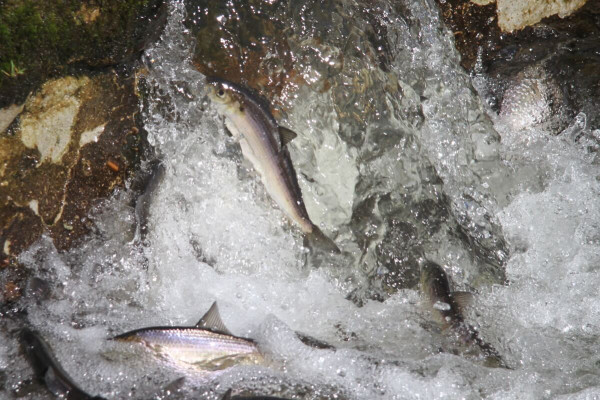
In the early days of town budgets on the Cape, salaries of town employees were offset by an abundance of small silver fish that ran in rivers come spring.
Wellfleet paid 17 employees in the late 1800s with revenue from river herring and had money left over to cover streetlights ($99.70) snow clearing ($67.63) and other expenses, including shingling the high school roof, according to Earle Rich in “More Cape Cod Echoes.” Rich also noted the largesse was due to selling rights to the highest bidder every year at town meeting; the contract also stipulated that every “townsman” had a certain amount of herring for his own use and each family received 200 herring at a half a cent each.
“The harvest of natural resources from estuaries like the Herring River was a major economic and social focus of the town, as indicated by the consistent attention given to the management of the herring run (including both alewives and blue-back herring) in annual town reports,” Biologist John Portnoy wrote in a Friends of Herring River publication.
Harwich had upwards of 3 million herring harvested, which prompted state fisheries biologist David Belding to number that town’s Herring River among the highest revenue generators in the state from 1870 to 1900. Herring had their own committee and regulations as early as 1787; even before that, in 1762, a fellow by the last name of Hall built a mill that impeded the route upstream, that was rectified quickly.
“Ever since the landing of the Pilgrims, when the alewife provided the most readily available source of food for the early inhabitants of New England, it has been closely related to the prosperity of the shore towns,” the late Belding wrote in his treatise on herring.
Brad Chase, senior biologist and diadromous fisheries leader with Massachusetts Division of Marine Fisheries, has a more personal, historical connection to the fish -albeit one that occurred hundreds of years later.
Chase grew up in Harwich and his father, who also grew up in town, told him that in the 1930s huge trucks used to come from off-Cape to harvest herring. Enormous amounts of herring were bound for Boston for use as bait in the thriving groundfish fishery and the city was paying more than the local market.
According to Belding’s report in 1920, declines due to loss of spawning habitat, deforestation and diversion for water supplies, as well as pollution and overfishing, were harming the overall population.
By 1934, the Commonwealth took control of the fishery, and formed the Division of Marine Fisheries Fishway Crew, which still exists today. DMF sets the overarching rules but towns can promulgate rules for specific runs with the agency’s approval. The 1940s through the 1970s were a period of much activity as fishways were built and there were numerous success stories of improved herring populations in coastal Massachusetts.
When Chase was a kid, in the 1960s, river herring spawning runs were strong in Harwich.
Come spring, there were certain days and times townspeople could harvest and he remembers going every Sunday with his dad. They would head to the run with a dipnet and a five-gallon bucket and usually see another three or four groups there.
“It was a really fun thing to do,” he said.
They would grill up the herring and eat the roe, a delicacy.
He also remembers people coming door to door selling shellfish and herring roe. His dad always bought some, even though they harvested themselves. For some, those door-to-door sales were a way to make ends meet.
“It was a spring ritual that was part of the Cape Cod culture,” Chase said. “There was little sense of declining run sizes until the 80s.”
In the 90s there was a shift, he said, more and more people getting into sport fishing and striped bass. The word spread that live herring was a preferred bait and harvest really escalated with some people arriving at rivers with large tanks and aeration equipment and later selling the 12-inch fish for a $1 a piece to bait and tackle shops.
Following a wave of shoreline and at-sea overharvest, a drought in 2000 and 2001 turned out to be damaging for the survival of juvenile herring.
“That effected recruitment for a few years,” Chase said. “We saw things tumble very quickly.”
Harwich instituted a moratorium on harvest in 2005; the state DMF put in place a moratorium for the whole state the following year.
Since then, efforts by the town, the state, and advocacy groups has meant a return of herring in some rivers. In several rivers, including Harwich’s Herring River, the population has recovered enough to start a small harvest.
Chase and others are hoping the harvest will re-connect the community with the natural world and the past. He also believes that allowing a limited herring harvest, when science supports it, will foster a return to a conservation ethic similar to how the harvest of shellfish reminds people of the importance of water quality.
“I think we have lost a lot of stewardship in some areas,” he said; in towns off Cape people have neglected the runs and herring wardens have been lost to budget cuts.
Chase knows some old timers who would love to have some local herring roe again.
“People cherished these connections with the natural world,” he said. “Gathering food from the shoreline is part of that.
Average people on the Cape have lost so much access to natural resources. Allowing a modest harvest of river herring is a small step towards maintain this heritage.”