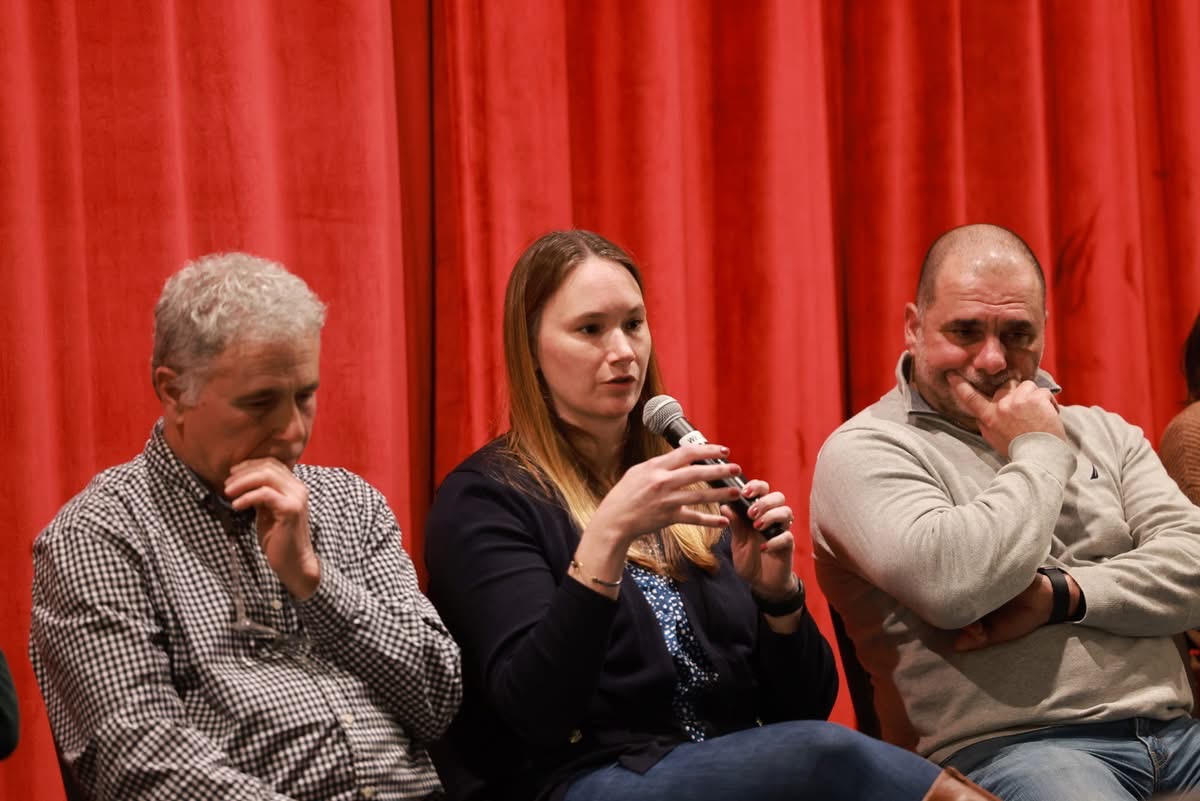
Aubrey Church, policy director at Fishermen’s Alliance and a former fisheries observer, was one of the panelists at the fundraiser for the F/V Lily Jean. Photo by Kim Roderiques.
By Doreen Leggett
In the film “The Hand That Holds the Line,” Captain Tim Linnell chokes up talking about the community banding together to help his family when his young son Sam had leukemia.
Sam, now a captain himself, also talks about the strong bond between fishermen and how they always lend a hand.
Chris Viprino, who lost his boat in a fire, says he will never forget the tremendous outpouring of support he received.
The love, caring and community talked about in the film was evident earlier this month at a sold-out showing at the Chatham Orpheum as a fundraiser for F/V Lily Jean. The Gloucester -based 72-foot fishing vessel sank on Jan.30, all seven aboard lost: Captain Accursio “Gus” Sanfilippo, Paul Beal Sr., his son, Paul Beal Jr., John Paul Rousanidis, 33, Freeman Short, 31, Sean Therrien and federal observer Jada Samitt, 22, of Virginia.
“From Cape Ann to Cape Cod the fishing community comes together to support each other,” said John Pappalardo, chief executive officer of the Fishermen’s Alliance, which organized the special screening with filmmaker Kim Roderiques and the Chatham Orpheum. Money raised benefits the families.
The film, funded by Fishermen’s Alliance and created by Geoff Bassett and Roderiques, delves into the lives of more than a dozen Cape Cod fishermen.
Roderiques wanted to help the families of the Lily Jean so worked with Aubrey Church, the Fishermen’s Alliance’s policy director and a former federal fisheries observer, to organize the event.
“The fishing community protects and rallies around its own and this evening is an opportunity to gather in remembrance at this heartbreaking time,” Roderiques said. “By attending, you are helping ensure these families feel the strength and support of the broader community.”
Before and after the film, there was a panel discussion led by Pappalardo and Massachusetts Senator Bruce Tarr, R- Gloucester, a childhood friend of Sanfilippo.
Tarr said that in the state, and state legislature, the importance of commercial fishing is never questioned:
“Each and every day we are reminded that the oldest industry in the Commonwealth is the fishing industry,” he said, invoking the “sacred cod” that hangs in the State House.
“It’s in our DNA, since our inception brave men and women have been willing to go to sea to feed the country.”
Tarr said the support Gloucester has received from across the country reminded him of the inherent goodness of people.
The panel was comprised of Rob Stello, who once fished out of Chatham and was in the film, Gloucester fishermen Vito Giacalone and Al Cottone, Policy Director Church, Julie Guild, mother of fisheries observer Samitt, and Jon Hare, Director of NOAA Fisheries’ Northeast Fisheries Science Center, home of the Northeast Fisheries Observer Program.
Cape Senator Julian Cyr, Rep. Hadley Luddy, and Rep. Steven Xiarhos were also on hand with Cyr saying, “This has been an incredibly hard winter for our coastal communities.” Xiarhos, whose son Nicholas, a Marine, was killed in Afghanistan, presented Guild a star from the United States flag to recognize her loss.
Fishermen on the panel talked about why they chose to go into one of the most dangerous professions in the world.
“If you think too much about it you don’t go,” said Giacalone, a third-generation fisherman and Policy Director for the Northeast Seafood Coalition.
Giacalone and Cottone made it clear that on fishing vessels everyone is part of the crew, part of the community, even though they have different roles to play.
Giacalone explained that although the observer program wasn’t welcomed when it began in 2010, commercial fishermen have since embraced observers.
Vessels such as Gus’s Lily Jean can’t go to sea without federal observers. Federal regulations require boats targeting haddock, pollock, cod, flounders and other bottom -dwelling fish have an observer on board to collect data. The data is used to improve management.
Hare, visibly emotional when he talked about Sammit, said he spoke to her, as he spoke to all observers, as part of their training.
He told her that how she did her job, how she partnered with the fishermen, would have impact beyond the boat. Hare said being a fishery observer is important, doing your job with integrity is important, respecting and partnering with the captain and crew is important, and safety was paramount.
Hare said Sammit’s death made working together to address challenges of the industry more important.
Guild said Jada, who graduated from University of Vermont last May, wanted to be an observer and had a passion for the natural world. Jada spent every summer in Rockport, in a home that had been in her family for generations. She felt connected to the place. She moved there after graduation and was making a life there, her mother said.
“She loved going out on the boats,” Guild said.
Guild read to the crowd from Jada’s journals; she thought that was most fitting.
“The crew say I am a good kid,” Guild read from one entry. “They also have been feeding me first every time. We all watched ‘Jaws’ together and talk between hauls.”
“She was courageous and fun,” Guild said of her daughter.
Church, who homeported out of Gloucester as an observer, understood Sammit’s experience. She said she would step on the vessel as a stranger, but over the course of the trip captains would share their knowledge, look out for her safety, and make sure she could do her job.
“Spending time as a fisheries observer gives you a real understanding of the risks fishermen face every day. You work in the same conditions, long hours, varying weather conditions and the constant unpredictability of the ocean,” Church said. “Fishing communities know the beauty and risk of the ocean.”
Cottone, who like Tarr was a childhood friend of Sanfilippo, is a safety trainer for Fishermen’s Partnership Support Services, an organization that is also helping families of the Lily Jean and provides mental health support for fishermen.
He talked a bit about why he made fishing a career.
When he was in the fifth grade, his teacher asked him to go out with his dad fishing and then write an essay for class.
“After that day I hounded my dad every night at dinner,” Cottone said. “It is very hard to explain the draw, the adrenaline.”
People know it’s a very dangerous occupation, but things happen on the highway too, he added. Sanfilippo was known as a mentor for younger fishermen and for a safe boat.
Stello comes from a family of fishermen and he almost lost his dad when his vessel was hit with a rogue wave on a cold February day in 1956.
“It is amazing how quick something can happen,” Stello said.
Rescuers were hoping to recover his body when they brought him aboard alive.
“He was literally blue,” Stello added.
His father continued to fish after he recovered and Stello remembers being at the pier listening to the older fishermen.
“The best days of my life were down there,” he said. “Those were the most amazing men. I wish I had half the qualities they have.”
Tarr has referred to the crew of the Lily Jean as “the Finest Kind” and that Sanfilippo was dedicated to carrying on his family’s fishing tradition, and if he was here he would say never give up on the industry.
Sammit’s mom said she was asked if Jada would want people to go back on the boats.
“Yes, she would,” Guild said.
Tarr had a closing message for those who attended. He asked them to go out and eat every local fish meal they could get their hands on.
“And say a little prayer for the people who are out at sea,” he said.
Donations can be made at FVLilyJeanFund.org