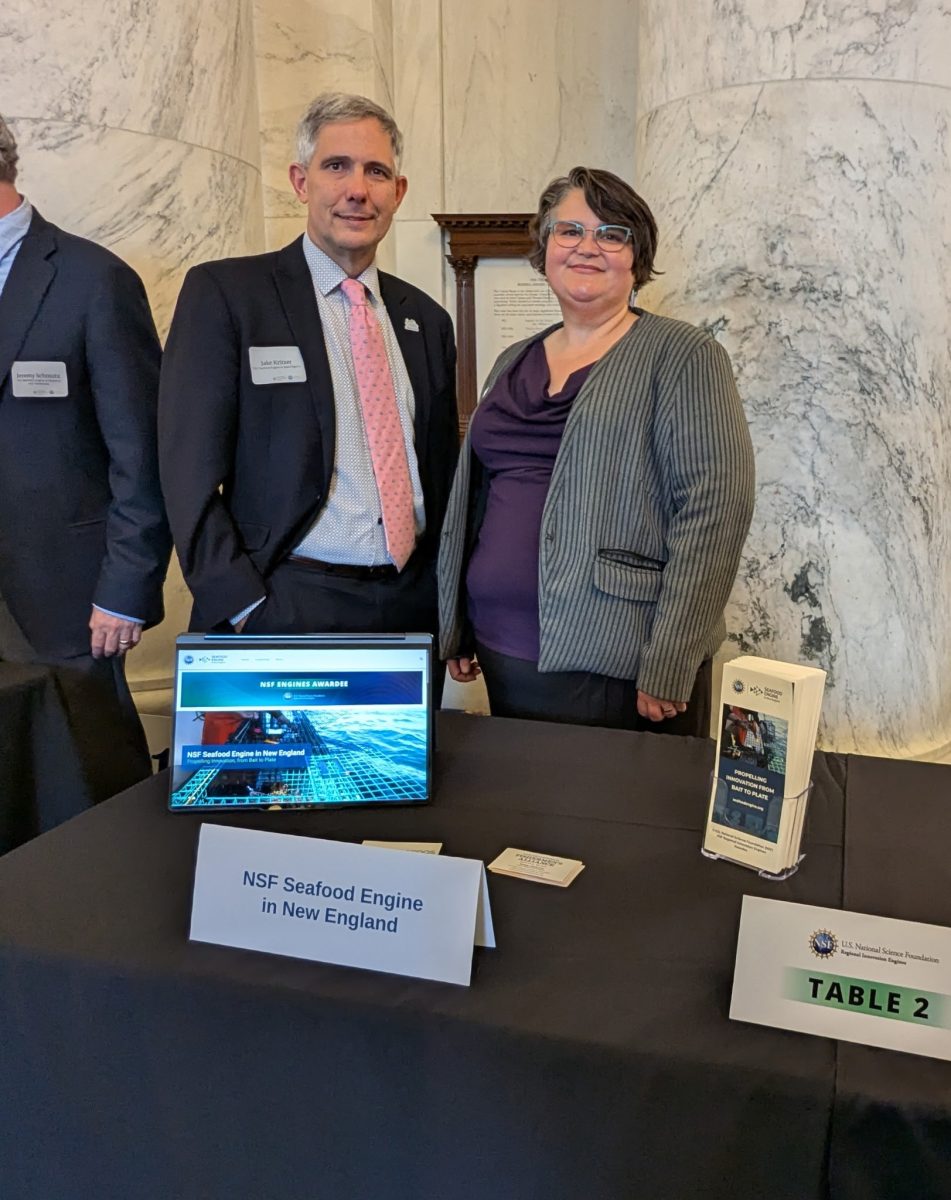
Jake Kritzer, NERACOOS, and Mel Sanderson, Fishermen’s Alliance, in Washington D.C. for the National Science Foundation award announcement.
By Doreen Leggett
Captain Beau Gribbin calls himself a dinosaur when it comes to technology, but he’s always looking for more environmental sensors on his fishing gear.
“Why not put more of these into the ocean? I ask every scientist I see,” he said earlier this month after returning from a 38-hour scalloping trip. He has a sensor on his dredge and a few on his lobster traps.
Gribbin attends workshops on changing ocean conditions, driving from Provincetown. As owner of two boats, and High Pressure Fisheries, he has come to a scary realization:
“Everything I know from my time on the water, 30 or 40 years? Take that, crumple it up and throw it away,” Gribbin said. “Everything I believed has been rewritten in the last five years.”
Pressures on New England’s seafood industry, including a rapidly changing ocean, prompted the Fishermen’s Alliance to join forces with more than a dozen partners to try to reverse the nation’s $20 billion annual seafood deficit.
Earlier this summer, their efforts resulted in the Seafood Engine in New England receiving an award of $15 million over two years from the National Science Foundation. The grant has the potential to grow to $160 million over 10 years.
A big part of the NSF Seafood Engine in New England is designed to meld blue-tech and fishermen’s observations to foster environmental intelligence.
“Fish smarter, not harder,” said Gribbin.
One strength of the NSF Seafood Engine, led by the Portsmouth-based non-profit Northeastern Regional Association of Coastal Ocean Observing Systems (NERACOOS), is the region’s culture of entrepreneurship and innovation.
“Given the long history of its seafood industry and tradition of science and industry collaboration, New England brings the intellectual know-how, infrastructure and workforce needed to support transformative innovations,” said Jake Kritzer, the executive director of NERACOOS, “the Seafood Engine gives us the opportunity to pilot these innovations and fast track their impact.”
Melissa Sanderson, chief operating officer at the Fishermen’s Alliance, has been working with Gribbin and other fishermen on a variety of projects, including eMOLT (environmental sensors on lobster traps and large trawlers) and the Cape Cod Oceanographic Research Fleet, which uses conductivity (salinity), temperature, and depth sensors.
She collaborates with Glen Gawarkiewicz, senior scientist of physical oceanography, and others at Woods Hole Oceanographic Institution as they harness data, primarily collected by commercial fishermen during their regular fishing trips.
Increasingly large changes in ocean temperature and salinity have made it difficult for fishermen to plan when and where to fish and hamstring a management process that relies on years of replicable data to update regulations.
“The NSF Seafood Engine in New England, particularly its fishing R&D projects, will develop the blue technology needed to help fishermen adapt to a rapidly changing ocean,” said Sanderson. “Innovative tools will provide early warning for when facts change on the water and provide fishermen with environmental intelligence needed to stay profitable.”
For more than a lifetime, fishermen have been leaning on traditional knowledge.
“Because of the wild fluctuations we are seeing now and expect to see, their historical knowledge is not as accurate as it once was,” she said.
Fishermen are seeing extreme variability in temperatures – 12 to 14 degree swings on Nantucket Shoals for example – in a matter of hours.
“These are just crazy temperature differences,” said Gawarkiewicz at a meeting with fishermen earlier this year.
Deluges of 14-to-17 inches of rainwater within 24 hours have altered the salinity of the Atlantic, effecting currents and fish species. Altered wind patterns also effect the ocean. Gribbin said for most of his fishing career summers meant a strong southwest wind most every afternoon. Nowadays it’s far less often and more of a breeze.
“Six days of southwest is good fishing for everything,” he said.
Gribbin added different wind patterns can change the location of the thermocline, the transition layer between warmer water at the surface and cooler deep water. That changes where he lobsters. Winds can also remove the thermocline altogether, like “shaking a snow globe,” he said.
Adding to the complexity, a growing number of warm core rings and cooler ribbons of water, the result of shifts in the Gulf Stream and Labrador Current, have meant different ecosystems can exist within miles of one another.
Gawarkiewicz has spoken about a pulse of cold water on the Outer Continental Shelf that was up to nine degrees cooler than the usual temperatures, “stunning,” he said. Fishermen saw mackerel in abundance, including schools miles long, in the cold water.
The research efforts will help fishermen to see ocean conditions like this in real time and capitalize on temperature shifts. The Seafood Engine is funding a Fishermen’s Alliance led project that relies on JaiaBots, sophisticated roaming robots. The JaiaBots can be dropped from fishing vessels and record ocean conditions over several miles. They then return to the boat where the information can be accessed.
“eMolt gives fishermen data where they are fishing. JaiaBots allow them to prospect for data, gathering information while they haul current gear and then after reviewing the data from the surrounding area, they can decide whether they should move their gear or leave it,” Sanderson said. “Adverse conditions can be highly localized and with JaiaBots fishermen can see the range of salinity and temperature.”
JaiaBots look like rocket ships combined with backyard darts. They loiter, measure surface currents, and go as deep as 30 fathoms.
Fishermen are grappling with species arriving late or early, and slight temperature changes are having big impacts. Gribbin mentioned that in 2023 the top of Stellwagen Bank was warmer, so he had a better lobster season than when the water was colder. On Patriot’s Day in April, Gribbin was shown some temperature models for 2026; the water looked cold.
“That may not be good,” he said.
Come August, it seemed 2023 was indeed better than 2026.
Temperature shifts affect other species too; skates and dogfish arrived later off Chatham. Black back flounders used to be on Stellwagen Bank in March, now they are not.
There are other looming questions.
“What are the multi-year impacts of these extreme events?” Gawarkiewicz asked.
Sanderson noted the NSF Seafood Engine is unique in that it will look at the entire seafood supply chain, from bait to plate. In addition to harvest efficiencies, the region needs to modernize processing to reduce the need for foreign imports and increase the value of the harvest throughout the supply chain.
Gribbin is looking forward to the arrival of JaiaBots and real-time data.
“It could be priceless,” he said.