
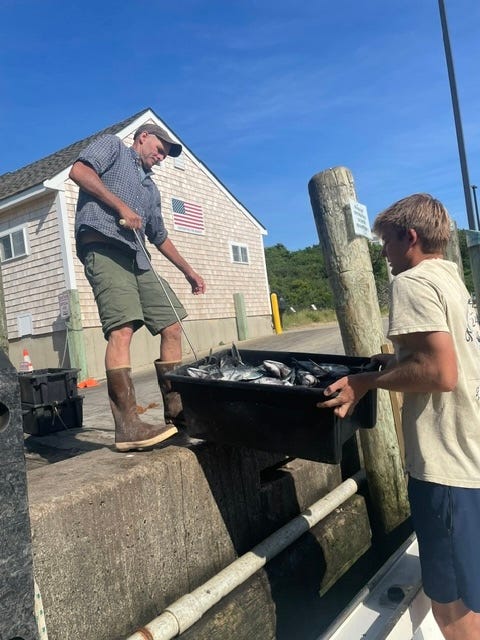
Kurt Martin and mate Tommy Svenningsen bring black sea bass into Chatham Pier Fish Market.
By Seth Rolbein
Fishing Vessel (F/V) Time Bandit, Kurt Martin at the helm, surged from Chatham fish pier at 4:30 am, leaving darkness to steam into a reddening sky and Nantucket Sound. The day’s target: Black sea bass.
At 42 feet long, more than 15 feet wide, Time Bandit is a great workboat with plenty of elbow room. Kurt smiled when asked how he came up with the name:
“Seemed like the boat was always stealing time, always something more to do. Now I have an idea for what the next one will be called: Sanctuary.”
Martin is one of the hardest-working, successful, independent commercial fishermen on Cape Cod. Living in hometown Orleans, 57 years old, he’s been fishing since he was 13.
“My father tried to talk me out of it,” he recalls. “I said I’d do it until it didn’t work anymore.”
This day proved why 44 years later it still works.
Kurt steamed for about an hour, slowing down not far from lanes traversed by island ferries where he had left a string of pots, also called traps. His is one of 42 permits in Massachusetts to allow black sea bass fishing this way, with a limit of 200 pots and a daily catch of 500 pounds. Kurt also lobsters, a different kind of trap, but this day was, as Nauset High School grad Meghan Trainor put it in a totally different context, all about that bass.
“You’ll notice something we didn’t do,” he said. “Bait.”
He calls them “habitat traps,” set on sandy or muddy flat bottom. Black sea bass sneak into protective holes and crevices among rocks or wrecks so traps are attractive, no further incentive necessary.
“We’re making structure for them,” he explained.
Martin’s deckhand was on his first Time Bandit trip; Thomas Svenningsen, from a strong local fishing family, 19 years old, already running his own lobster traps and working charters too, filled in for the regular mate. For those who wonder about the future of local fisheries, Thomas personifies it.
Kurt swung around and snagged his first set, a couple dozen traps. They sit on the bottom waiting for him, connected by a single line so he can haul, cull, send any unwanted life back into the water, then move to the next pot while Thomas temporarily stores empties on-deck. When the string is done, Kurt will steam to a different location or stay right there (depending on how well they are fishing) and play out the traps again, making logbook notes so he knows where to return.
Black sea bass are handsome, dark spotted skin, a colorful sheen when they first emerge. Two to three pounds is good market size; unlike codfish they don’t keep growing, they stop at around six pounds (rarely reached). Some people refer to them as posterchildren for ocean warming, moving north as water temperatures increase to their liking. Kurt is skeptical; he thinks they have always been around, fluctuating over time.
What’s certain is they’re gaining local popularity, deservedly so. Fillets can be small, a little bony, but this is a great-tasting white fish and savvy places like Chatham Fish Pier Market (where Martin sells a lot of his catch literally off the boat) are offering sea bass fish and chips, or ceviche. Others love to grill whole and tease white flakes off spines.
“Jumbos” might fetch Kurt around $3 a pound, mediums and smalls less by a dollar or more. Kurt flipped back many smaller (though legal) fish, hoping to fill the 500-pound quota with jumbos. That’s risky, though he figures he can get his limit toward the end of a day if he’s short — at that point a couple bucks a pound is better than nothing. The fish he tosses back are alive, no hook to pull, no crushing weight, no dead discards.
He doesn’t need 200 pots to get his limit so he’ll rotate, often haul some lobsters too. He’ll likely fish more than 100 days this year but not all marathons, some trips can be five or six hours.
So it was this day. Reaching his limit, Kurt stood between hauler and wheelhouse, Thomas in back making sure the last pots were ready to re-deploy. The Sound was flat-ass calm, no other boats in sight.
“This looks like a good spot,” Kurt mused.
To me it looked no different than any other, but after more than 40 years fishing, nuances become apparent. Experience reveals subtle distinctions.
So traps played out from the stern, settling on the bottom, starting to work again. Then came the steam home to see what that day’s price would be because that, like everything else, is not guaranteed.
This story was originally published in Seth Rolbein’s substack, A Cape Cod Voice.