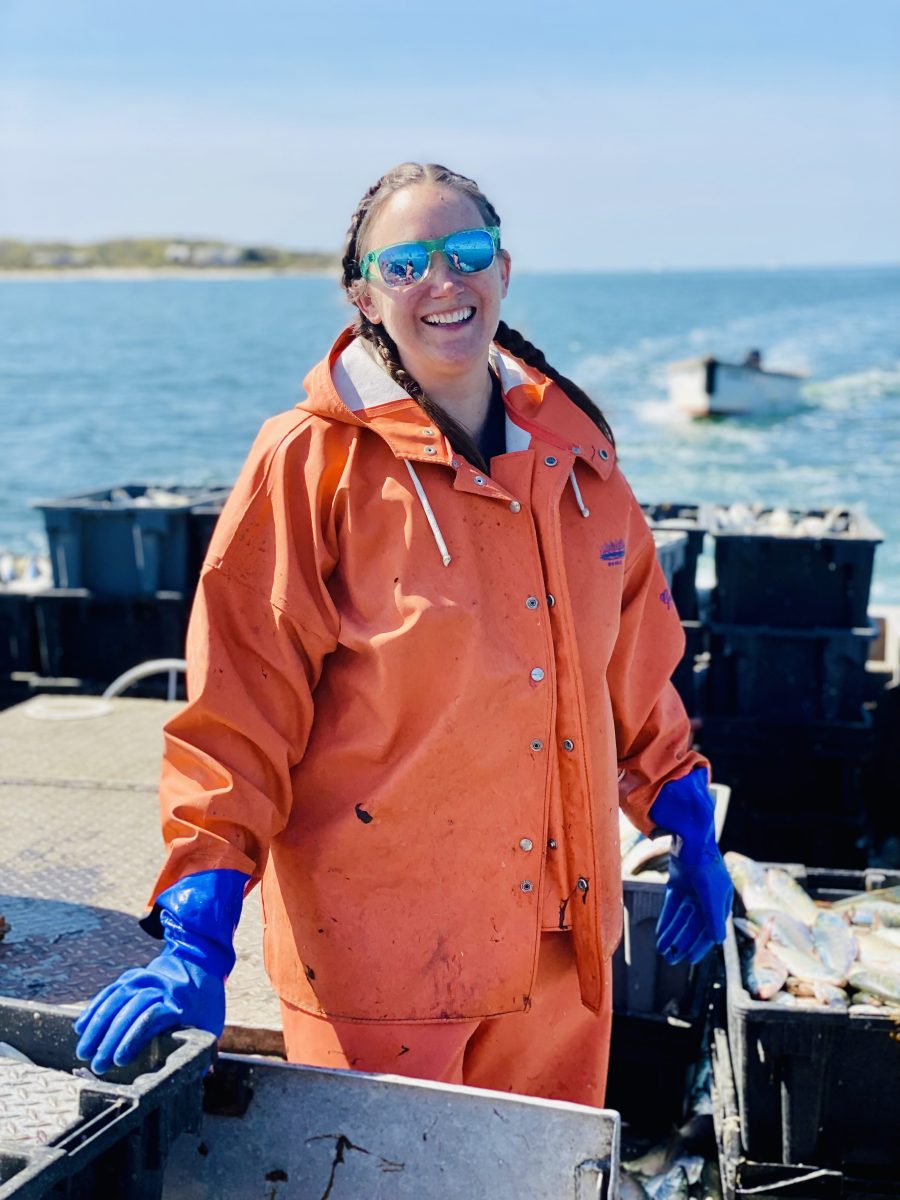
Aubrey Church, policy director at Fishermen’s Alliance, was a recent guest on WCAI’s “The Point.”
Edited by Doreen Leggett
Fishermen’s Alliance Policy Director Aubrey Church, Shelley Edmundson, Executive Director of the Martha’s Vineyard Fishermen’s Preservation Trust, and Joshua Reitsma from WHOI Sea Grant Program and Cape Cod Cooperative Extension, joined Mindy Todd from National Public Radio WCAI’s public affairs show “The Point” to explore fishing and aquaculture. It was a great conversation, ranging from federal cuts to how fishing permits work. Below is an edited version.
Mindy Todd: Commercial fishing has been part of the cultural and economic fabric of this region for generations. Fishing has always been hard work, but changes to the climate, water quality, fish stocks and restrictions on where, when and how fin and shellfish are caught have made the profession even more challenging. Today we discuss the regional small-boat fishing fleet and commercial shellfishing.
What are the major fishing ports on Cape and how has that changed?
Aubrey: A lot of people don’t realize that all 15 towns on the Cape have a fishing industry. It is the fabric of our coastal communities. Many may think of Chatham, but there are a lot of fishing ports that are really successful here on Cape Cod including Provincetown, Wellfleet, Orleans, Sandwich, Woods Hole.
What we are starting to recognize is the importance of supporting those working waterfronts and infrastructure. We are at a pivotal point right now, not only with climate change, but with aging fleets and aging dock infrastructure. This is a pivotal time to educate the community and town officials about why we have to support working waterfronts.
Mindy: How many small boat fishermen do we have regionally and how has this number changed over the past few decades?
Aubrey: In 2022 in Barnstable County there were more than 1,100 fishing businesses, so those are people relying strictly on commercial fishing whether that is for scallop, lobster, groundfish, bluefin tuna, skate, monkfish quahogs. There are also aquaculture farms, as well as individuals just targeting striped bass.
We have seen a decrease in wild harvest permit holders and some of that can be attributed to COVID, but also some of the challenges of running and operating a business, the money to purchase a boat, equipment, permits, can be a lot of debt. Oftentimes you hear the term “greying of the fleet” and that is where those challenges can prevent younger fishermen from entering the fishery.
We have programs including the Young Fishermen’s Development Act, that train young men and women to get into the fishing industry because it is a viable industry.
Shelley: Martha’s Vineyard and the Cape both have younger fishermen entering the fishery. We see new businesses coming in and people taking over retiring permits instead of having an older fishermen retire and that permit being loss to the community. This is happening more and more.
Mindy: You just mentioned a whole bunch of different species and it changes seasonally, right?
Aubrey: Yes, a lot of fishermen are learning it’s important to diversify their business portfolios so they can be successful. They might be fishing for lobster a certain time of year and then switch to scalloping or go for cod, haddock, and then switch. In the summer in Chatham they may be going for skate and dogfish and in the winter they may go deeper off the canyons for monkfish.
We are witnessing more species moving from New Jersey north. So we are having fishermen diversify what they are bringing in and we are trying to educate consumers that they should try new species they may not be used to eating.
Mindy: Explain how fishing permits work.
Shelley: You need a fishing permit to fish state waters, federal or a combination. It gets very complicated and the regulations change year to year on what you can harvest and when.
The prices for permits can range from a couple hundred dollars to multi-millions, depending on the species and the permit, so the access to fish has become harder and harder.
Aubrey: Both of our organizations have permit banks that allow us to retain fishing access in our local communities. When fishermen retire, those permits can end up migrating off Cape Cod or off the Vineyard. We both care deeply about making sure fishermen have access to that quota and opportunity. We work hard to provide affordable access.
Mindy: What’s a permit bank?
Shelley: I think of it as a library holding onto important books for the community and maintaining access. We maintain access to fish our waters and ensure that the next generation can maintain that in a way that is cost effective.
Mindy: How do you acquire these permits?
Shelley: We do a mixture. We sometimes buy directly from the fisherman, and sell to a younger fisherman or whoever is able to accept the permit and make payments. Or we will just be a connector between two fishermen.
Mindy: Is what fishermen are catching changing, and how much they are catching?
Aubrey: Yes, they always talk about black sea bass, a species that traditionally has been very abundant in North Carlina, New Jersey, New York. We are seeing it off our coast. It is delicious white fish, but oftentimes managers don’t have accurate or timely data on how the resource is doing in our waters, so that may limit the amount of fish a fisherman can bring in. By working collaboratively with fishermen and scientists we’ll be able to record how many are in our waters.
Our scallopers are having to fish farther offshore, lobsters are going into deeper water. Species can shift north to colder water, some can expand their range and other species are restricted, like Atlantic cod where they only have a certain thermal tolerance.
Fishermen are jacks of all trades, resilient, they want to harvest what is abundant, they want to make sure managers are seeing that.
Mindy: Does the quota change? Is it timely?
Aubrey: That is what you hope for. But there is often a lag time where they need several years of data before they are willing to change the quotas, which can be really frustrating for fishermen.
Mindy: What is the market for different species?
Aubrey: There is a lot of opportunity to eat local on Cape Cod. I always encourage people when they go to the local fish market to ask for different species, even if they don’t see it on the list because oftentimes fish markets are able to get those species if they know that a consumer wants it. People always want to get salmon, shrimp, tuna, cod, but there are a million other delicious species off our coast. Scup is my favorite. Educating people to try something different, learn how to prepare it — fish can be whole, how do you prepare a whole fish, how do you fillet? We have resources on our website, neat little youtube videos, recipes.
Mindy: What are questions fishermen and fisheries biologists have about impacts of warming waters?
Shelley: We are all wondering what is coming next, who is eating what and how that will change. The more we can pull fishermen into collecting data to help answer those questions, and be able to be flexible, the better. When fishermen help gathering data, also with regulations involved in harvesting, the stronger and more sustainable our fisheries will be.
Aubrey: Many fishermen have oceanographic sensors on their boats to collect bottom temperature. This allows them to refine their fishing practices and allows scientists to have real-time data.
Mindy: How about cuts to NOAA?
Shelley: One concern is just the staff that they need to open or close our fisheries, that is essential. Some changes we are seeing, the impacts are yet to come, but will soon.
Aubrey: Each year’s catch limits and areas open to fishing rely on new regulations published each year. The president’s executive order mandates we remove 10 regulations for every new one. That becomes really problematic for fisheries management.
Shelley: Our conch and whelk fishery is primarily an exported product to Asia, China, and the tariffs might make this fishery collapse. We are seeing a lot of concern in species that are exported.
Aubrey: It is really unsettling when you are thinking about how to plan your business and making sure you can support families and crew.
Shelley: Especially this time of year when you are fronting a lot of your bills on the expectation you are going to able to harvest.
Josh: There is a lot of talk about the cost of doing business. This is an expensive place to live, and it is becoming harder. Just the cost of pulling boats out of the water, servicing and storing gear, where are you going to do that? It all costs a lot. There needs to be community recognition about the importance of the industry.
Listen to the entire show here.