
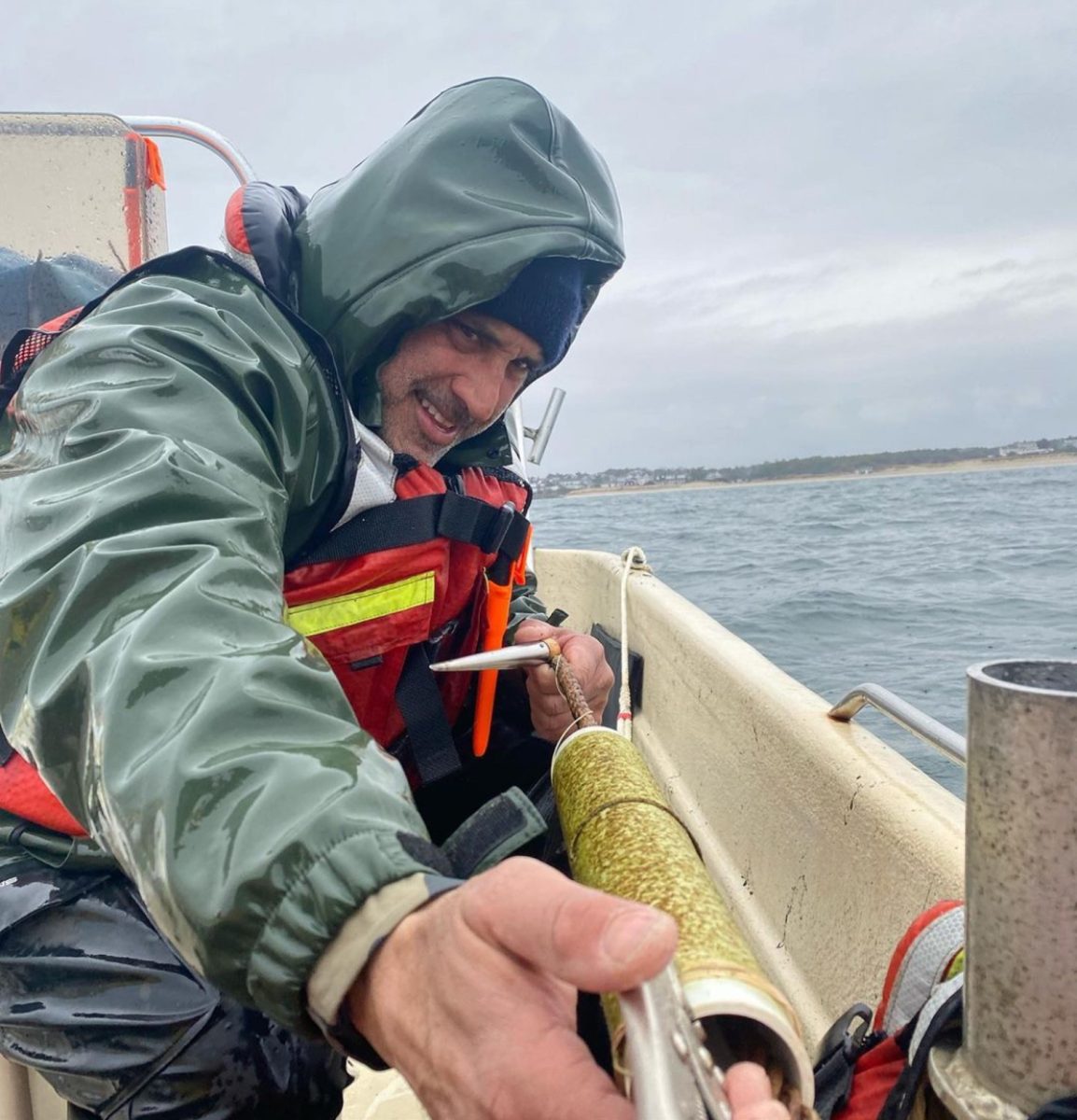
Jamie Bassett, of Chatham Kelp, looks down the barrel of a seed spool.
By Doreen Leggett
Steve Gennodie, in a checkered button-down shirt and grey jeans, stood in biting wind outside the Fishermen’s Alliance to talk to close to 100 people as they left the building.
He held a plate of furikake, also sprinkled on ahi tuna and avocado mini tacos many were munching as they left the first Meet the Fleet of the year on April 16. The heart of the savory Japanese spice blend was kelp from a farm just a few miles down the road.
“You have a little treasure in Chatham,” Gennodie told everyone.
Gennodie, who owns Chatham Pier Fish Market, had joined Jamie Bassett, Richard Curtiss and Carl Douglass from Chatham Kelp to talk about his business (which opened for the season that day) and how he hopes to sell local furikake.
“We are very excited about it,” he said with a grin at Bassett.
“We’ll talk,” Bassett smiled back.
As Bassett showed in his presentation, there is a lot of hype about kelp. The algae is high in nutrients and helps with everything from heart health to blood sugar, an ecosystem winner that removes harmful carbon from the ocean, slows erosion, smooths out ice cream, a welcome addition to burgers and meatballs – even a wound dressing.
Bassett readily admits seaweed is a hot item, but there is one issue locally with the sugar kelp they grow.
“No one knows what to do with it,” said Bassett.
The trio first got the idea for the kelp farm in 2017, “on the porch of the Red Nun.”
Bassett, a Chatham native who has been involved in various fishy endeavors, said when they started the three-year permitting process there was only an experimental farm in the state.
“We are, at the moment, the largest, permitted stand-alone kelp farm in Massachusetts,” he said. “You can see the entire kelp farm from the first parking lot at Harding’s Beach.”
The farm is in water about 25 feet deep and they “plant” only 12 or 13 lines of 350 the permit allows. They typically would be harvesting this time of year, but this has been a slower than usual growing season.
Kelp is planted in December and harvested in the spring. Bassett said they get seed spools from a supplier off-Cape that are unwound into the lines that stretch about 200 feet.
“It is always a race to get the seed spools. You have to get them on the farm right away,” he said, adding that one year late arrival of seed spools had the trio on the farm Christmas Eve and Christmas morning.
Lines are secured by 75-pound moorings, a welcome adjustment from 200-pound concrete blocks in initial years.
Bassett said every year they look at skimpy, new growth on the lines and wonder if the kelp will thicken up. Then, boom.
“It grows very nicely,” he said. “It’s beautiful. It looks like brown ribbon candy.”
The audience agreed as Bassett had photos showing planting and harvesting from a crowded Carolina Skiff, drying in a greenhouse in Chatham.
The audience kept up a steady stream of questions, from whether the farm gets in the way of boats or swimmers (they have never seen a boat save the Coast Guard, and swimmers don’t seem to be fond of wintry water), to whether the kelp has predators (not exactly, but as the waters warm biofouling can occur, in which case kelp is used for fertilizer and not food).
Many wanted to know where they could get products, from soap to beard balm to hot sauce, all available at local stores and online.
Watermelon seltzer, which made its debut that night, was served along with kelp beer from Hog Island brewery.
“I would definitely buy it,” said Regina Stoker, enjoying a glass of the pink beverage with her husband Mark.
“It has some health benefit,” she said with a grin, also good for the ecosystem – what’s not to like?
Kelp has also appeared on menus at Chatham Bars Inn and Chatham Pier Fish Market, one of many local harvests displayed at the fish market that is a stone’s throw from Chatham Harbor.
The market has been at the pier for 75 years. Gennodie bought it in 2020.
He had been a chef, including at the Four Seasons, before making the switch to the seafood industry. Gennodie also owns Rocky Neck Fish, which has a facility on the Boston Fish Pier, as well as shops on the South Shore.
He knew Andy Baler, the former owner at the market and takeout restaurant, from the tuna business.
“I knocked on his door, made him an offer and here we are,” Gennodie said.
The pier has a personality all its own. Though parking can be tough, people flock to the market and restaurant and Gennodie appreciates the community support.
“It is always exciting. It is always chaotic. I enjoy it,” he said.
Gennodie buys from 10 to 15 fishermen and shellfishermen on the Cape, and has a saltwater lobster tank with 60 gallons a minute pumping in from the harbor. Because of the market’s small footprint most of the fish bought in Chatham is processed at Gennodie’s place on the Boston Fish Pier.
Sometimes the fish comes back, other times it goes to other markets.
They also buy eel from Maine, soft-shelled crab from Maryland, salmon from the Faroe Islands. They always try to buy from captains and boats they know.
Gennodie highlighted Captain Kurt Martin who was in the back of the room, saying with pride that together they sold five percent of all black sea bass caught in Massachusetts last year.
The jumbos sell themselves, but the smaller ones are harder to showcase as fillets.
“We got creative, it’s fish and chips and it sold like crazy,” Gennodie said to applause.
“We pack a lot of punch for our small building.”