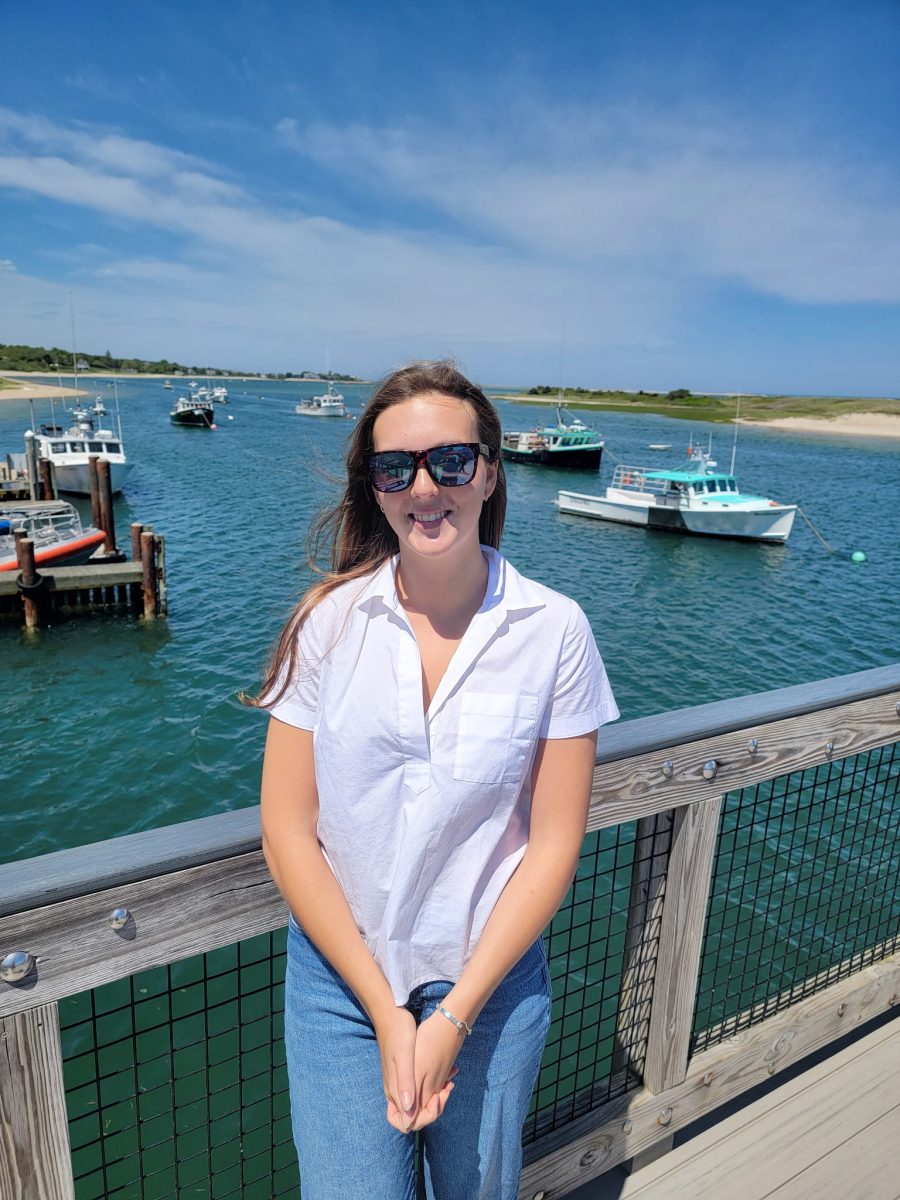
Sara Cornell, a Nauset High graduate and senior at University of Miami majoring in Marine Affairs and Ecosystem Science and Policy, helped us out for three months as an intern this summer. As she was heading back to Miami we asked about her time at the Fishermen’s Alliance.
Tell people about your internship.
My responsibilities this summer focused on communications and public engagement. I created videos, infographics, handouts, and other public-facing materials for social media and for events, with the goal of making complex fisheries topics more digestible to the public.
I met with local stakeholders, toured a shellfish processing facility, researched characteristics of fisheries in different Cape Cod towns, and created written pieces and videos about topics including razor clamming, dredging, gillnetting, clamming, and harpooning for bluefin tuna. I toured ports, met with harbormasters, developed relationships with commercial fishermen, and gained a deeper understanding of issues affecting the local fishing industry and working waterfronts.
What were some of your most rewarding experiences?
One was the opportunity to go fishing on multiple occasions. Being on the water allowed me to build relationships with fishermen we advocate for and better understand the challenges and realities of each fishery firsthand.
I also worked on the soon-to-be-released Port Profile Project, which provides a comprehensive overview of commercial fishing activity, infrastructure, and economic impact across Massachusetts ports. I also organized July’s Small Boats. Big Science. event, a discussion about working waterfronts.
What’s your background?
I was born and raised on Cape Cod. Growing up in Brewster, I spent countless hours exploring tidal pools along the bay. As a teenager, I spent free time razor clamming, harvesting oysters, and fishing for tautog, tuna, striped bass, and bluefish with friends and family.
My father was once a young fisherman working around Nantucket and Cape Cod, and my older brothers spent summers working alongside Chatham fishermen. I grew up watching them leave before dawn, 2 a.m. hardly counts as morning, to put in more than a full day’s work on the water and at the fish pier.
I admired how hard they worked, but it wasn’t until I began studying marine policy that I truly understood what their work represented. Commercial fishermen carry generations of history, knowledge, and tradition. They are an essential part of our coastal economy, but they’re also part of what makes the Cape, the Cape. Their stories connect communities, and their work helps preserve a way of life that deserves to be understood and supported. I don’t take lightly the opportunity to work on their behalf.
What knowledge and skills did you gain and how do you plan on applying them?
I gained a much deeper understanding of many roles that towns, fishermen, state agencies, and the federal government play in managing fisheries. Seeing how these groups interact gave me a broader perspective on fisheries management.
I hope to apply these skills by continuing to bridge the gap between science and the public through meaningful, effective, communication. I want to help tell stories behind fisheries and coastal communities.
One idea that stayed with me throughout the summer was something John (Pappalardo, the CEO at Fishermen’s Alliance), said about the coast: “It’s not a line. It’s a system.” That perspective changed the way I see our coastline. Tidal pools I played in are connected to offshore waters where fishermen work, dunes that protect our shores, shellfish habitats, and working waterfronts where boats unload each day. This internship helped me understand how interconnected our environment, economy, communities, and people truly are.
Have your career objectives changed?
This experience showed me how valuable my education has been while also highlighting that no single perspective tells the whole story. In the classroom, you often learn one side of an issue, but working with fishermen and coastal communities demonstrated the importance of listening to multiple perspectives before forming conclusions. It also taught me that creating meaningful change starts at the local level through building trust with the people most affected. While my overall career goals have not changed, this internship inspired me to pursue work that is personally fulfilling.
Tell one fun story or memory that happened.
One of my favorite memories happened the morning I went harpooning aboard the Mattanza with Captain Eric Hesse. I had baked homemade chocolate chip banana bread to bring as a small thank you gift. I was a little hesitant to bring it because of an old superstition that bananas are bad luck on boats, but I figured banana bread was probably far enough removed to be safe.
When I handed it to Eric and mentioned my concern, he laughed and said, “I actually brought my own banana today … We don’t really believe in those superstitions here.”
As we spent nearly three hours waiting for our first opportunity at a tuna, I couldn’t help but think about another old fishing superstition; that women are bad luck on boats.
Within the next 90 minutes, however, we landed three bluefin tuna. Eric jokingly said I seemed to be good luck, and that’s when I told him I didn’t believe women were bad luck at all. Instead, I like to call it “Lady Luck.”
By the end of the day, we had landed five bluefin tuna, each measuring between 105 and 112 inches in length.
Later that summer, John joked that I had earned a reputation as a good luck charm aboard the fishing vessels I’d been on, a streak I’d certainly like to keep going.