Monthly e-Magazine Articles

A quest to protect Wellfleet waters from a green menace

A quest to protect Wellfleet waters from a green menace

“I wouldn’t have you here if it wasn’t the apocalypse.”
Those words from Wellfleet’s Assistant Shellfish Constable Johnny “Clam” Mankevetch as he motored through a plate-glass calm Chipman’s Cove on a bright blue late fall day.
He was heading to half a dozen converted eel traps he had marked with plastic-bottle buoys re-purposed from the dump, now designed to catch what Mankevetch, an upbeat nature-loving guy, calls a scourge:

read more
WaterWORKS highlights jobs in blue economy

WaterWORKS highlights jobs in blue economy

Fisherman Will Nicolai, a tall, long-haired, easygoing 21-year-old, has two older siblings engaged in high finance, but the Sturgis West graduate tried college (two colleges) and decided that wasn’t for him.
Captain Eric Hesse has a degree in physics and a graduate degree in civil engineering, but the lure of harpooning bluefin tuna and longlining for groundfish was too strong.
Jake Angelo of Barnstable Seafood Company went to Massachusetts Maritime Academy, toyed with being a private yacht captain, but found his dream job on the water fishing for black sea bass and clams.  
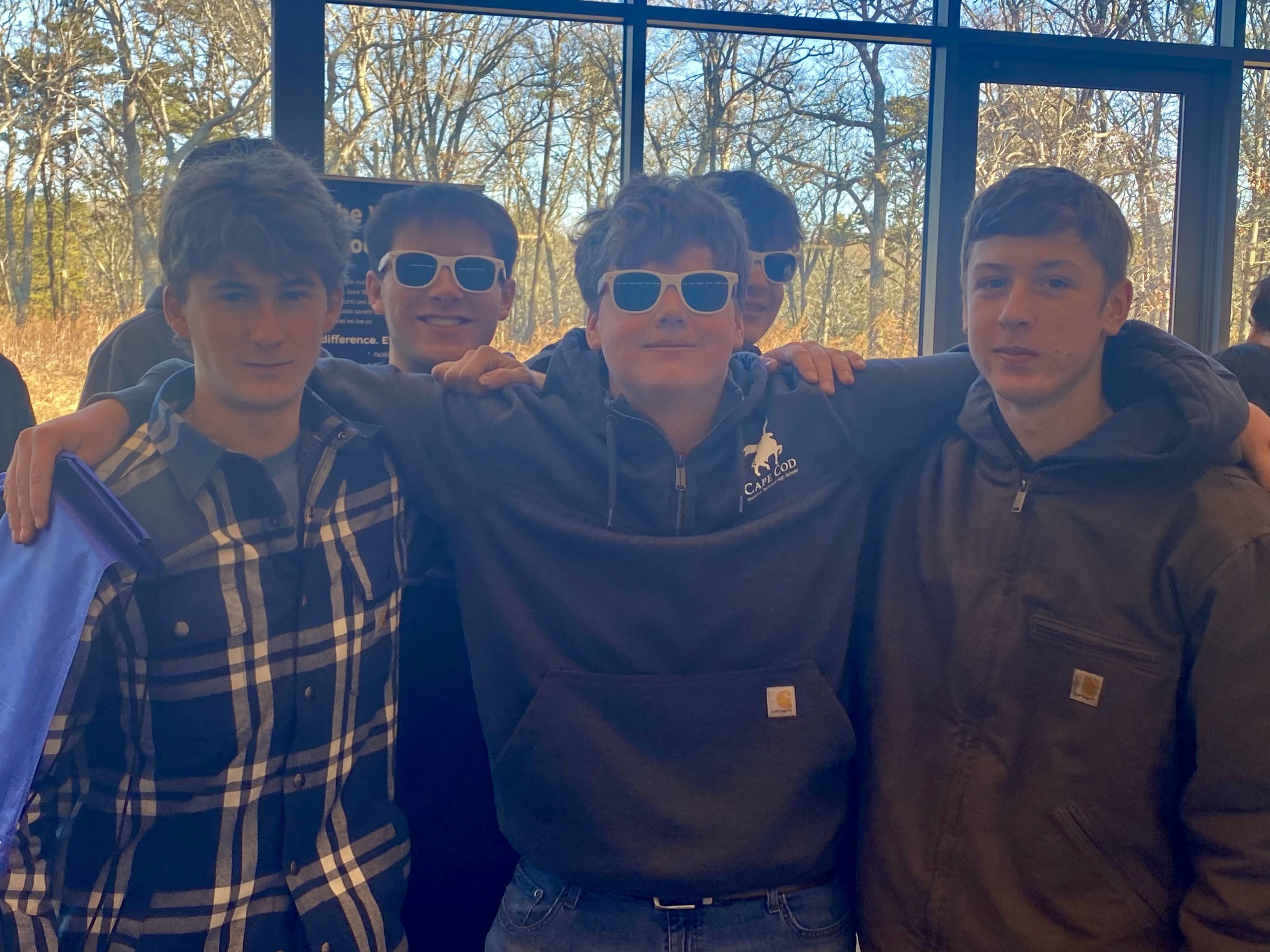
There is no one way to get into commercial fishing and opportunities abound if you know how to work hard, the trio told dozens who stopped in at the Cape Cod Commercial Fishermen’s Alliance table at WaterWORKS at Cape Cod Community College.

read more
Study says seafood independence is possible

Study says seafood independence is possible

Josh Stoll is steeped in fisheries research and policy and has often heard how the United States imports 90 percent of its seafood.
“Everyone from my mother to members of Congress have referenced that statistic,” said Stoll, an assistant professor in the School of Marine Sciences at the University of Maine. “If you always talk about the problem, there is not really space to imagine something different.”
So, he, and other researchers, Tolulope Oyikeke and Sahir Advani, are giving people that space. The trio recently published a treatise, “Seafood independence is within reach: a multi-scale assessment of seafood self-reliance in the United States,” in the journal Ocean Sustainability.

read more
Fishy first in Provincetown

Fishy first in Provincetown

Acadian Redfish, which ranges from Virginia to Iceland, also has a wide-ranging history, including being co-opted by the United States Army during World War II. But it was first identified in Provincetown.
The bright-colored fish was discovered in the harbor at the tip of the Cape by Captain Nathan Ellis Atwood in 1854. Atwood was friends with Dr. D. H. Storer, a physician and naturalist who identified numerous fish species and described others, including yellowtail flounder.  

read more
Photo Gallery: Green crabs gone gourmet

Photo Gallery: Green crabs gone gourmet

Green crab is considered one of the most pernicious invasive species in the world and has proved destructive to the Cape’s marine ecosystem.
To fight back against the European invader which makes short work of clams, scallops and young lobsters as well as destroys eelgrass, people have tried a variety of measures.
Some towns, such as Ipswich, have put a bounty on their heads, others harvest them for bait and many have tried to create a market for them. Greencrab.org  was founded in 2020 to raise awareness and to take green crab from “problem to plate.”
This gallery shows green crabs being harvested on Cape as well as showcases a variety of green crab menu items.

read more
A clarion call: Fisheries management is broken

A clarion call: Fisheries management is broken

When the executive committee of New England Fishery Management Council, which I serve on, sends a 17-page letter to the Northeast Fisheries Science Center saying they need to get their act together and make profound improvements for the sake of American fishermen, that’s a big deal.
The Management Council is at the top of the regional pyramid when it comes to creating fishery policies and regulations, though what we propose still needs to be approved in Washington.
The Science Center out of Woods Hole does all the fieldwork and scientific studies to define what our fishermen can catch and still keep stocks healthy. Their survey work and analysis is crucial to defining most decisions.

read more

Categories

e-Magazine PDF’s