
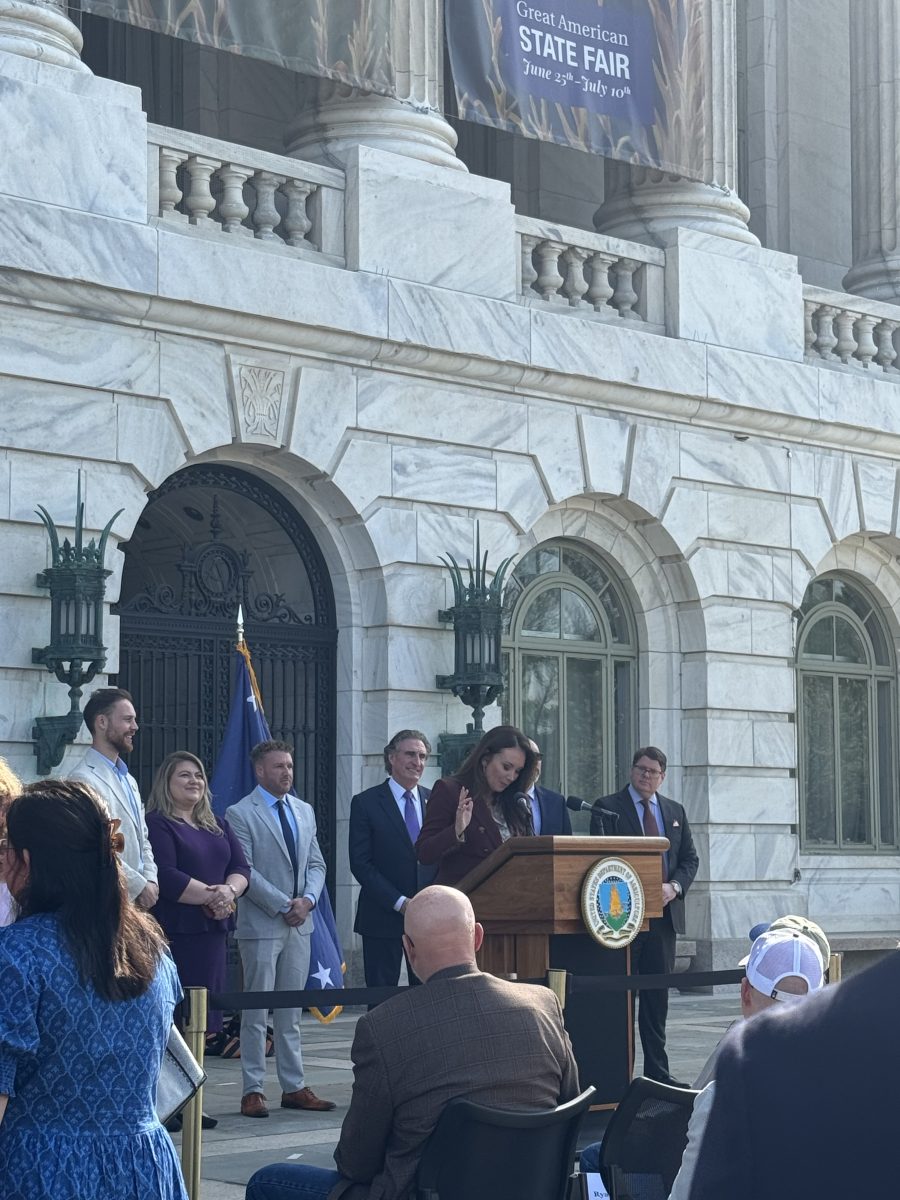
U.S. Secretary of Agriculture Brooke L. Rollins announced the new Office of Seafood at USDA headquarters.
By Doreen Leggett
Nearly 200 people packed a spacious, blue-carpeted room in the Dirksen Building on Constitution Avenue NE, where members of Congress mingled with administration officials and fishermen from across the country, enjoying dishes ranging from red snapper and black cod to Cape Cod skate stew.
In the crowd, enjoying respite from a 90-degree humid day in Washington D.C., Captain Bill Amaru received two pieces of historic memorabilia from a man who crewed for him close to 50 years ago, Jeff Pike.
Pike, who traded Grundens for suits decades ago and has his own lobbying firm, handed off two framed posters from 1975. Both were yellowed with age and had none of the glitzy panache seen in marketing materials today, but their message was clear.
One, with a haddock in the center, proclaimed, “Help pass the ‘Studds-Magnuson Bill’ 200 mile limit a must,” asking people to call or wire President Ford or their Congressional representatives. The other, larger, had eight sketches of vessels in the “Soviet” fleet, including a base ship with a crew of 640 and capacity to store 50,000 cases of fish.
“The Soviet fishing fleet is 12 miles off our coast and sucking up everything that swims, crawls or hides in the sand… They leave nothing… They put back nothing… We must have legislation now to control our Continental Shelf and regulate foreign fleet catches,” it read.
Both fit the moment.
Amaru was in D.C. the third week of April to help celebrate 50 years of the Magnuson-Stevens Fisheries and Conservation Management Act, MSA, which the Studds-Magnuson effort became, named after two legislative champions. Pike began working for Rep. Gerry Studds who represented the Cape, as well as the fishing community of New Bedford, in 1979 and was gifted the posters when he left the office after 16 years (with a break of a few years when he fished out of Chatham on F/V Miss Molly). They had hung on the walls of his office for decades.
Pike and Amaru were on the fishing grounds before the act, which pushed foreign boats offshore and transformed the country’s fisheries, became law on April 13, 1976.
Amaru told the crowd about those long-ago days in his 32-foot wooden-hulled Joanne A, the first of several vessels named for his wife and whose descendants are fished by his son and grandson. He sat on a panel organized by the Fishing Communities Coalition, representing small-boat fleets coast to coast. FCC held the event to recognize the importance of the act and to “envision the next 50 years of U.S. Seafood.”
“Usually, the first thing we would see, in the 1970s, were lights from foreign trawlers fishing on our grounds,” said Amaru, wearing a black suit and purple tie with boat shoes. “The first thing we had to do was figure out how to get gear in the water without getting run over by 250-foot factory ships.”
The act, Amaru said, got rid of the trawlers and turned the fishery over to United States fishermen who made the most of the opportunity, with no limits on what they could catch with larger, more capable boats. Their success resulted in overfishing so reauthorizations of the act placed strict limits on the catch.
“Now we are back to the point where we can talk about the future of the fishery because we are sustainably harvesting our resource,” he said.
Linda Behnken, executive director of Alaska Longline Fishermen’s Association, a member of FCC along with Fishermen’s Alliance, said the nation has done a good job rebuilding fish stocks. Now attention must turn to rebuilding fisheries, which have too few fishermen to keep the fleet healthy and too little investment in businesses and working waterfronts.
Joe Letourneau, who fishes out of Newburyport, said he is the only groundfisherman left in the port.
“There are constant threats from real estate, tourism (and) city politicians that see a better use of that space,” he said. “We are constantly being challenged for what little piece of shoreside facilities we have.”
Barton Seaver, the noted chef, author, and speaker, crafted a menu highlighting domestic, wild-caught fish—sourced directly from fishermen who later engaged with attendees at a two-hour reception following the panel.
Seaver said Americans don’t fully understand seafood’s importance to the early success of the country. He said people talk about heirloom tomatoes, but fish is our country’s first heirloom food.
“It was upon the backs of cod that men and women first took our steps toward economic and political freedom in this country,” Seaver added. “Long before we ever found amber waves of grain, we were plying the tumultuous and tempestuous waves of the North Atlantic.”
Seaver said we can shape the next generation of maritime opportunity and revive our legacy food system.
During the panel, Ben Martens, moderator and executive director of Maine Coast Fishermen’s Association, announced breaking news: the creation of an Office of Seafood in the U.S. Department of Agriculture.
FCC has been a strong advocate for the office which will advance policies that strengthen domestic seafood production, working waterfronts and coastal economies.
“There is so much opportunity when you think about how you re-introduce seafood into our food system,” Martens said.
According to research out of the University of Maine, from 2018 to 2023 USDA invested more than $31 billion in food systems programs, but less than 1 percent went to seafood. Of that, an even smaller fraction went to wild harvest seafood. The announcement from Secretary of Agriculture Brooke Rollins marks a commitment to expanding those opportunities.
“With the launch of the USDA Office of Seafood, we are honoring decades of hard work on the water and opening the door to new opportunities, stronger support, and a brighter future for the seafood industry,” Rollins said in a statement.
Aubrey Church, policy director at Fishermen’s Alliance, was in D.C. for the anniversary celebration of Magnuson-Stevens Act. During this and earlier trips to Capitol Hill she and close to a dozen fishermen from the Cape have spread the word that access to grants, loans, and risk management tools help keep small fishing businesses resilient.
Investment in working waterfront infrastructure and local processing helps harvesters maintain access to valuable seafood supply chains. Domestic seafood procurement provides critical nutrition, and workforce development helps nurture the next generation of fishermen and seafood professionals. These funding opportunities already exist for farmers and ranchers, Church said.
“MSA was never just about the fish,” she said. “It was about people and fishing communities who depend on healthy oceans, and rebuilding stocks pushed to their limits, so they remain viable for generations. A new USDA Office of Seafood can extend that success, ensuring that for the next 50 years we protect both fish in the water and communities on the docks.”