
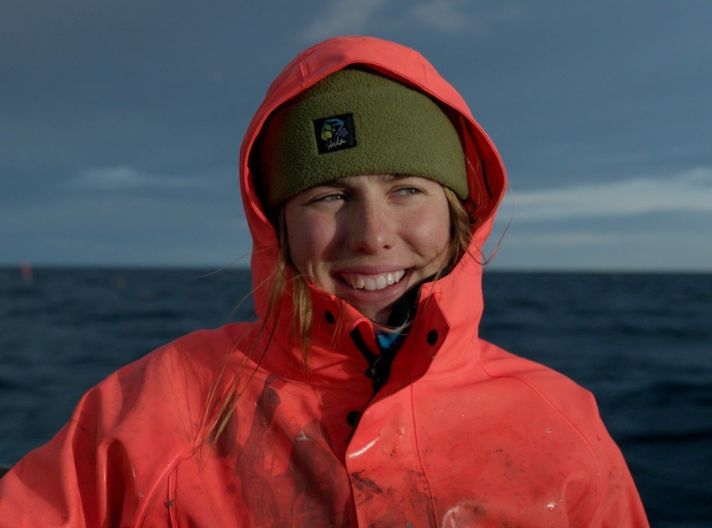
Caitlin Townsend. Photo by Kim Roderiques.
By Caitlin Townsend
A lot of people look forward to signs of spring, daffodils, peepers, river herring and the chance for new beginnings. I’m no different, but what flips the switch on a long winter for me is NGOM – the Northern Gulf of Maine scallop season.
NGOM, a high-stakes, fast-paced fishery, is the kickoff event for my fishing season. I start with NGOM, then my dad sets his lobster traps in May, and then in June, I fly out to Bristol Bay, Alaska to harvest sockeye salmon. When I arrive home in August, the timing lines up perfectly with the lobster run.
This year, after taking a new job as Working Waterfront Organizer at the Fishermen’s Alliance back in January, life looks a bit different. I get to spend my days gathering intel from the fleet in a different way, being more involved in the entire fleet instead of my small bubble. I get to learn more, meet more people, and understand more issues.
So professionally and personally, I knew that I could not miss out on being in the middle of the action for NGOM, so I made the choice to drive up to the epicenter of activity, Gloucester, MA. Gloucester has become the homeport for most boats fishing NGOM for a few reasons. For one, there is enough dockage and buyers in Gloucester to support an influx of boats during a time where there isn’t a lot of other fishing activity. Another reason is Gloucester is closer to Maine, where a lot of the NGOM boats are from. Many boats also leave from Provincetown as well as Boston. All three of these ports have easy access to Stellwagen Bank, where most of the fishing activity happens.
I had a lot of feelings going into another fishing season. A tragic winter with the loss of all aboard the F/V Lilly Jean of Gloucester and the F/V Yankee Rose out of Provincetown left me feeling a bit weary of returning to the ocean in a way I had never felt before. I had always felt somewhat fearless and unstoppable on the water. It is my happy place. I have done the safety trainings. I have heard the scary stories. I have been in bad weather. The feelings from this winter’s accidents left me shaken, but the passion and love for the industry outweigh the worries.
Unfortunately, my schedule didn’t allow me to start fishing on opening day, and a DC fly-in to advocate for the commercial fisheries left me unable to stay until the bitter end, so my first day on the water was April 4. Before I went up to Gloucester, I spent some time down the docks in Ptown, checking in with everyone on the first few trips. There were some familiar boats in town from other parts of the Cape, such as F/V Three Graces and F/V Stella Jane, as well as some hometown boats, like Provincetown’s F/V Kahuna. There were even boats from Ocean City, MD.
On the first trip of my fishing season, we left the dock at 6 a.m. I was so happy to have left in the light. Sometimes I hate leaving in the dark, especially somewhere that’s sort of unfamiliar. It makes me feel uneasy, like I can’t grasp my surroundings. I thought a lot about the industry as we made the steam south for Stellwagen Bank, about the culture, the history, and how lucky I am to be here, gathering knowledge and doing what I love so I can continue to advocate for fishermen across Cape Cod and New England.
NGOM is such an interesting time with all the boats around from all over. You have boats from Maryland and boats from the Canadian border. NGOM becomes almost a gathering point, a meeting of the minds. Intel is shared across docks that normally wouldn’t see a Maine lobsterman on one side and a Massachusetts scalloper on the other. There are 40-foot Maine lobster boats rigged for scalloping, to make a little extra money before the lobster season begins again. There are also big New Bedford scallop boats fishing the same bottom.
Some boats are going single handed, just captain and one crew, but sometimes you see a boat with a captain and three crew. Everyone in the northeast wants a little piece of the NGOM pie. There are big scallops, we typically catch u10s, even u8s, which means there are 10 or 8 scallops to a pound. This makes the cutting process fly by. Depending on the boat and the deckhand, 200 pounds is a quick job. This year, somedays we caught 10 bushels a tow, somedays only three bushels a tow.
The dredge goes out, gets towed off the stern, and then gets dumped on deck. Picking the pile is always interesting. You stand, legs apart, with a bushel basket between your legs – you are almost squatting – and your hands work fast, with your eyes telling you what to put in the basket and what to kick to the side. Once the pile is picked, rocks, and numerous empty shells from the boats around you, are shoveled back over.
You drag the bushels to the cutting box, which sometimes is a sheltered hut with a trough down the middle where the scallops are dumped. Other times, it’s just a wooden box nailed to the rail of the boat. This is where you stand and open your scallops with a scallop knife that has a carefully and intentionally taped handle to best match your grip. Then you throw your empty shells back over and cut your meats into a bucket. And repeat. The NGOM trips last anywhere from six to 12 hours. Most of that is the steam in and out, or time spent in the cutting box.
I go through intense waves of thought while I’m in the cutting box on the back of a boat. When I first started shucking scallops, I learned that you don’t leave the box until the job is done, just keep on cutting. I mostly adhere to that golden rule, though sometimes I stop to snap a picture, grab a sip of water, or reach for a pink, sugar-free Red Bull if it’s 2:30 a.m.
Being in the cutting box is one of my favorite places to be. I get to think, but I also get to chat with the deckhand next to me or even put on headphones and listen to my carefully curated “in the cutting box” playlist. Usually, my thoughts start with frustration with my cutting skills “Ugh, I’m too slow,” or “Why am I not pinching the guts?!” Eventually, that quiets down, and it becomes a steady, thoughtful rhythm until all the scallops are cut. Then my mind wanders: What else can I do for the industry? How can we keep fishing? How should we manage this area? I wonder how other boats are doing. Sometimes I work through these questions; sometimes I just zone out. Or I think about my friends, my family, and of course, my dog Hen.
It is exciting in Gloucester, diesel trucks, which are smelling a little fishy, line the streets. There are more mast lights in the harbor than the days before April 1. It is a place where you might run into your friend, another woman lobsterman from an island in Maine, in the Market Basket parking lot. There are fishermen sitting around in the newest, hippest coffee shop in town, all jockeying to get their next trip in, during the best weather window. Luckily this year the weather was relatively okay. We had a few bumpy days, but we also had some glassy calm days.
I ended up doing a lot of night fishing. One night over tacos, I was speaking to a friend, the same friend that I ran into in Market Basket, about how much I disliked fishing at night. She explained to me how much she loves it. How it is almost like sensory deprivation, and your senses become heightened on the back deck. How you can see more, and hear more, and feel like you are in your own bubble. That very night, I went into our early morning trip with that mindset, and it changed night fishing for me forever.
The Northern Gulf of Maine is a different scallop fishery than any of the others. Once it begins you fish until the quota is met. The quota is set by the New England Fishery Management Council. This year, the industry was allowed a total allowable catch (TAC) of 482,753 lbs. Each boat is allowed 200 pounds of shucked meats or 1,666 pounds of shell stock per calendar day. This year, depending on how you played it, that equaled about 13 fishing days. I was lucky to fish seven trips this season.
The excitement, the labor, and the love of it all are what keep me going. Each day I fished was different: calm, rough, quick tows, long tows, in the middle of the night or even after Easter brunch. I fished on three different boats during NGOM, one fiberglass and two small, steel-hulled, owner-operated boats. It kept me in tune with the industry and made me feel more informed, being in the middle of a fishery that has evolved rapidly over the years.
In all, 410,468 pounds were landed to a dealer for the 2026 NGOM season. Now, it is time for the real work. How should we manage next year’s scallop season? Those answers will come eventually, but for now, it’s just the beginning.
The important part, the conversations that shape those answers are already happening. They happen between fishermen, between fishermen and advocates, or even between fishermen, advocates and policy makers. I carry first-hand experience from this season with me into the spaces where these talks happen. For me, that’s what matters most. I am taking the reality of life on the water and making sure it’s part of how we move forward, so this fishery, and the people who fish it, have a future.