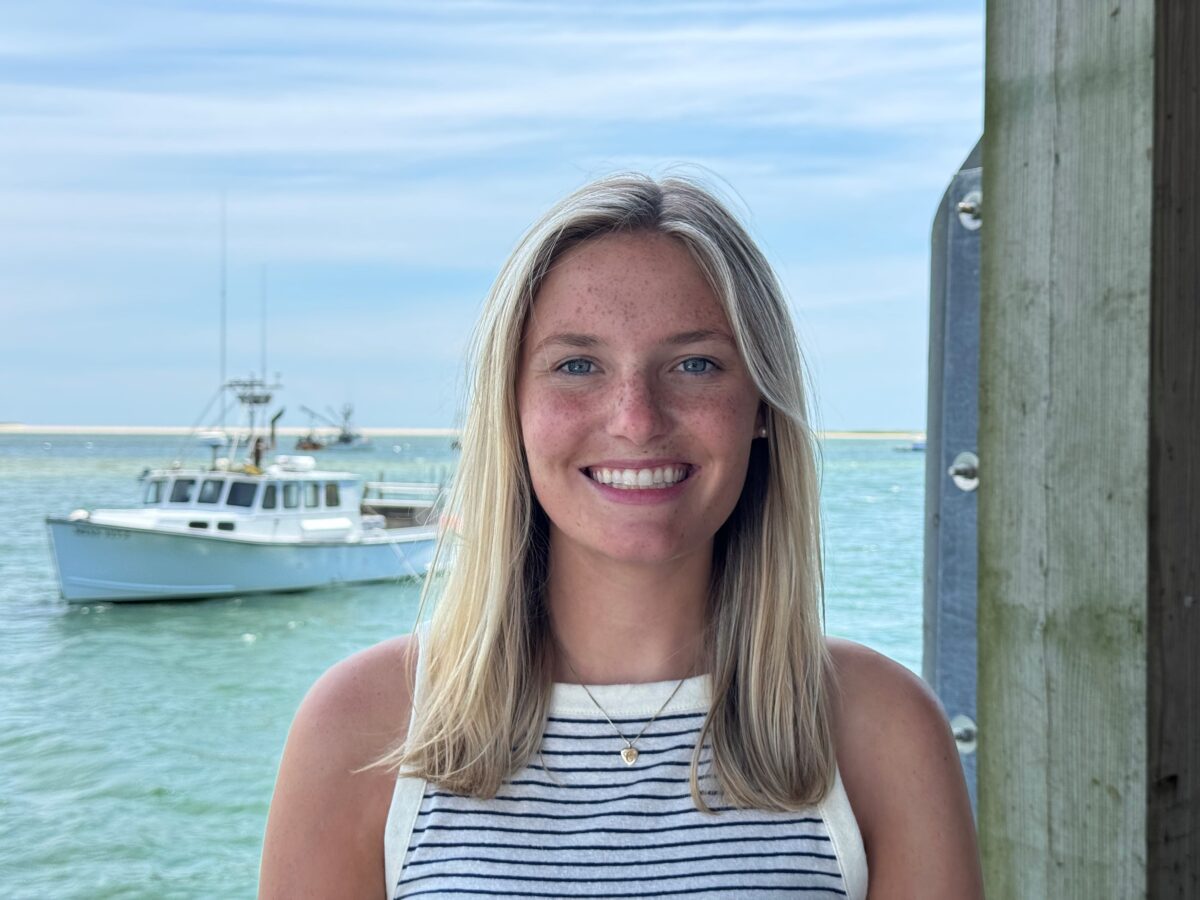
Caroline Williams, policy intern at the Fishermen’s Alliance.
By Doreen Leggett
Caroline Williams remembers the video well:
Summer intern Ana Brown, smiling and dotted with fish slime, was standing at Chatham Fish Pier talking about her work with the Fishermen’s Alliance after a day aboard F/V Constance Sea.
Will Nicolai, a friend of Williams, had sent the video last winter as she headed into her last semester of junior year at University of Virginia. Williams, an Economics and Global Studies major, had been applying for internships and wasn’t sure she wanted to go into the finance realm. Nicolai, a mate on the Constance Sea, knew Williams was focused on the environment and sustainability as part of her major.
“Ana was onboard and doing monkfish research and (Will) would tell me about it,” Williams remembered. “He said what she was doing was really cool and I might be interested in it.”
With the video clip was a note from Nicolai, who she has known since they were 12, suggesting she apply for the Fisheries Leadership Intern Program at the Fishermen’s Alliance. She did and was selected to help Policy Director Aubrey Church keep tabs on the increasing number of wind meetings, proposed wind lease areas, and scientific studies. Williams also helped launch a research project that taps fishermen to collect oceanographic data which will help measure changing ocean conditions.
“Caroline’s commitment to creating outreach materials that could inform the public as well as fishermen was invaluable and helped launch the Fishermen’s Alliance forward in our advocacy efforts associated with wind development in our region,” Church said.
Williams’ connection to the Cape and her plans to pursue a Master of Public Policy and Leadership degree in UVA’s accelerated program helped secure the three-month internship.
A resident of Cohasset, Williams spent summers in Brewster and the peninsula has been beloved by her family for generations. When her grandfather passed away and her grandmother thought about moving off-Cape to be closer to the family, Williams said her parents wouldn’t hear of it – they bought a house in Orleans to be close to her instead.
Knowing her work would involve plugging into hearings and informational sessions swirling around wind lease areas affecting Cape fishermen, Williams did research before she started the internship in May and wrote a comment letter from the perspective of a local commercial fishing captain.
“I focused on three main concerns: the disruption of commercial fishing vessel routes, dangers to marine life, and the negative effects on tourism in relation to my business,” Williams wrote.
Williams explained that the distance vessels travel offshore, and the gear they use, make it difficult and unsafe for them to operate in wind farm areas. That flies in the face of the federal law:
“Under Appendix A Section 388 of the Energy Policy Act of 2005, Public Law 109-58 (4), ‘the Secretary shall ensure that any activity under this subsection is carried out in a manner that provides for [safety],’” Williams wrote.
Williams said that after listening to fishermen and understanding the risks of improperly sited wind farms, her concerns have expanded.
“What I said in my letter was barely scratching the surface,” she said. “I have done projects on offshore wind in Virginia and Massachusetts in both my economics and global studies classes. This summer gave me the opportunity to be completely immersed in the conversation surrounding offshore wind and hear new perspectives. I hope that my master’s program will give me the tools to eventually be involved in the policy side of offshore wind and other climate-related initiatives.”
Before she arrived at the Fishermen’s Alliance, she was solidly in favor of wind energy. Now her feelings are more nuanced. Industrial-sized wind farms may not be the only answer, or an answer at all. Maybe, as one fisherman suggested, smaller scale projects (solar panels on highway medians for example) are the answer. Those projects are much more complicated, and not likely a financial “windfall” for corporations, but may make more sense.
Williams said most of her time at university is spent learning about and discussing the perils of climate change.
“We learn the saddest things,” she said. “That can be a little bit defeating.”
But there is a steady drumbeat message to her and her peers:
“You’re the generation who can fix it,” she said.
At school, one of her projects dealt with how to protect a refugee camp with 28,000 people in Bangladesh from storms and sea level rise. Planting mangrove trees alone is not going to do it, she said.
Her internship emphasized there must be systemic changes at the government level, cohesive, multi-pronged solutions, built on science with stakeholders driving the process.
“Policy is now the route I am taking. Working with Aubrey (Church) to amplify the voices of fishermen in the offshore wind space was by far the most rewarding part of the summer,” Williams said as her internship winded down in mid-August.
“I always admired the hard work of commercial fishermen, but I had never truly understood the importance of commercial fishing to the Cape culture and economy. Learning about the amount of revenue generated from various species in each offshore wind lease area gave me a better perspective of the extent of commercial fishing in the economy. It also gave me a new understanding of how people’s livelihoods and communities depend on commercial fishing. Not just fishermen, but people on the docks, processing facilities, gear producers.”
Williams’ other project involved fishermen in scientific research, which will provide better information on how climate change is impacting the ocean and fishing businesses.
She kickstarted a new research project at the Fishermen’s Alliance: The Cape Cod Shelf Fleet, done in partnership with Woods Hole Oceanographic Institution.
Local fishermen have started deploying conductivity, temperature, depth (CTD) instruments to collect water column profiles and oceanographic data in the Outer Cape Coastal current to better understand changes to the environment. Fishermen know the ocean better than anyone else and including their observations with the data will provide a more valuable interpretation, Williams said.
“It is important that our internship program foster the next generation of scientists and give them the opportunity to engage with local fishermen,” Church said.