
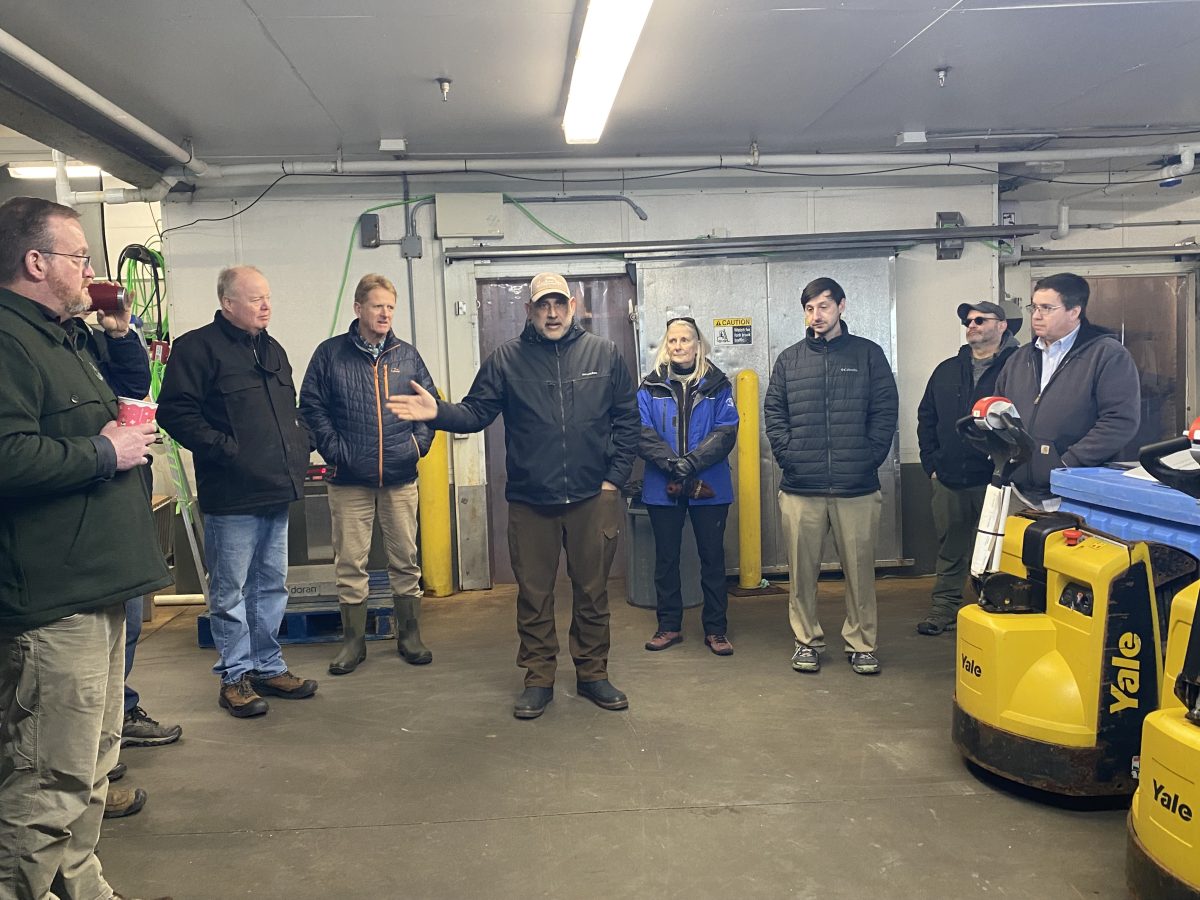
A crowd, including DMF director Dan McKiernan, was on hand for a recent tour of the fish pier led by Jamie Bassett, center. Department of Agricultural Resources Commissioner Ashley Randle and others were celebrating recent Food Security Infrastructure Grants.
By Doreen Leggett
Jamie Bassett runs a packing business at the Chatham Fish Pier, a fulcrum building for the industry since the 1940s.
“My grandfather probably brought fish into this port a time or two,” Bassett told a crowd gathered on a frigid January morning.
In his grandfather’s day the pier was known for cod. Now Chatham is known for skates.
“We did three million pounds of skate last year,” Bassett said.
Bassett is working to increase domestic consumption of skate, open international markets and expand local processing.
He got a Food Security Infrastructure Grant from the Massachusetts Department of Agricultural Resources to defray the cost of processing machinery for both skate and dogfish. His affiliate Shellfish Brokers was among several Cape entities, including Wellfleet Shellfish Company, Barnstable Seafood and the towns of Chatham and Orleans, to receive grants to fill gaps in the regional food supply chain while supporting emergency preparedness, and improving access to local, high-quality seafood.
The allocation of funds from the program is small but took on added importance after funding from the United States Department of Agriculture was cut last year.
Government funds have exponential return; an ice machine at the pier helps protect millions of dollars of product for example.
Commercial fishermen are looking to gain some parity with USDA funding provided to farmers and ranchers.
Fishermen led by Alaska Sustainable Fisheries Trust (a sister to Cape Cod Fisheries Trust) hired Joshua Stoll at the University of Maine’s Social Oceans Lab to do a deep dive into USDA grants from 2018 to 2023. They focused on grants awarded by four USDA agencies responsible for strengthening domestic food systems: Agricultural Marketing Services, Food and Nutrition Services, National Institute for Food and Agriculture, and Rural Development.
They found that of USDA’s $31.2 billion in funding, only a half of one percent – $261.7 million – was associated with the seafood sector. Of that, 78 percent went to aquaculture.
“Commercial fishermen are innovative entrepreneurs,” said Aubrey Church, policy director for the Fishermen’s Alliance. “Often unable to secure traditional loans, support from USDA could move their plans from paper to reality. I know one captain who was able to triple his employees and create a new product with help from a grant.”
Linda Behnken, executive director of Alaska Longline Fishermen’s Association, has been in the industry for close to 40 years and pushed for the study.
“Very few people know who caught their seafood and fishermen are getting paid the same as they were 20 years ago,” Behnken said.
Advocates on Cape are hoping USDA can increase funding to state programs that make greater connections between fishermen and customers.
“Catching, sourcing, and selling seafood to local residents and businesses has always been something I’ve strived for but with all the intense handling regulations and high price of equipment it is tough to do,” said Jacob Angelo, who owns Cape Cod Artisanal Seafood and a wholesale company called Barnstable Seafood Co.
“Most fishermen can’t afford (public safety) requirements to sell direct to the public. That is where the Food Security Infrastructure Grant comes in. It has helped small seafood businesses acquire necessary equipment to handle products safely and reach more local customers.”
Reasons for the low level of federal investment in seafood vary, and include the USDA’s traditional focus on beef, chicken and pork.
Looking to start a community-supported fishery in Alaska years ago, Behnken looked to federal grant funding.
“We found very little available for seafood,” she said while on a call organized by Local Catch Network, a national group that advocates for community-based seafood systems.
When Behnken did find a grant she believed they were qualified for, they were rejected.
The reason? The co-op was planning on selling more than one species. However, farmers with different crops could qualify.
“We need to rethink the Farm Bill into the Food Bill,” she said.
There are other hurdles.
USDA requires at least 51 percent of raw materials (think fish) be produced by the applicant, which can be difficult for small- and mid-sized seafood operations.
For example, in Alaska many salmon harvesters don’t have processing equipment, so sell their catch to a processor and buy back the product to sell. Therefore, it’s hard for harvesters to say for certain the salmon they are selling is the salmon they caught. This issue is compounded because some fisheries are seasonal and don’t make up half of a fisherman’s income, though vital for business plans.
Authors of the report called for structural reform within the USDA.
“There’s nobody (in the USDA) whose job requires them to get a certain percentage of funding for fish. There’s not a silo of fishery bureaucrats, like there is with beef,” one respondent to a survey said.
The Fishermen’s Alliance has been fighting for an office of seafood in the USDA since 2020. The Fishing Communities Coalition has been advocating for changes in frequent trips to Washington, D.C.
Late last year, Congress created a Seafood Industry Liaison to support U.S. commercial fishermen and aquaculture. The position will focus on coordinating seafood policies, increasing industry access to USDA resources, and expanding seafood purchases for federal food programs like the National School Lunch Program.
“With the wild capture fisheries representing almost two percent of our nation’s food production, to be on par with other proteins calls for an additional five percent in investment from USDA,” said Church.
“That modest increase would make a huge impact on small businesses that are the backbone of our peninsula as well as strengthen the local food systems that keep our communities healthy.”