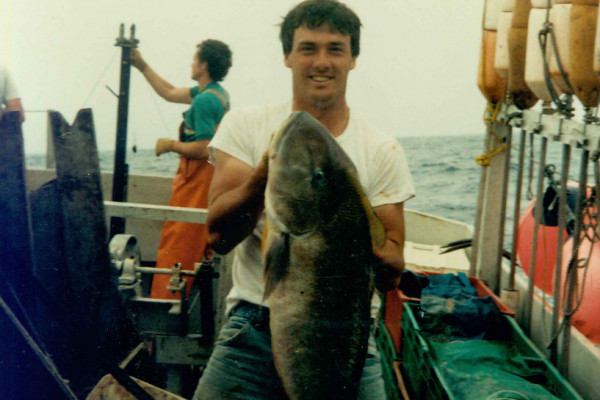
Mark Leach was one of a dozen fishermen who attended an ocean acidification workshop. Research shows that OA can affect cod.
File photo
By Doreen Leggett
After a presentation on ocean acidification, fishermen Beau Gribbin and Jesse Rose joined scientists and others at a table where a nautical chart of the ocean off the Cape was unfurled. The captains pointed to a spot near the northern part of Georges Bank.
Some scallops they had harvested from that area had the same twisted shells researchers had presented moments before, impacted by ocean acidification.
That connection was what Austin Pugh of Northeast Coastal Acidification Network (NECAN) was looking for. NECAN’s role is to synthesize and disseminate information about ocean acidification. The workshop, which brought together about a dozen fishermen this month, was meant to expand and strengthen NECAN’s efforts.
Established under the Northeastern Regional Association of Coastal Ocean Observing Systems (NERACOOS) in 2013, NECAN brings together researchers from different sectors and has sister organizations established across the United States and world. Pugh is from NERACOOS while the workshop’s other speakers, Samantha Siedlecki and Carolina Bastidas, were from the University of Connecticut and MIT Sea Grant.
NECAN researchers have been up and down the coast holding workshops with fishermen trying to match levels of ocean acidification to biological impacts.
“This is where fishermen are key. What you do day in and day out is biological monitoring,” Pugh said.
Ocean acidification is when the pH of seawater is lowered for an extended period time because of absorption of carbon dioxide.
The concentration of carbon dioxide in the atmosphere has been increasing since the Industrial Revolution, tracked for close to 70 years in places like Mauna Loa Observatory in Hawaii. Scientists say the ocean is 30 percent more acidic than in the 1700s.
Scientists have matched the trajectory of CO2 in air to the decline of pH in the ocean, said Siedlecki at the workshop held at UMass Dartmouth’s School of Marine Science and Technology. More CO2 dissolving in the ocean means more carbonic acid, detrimental to multiple marine organisms, including scallops.
“They need calcium carbonate in the water to make those shells,” said Siedlecki.
Shellfish at a hatchery in the Pacific Northwest in 2007 were among the first to sound the alarm. Researchers discovered acidic ocean water drawn into the hatchery was too corrosive for oyster larvae to form shells.
Since then, a lot of research has occurred in controlled settings and mostly on surface waters.
“What happens in the lab can be very different from what happens in the water. You can help groundtruth it,” Pugh told fishermen. “You guys are changing the game when it comes to subsurface data.”
Fishermen are already aware of the effects, but much remains unclear.
There are areas south of the Cape, such as the New York Bight, where scallops have weak shells and poor meat quality. That information, and images scientists at the event shared, prompted concern about mass die-offs during larval stages.
A large scallop mortality event caused by high temperatures in the Mid-Atlantic between 2022 and 2023 dropped the biomass and abundance of scallops from approximately 680 million in 2022 to 160 million in 2023.
“Changes in the mid-Atlantic worry scientists and fishermen because of what could happen off our coast,” said Aubrey Church, policy director at Fishermen’s Alliance. “Scallops are still growing but at a slower rate, which could have serious downstream effects when it comes to how many scallops fishermen can harvest.
“I think there are a lot of questions on whether this is ocean acidification, or warming, or both?,” Church added. “Scientists say the time to reach harvest size, maximum shell height and mortality are sensitive to both these stressors and the effects are cumulative.”
Gathering more information and making it available to fisheries managers is a goal.
“Once we confidently understand these correlations, it can help managers make better decisions. For instance, if we observe environmental variables present that make scallop growth unlikely or very poor, there is no point in closing the area hoping they grow up. Fishermen could just harvest them at a smaller size before the mortality event and cut their losses,” said Mel Sanderson, chief operating officer at Fishermen’s Alliance.
Information about the shifting Labrador current was also of interest to fisherman at the meeting. The Gulf of Maine has been warming steadily, but in recent years the warming has slowed because of a stronger presence of the cold Labrador current.
That was good news because warming waters have negative effects on everything from cod to lobster. But initial research is showing that the cold water is strengthening acidification.
“Think of it this way,” said Carolina Bastidas. “A cold soda holds more bubbles than a warm one.” CO2 is a gas, so cold water holds more CO2, which increases acidification.
Bastidas walked the group through the effects of ocean acidification on several different species. Jonah Crab digestion slows down in more acidic conditions (at a pH of 6 or 7, the ocean is typically 8) and lobsters may forage less effectively. Lobster larvae also were thought to be negatively affected, and researchers are looking at whether lobsters’ shells will take longer to harden, similar to Dungeness Crab.
Surf clams had less reproductive success and summer flounder is particularly susceptible to OA, even its cranio-facial features were affected. One species that appeared to do swimmingly with high acidification was black sea bass.
Mark Leach, who has been fishing and lobstering for close to 40 years, said he had heard acidity negatively affects cod, but it was premature to draw many conclusions.
“It looks like you need a lot more data,” he said.
Fishermen are already involved in collecting oceanographic data through eMOLT – the environmental sensors on lobster traps and large trawlers program. They are poised to collect more.
“The workshop planted the seeds for future research and monitoring collaborations,” said Sanderson, who collaborates with the eMOLT program for the Fishermen’s Alliance. “As a result, we are hoping to refine our eMOLT sensors to better provide data that will be useful to track acidification.”