
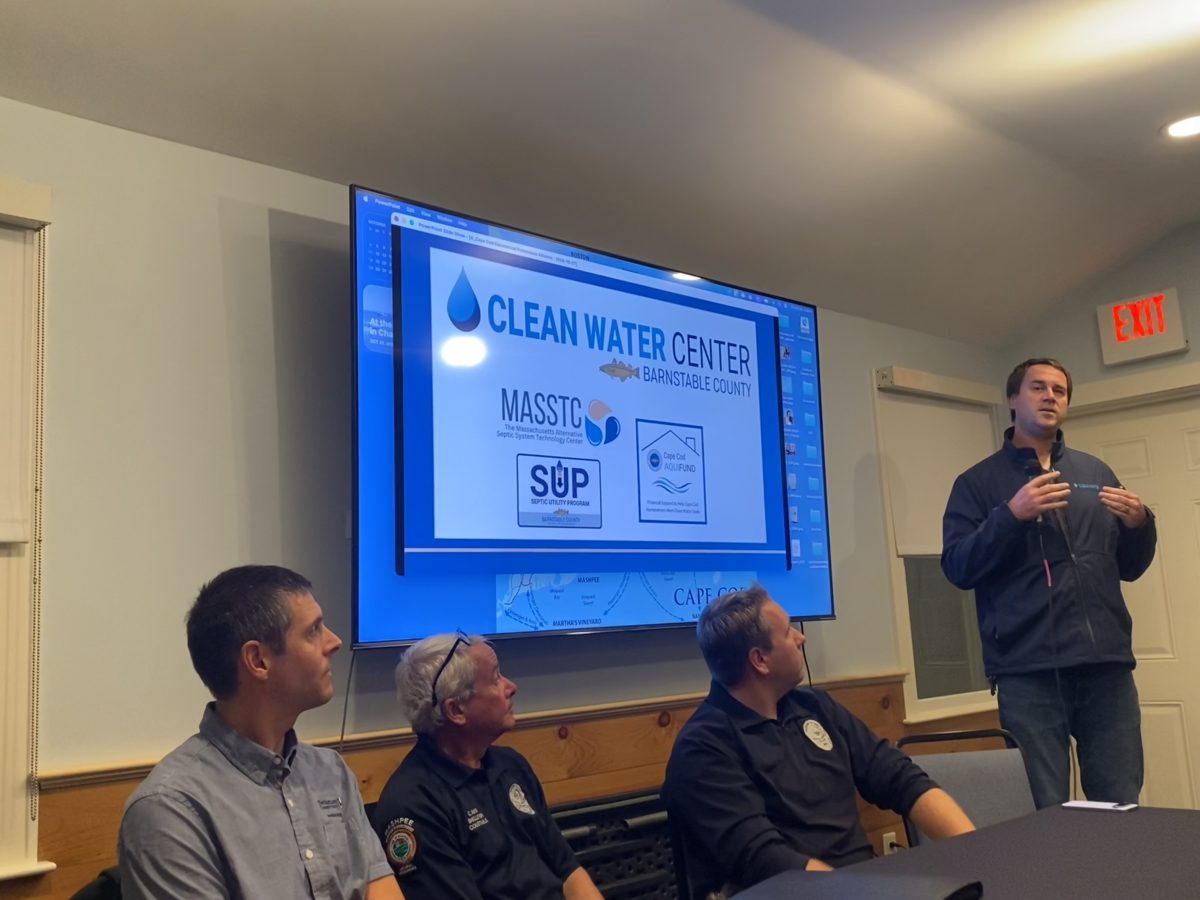
Brian Baumgaertel, MASSTC Director, speaks at the October Small Boats.Big Science event.
By Doreen Leggett
As environmental reporter for CAI, Cape and Islands National Public Radio, Amy Kolb Noyes learns about a lot of topics. Recently they have run the gamut from oyster reefs to ‘pee-cycling,’ innovative septic systems to the possibility of sewering Wellfleet.
There’s a theme:
“They are all efforts to reduce nitrogen pollution in our bays and estuaries,” she said.
Kolb Noyes was moderator at the October “Small Boats. Big Science.” event at the Fishermen’s Alliance where these issues, plus nitrogen’s impact on fisheries and the benefits of regenerative fertilizers, were front and center.
“From Flush to Filter: Removing Nitrogen from Cape Cod’s Bays and Estuaries” featured Bill Amaru, commercial fisherman; Steve Kirk, Nature Conservancy MA Coastal Program Director; Brian Baumgaertel, Massachusetts Alternative Septic System Technology Center Director; Keith Wilda, ARC Hatchery; and Chris Avis and Tyler Grady of Mashpee’s Natural Resources Department.
All said there is no one answer to solving the problem of too much nitrogen in our waters which degrades water quality, leading to massive algae blooms, suffocating shellfish, and the disappearance of eel grass and finfish.
“Oysters (alone) are not the silver bullet that will solve the problem, there is a place for all these activities,” said Kirk.
“We need all of these solutions to be engaged,” agreed Baumgaertel.
Baumgaertel showed images of Cape towns in 1952 and in 2025. Swaths of woods and open space have been replaced by homes.
“All these houses have toilets in them, and people flush them every day,” he said to a crowd that filled the barn at the Fishermen’s Alliance.
Baumgaertal added that as years go by the nitrogen problem has gotten considerably worse. Amaru has seen this firsthand.
A commercial fisherman out of Orleans and Chatham for 50 years who grew up summers on the Cape, he remembers a very different place.
“Nauset Estuary is a large estuary that supported finfish and shellfish for many centuries until fairly recently,” said Amaru. “That’s where I live.”
Bay scallops, blue mussels, and flounder were so common that no one thought they’d be gone one day.
“We had eelgrass that would choke an outboard motor,” he said to murmurs of agreement.
The healthy inshore fisheries meant everyone was connected to the water. Those days are gone, he said.
Amaru said he doesn’t think the Cape can go back in time but that improving coastal waters is possible and necessary.
Kirk said 75 percent of all commercially caught fish and shellfish in the United States spend at least part of their lives in estuaries and that “we are really working toward a world where people and nature can thrive.”
One project The Nature Conservancy is involved in, with Mashpee as a partner, is construction of an oyster reef in Hamblin Pond.
Avis, Mashpee’s shellfish constable, said 135 cubic yards of sea clam shell trucked in by two 18-wheel dump trucks was placed on the pond’s floor to create a foundation for a new reef. Then hundreds of thousands of adult and juvenile oysters were put down. Earlier this year another 10,000 live oysters were placed on the reef to help make it self-sustaining.
Grady, Mashpee’s natural resources officer, said the town is expanding its shellfish program and planting more quahogs as well. The goal “is sustainable fisheries and sustainable habitat.”
Oyster reefs provide habitat, enhance coastal resilience and support wild fisheries and aquaculture.
Kirk said shellfish reefs have similar benefits to coral reefs. Oysters, once abundant in Massachusetts waters, have been functionally extinct for decades. The Nature Conservancy’s work with Mashpee is part of a broader TNC initiative to restore oyster habitats.
These projects “have global implications,” he added.
Mashpee began looking at shellfish to remove nitrogen (a single oyster filters 30 to 50 gallons a day) when the enormity of their sewer bill became clear.
“It is just incomprehensible to come up with $20 million,” Avis said.
Baumgaertal said the cost of sewering the entire Cape continues to escalate – from $5 billion in 2015 to $10 or $15 billion now.
That is one reason why many are looking at innovative and alternative septic systems to reduce costs.
Baumgaertal said his technology center, part of Barnstable County Department of Health and Environment, tests and evaluates emerging treatment technologies, including permeable reactive barriers and urine diverting toilets.
“We function as a little incubator,” he said.
As towns work to solve a serious problem that is bad for the economy and environment, officials often focus on sewers. Panelists said citizens need to advocate for a combination of alternatives.
While looking at long timelines, there are more immediate steps. Alternative “old-school” fertilizers is one.
“We called it farming. We didn’t call it organic or regenerative,” said Wilda, who grew up on a farm in Hadley, Massachusetts.
Along with running A.R.C. Hatchery and his own oyster farm, Wilda has been in business creating alternative fertilizers.
“I’ve done this with kelp. I’ve done this with fish waste,” he said.
Unlike synthetic fertilizers which use nitrogen and phosphorous for quick fixes, regenerative fertilizers foster living biology to restore soil health.
The good problem is when they work he loses customers; he isn’t needed anymore.
Several audience members seemed energized about what they could do: buy local oysters from markets, get a shellfish permit and dig oysters and quahogs, embrace a Cape Cod lawn, get educated, educate others, go to town meetings and run for town boards.
“We have to have a lifestyle that is more in keeping with this fragile and priceless peninsula we are living on,” Amaru said.