
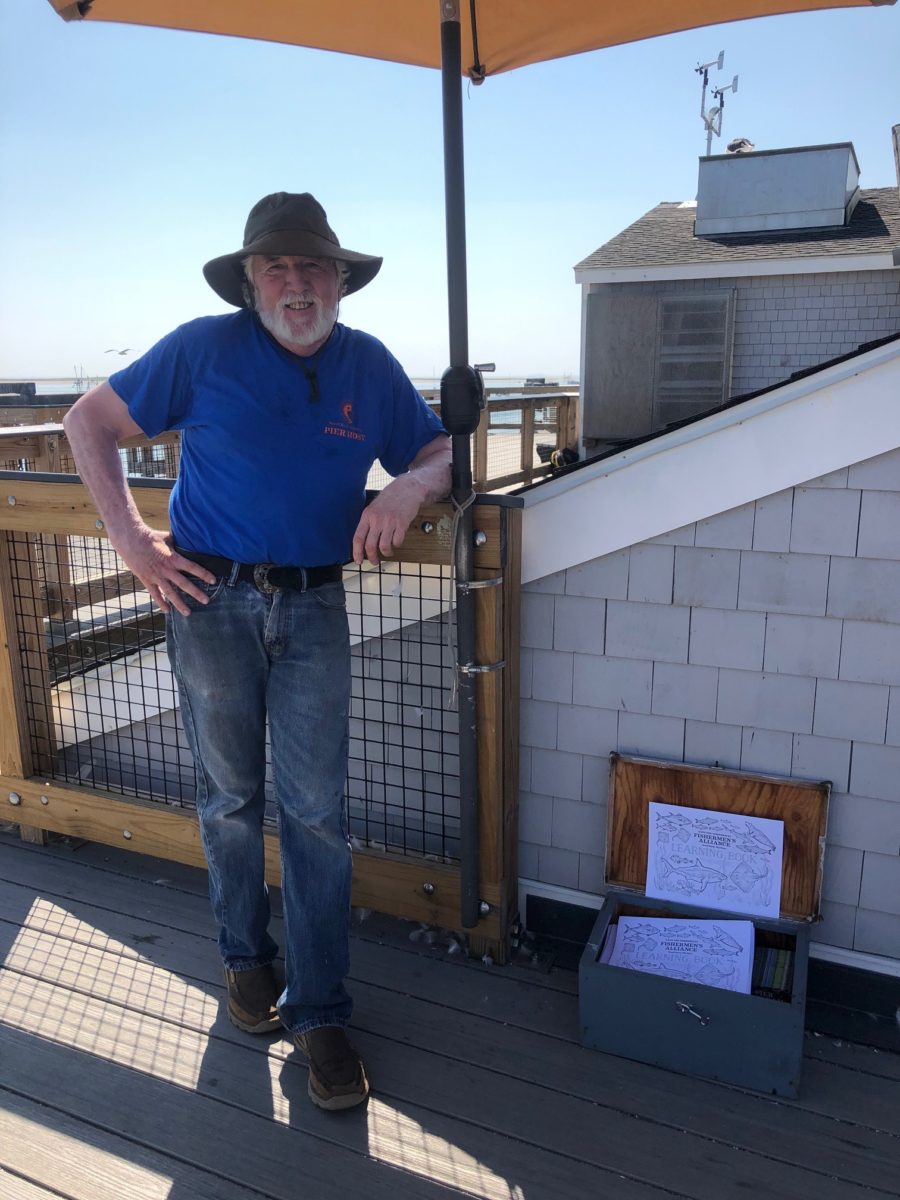
By Doreen Leggett
“Did you ever really love something? We had a community. We got what it was that fascinated us.”
Mike Anderson is talking about commercial fishing during a certain time and place with certain people.
He describes his heydays, the late 1960s through the late 1980s – although he fished for decades after and still quahogs – as “idyllic, Hemingway-esque.”
Anderson arrived on the Cape in the mid-60s, on a quest for striped bass. Pleasant Bay was the mecca.
“You have to understand, my best bass at Plum Island was 14 pounds. The first cast (in Chatham) that I made was 17 pounds.”
Anderson had graduated from college with a degree in English, student taught for “10 minutes” and took some truck driving jobs but had no real commitments.
“I was this wild-assed hippie; no one expected that much from me,” he said with a chuckle. “I had no idea in the world what I wanted to be. I never chose to be a fisherman.”
He knew what he didn’t want, and that was to conform. His father was a chemist and wore a suit all his life and Anderson didn’t envision that.
“I always wanted life to be an adventure and the North Atlantic is a giant adventure. That is just the truth,” he said.
Newly married, he was renting a place in Orleans and fishing, but then winter came. He heard about long-raking for quahogs from guys he had been hanging out with at the Land Ho!, the Orleans watering hole. He thought he’d give it a try and set out in a plywood skiff with a 20-foot wooden pole that had a rake at the end.
“I was inept,” he said. “And I was highly rejected by the quahog fleet because I had long hair and was from out of town.”
Old-timers weren’t giving him tips so one morning at 2 a.m. he just climbed on one of their boats and took a good look. From then on, he was pretty good at it.
“I got into the club,” he said.
Skilled fishermen, Al Raymond and Tiggie Paluso among them, took Anderson under their wings and he began cod fishing out of Chatham Fish Pier.
He jumped from boat to boat but had a big problem every time he went to sea.
“I was seasick for 17 days in a row,” he said.
Anderson told his then wife he was getting out of the industry and they were moving to Vermont.
Then, despite all that, “inexplicably,” he bought a boat.
He was never seasick again. Maybe it was the added responsibility, he still isn’t sure, but he was thankful.
The hook fleet was big then, close to 100 boats. And there were a lot of fish around.
Back then they baited hooks, typically with herring, and laid them out 200 to a tub (which is why it was also called tub trawling). Hooks played on long lines, six feet or so apart. Anderson said that on his very first trip – with Richie Eldredge on F/V Christian – he ended up with 88 125-pound boxes.
The price was low though, particularly in summer. Winter they could make a little money.
“When we’d catch 2,000 pounds and couldn’t make a 100 bucks we would long rake,” he said. “No one counted on finfishing to be the sole provider.”
Fishing touched every part of the town.
“It was a community that understood where its bread was buttered,” he said.
When Anderson went to get groceries after work, or the Squire, he would apologize for smelling fishy. “The girls at the A&P would say, ‘It smells like money!’”
What he remembers most is the camaraderie and how fun and interesting life was.
“The bar rooms were full of the coolest, craziest people you ever saw. They couldn’t exist in society,” Anderson said. “It was an unbelievable life. We were free.”
The fisheries began to change in the late 1980s. Longlining was difficult work and more fishermen had started gillnetting, where they could leave their gear overnight and return the next day.
“Longlining was tedious, you would fix the gear …. everything breaks endlessly … and bait in the morning. Not everybody was cut out to do this,” he said.
Between the gillnetters fishing where some hook fishermen had traditionally fished, as well as large draggers from off Cape tearing up the bottom, Anderson and others began to see less and less fish.
“There started to be blank spots and the fish that used to come across the shoals wouldn’t come anymore,” he said, explaining the sea bottom is as varied as the land, with mountains, hills, valleys and grasslands.
Anderson said he and others who helped start the Cape Cod Commercial Hook Fishermen’s Association – now the Fishermen’s Alliance – could see the writing on the wall. Others couldn’t.
“I knew the world was finite, but there was a position here that there were so many fish it was foolish to think they would disappear,” Anderson said.
Groundfishing and quahogging aren’t the only fisheries Anderson has experience with. He has been dogfishing and has done a fair amount of halibut fishing over the years.
“The first time I ever went (for halibut) I caught three,” he said.
Some of his most memorable moments have been tuna fishing. Renee Gagne, now the shellfish constable in Chatham, was crewing for him once and went overboard after gaffing a tuna. She landed on top of the tuna and he had to yank her back aboard by her belt loop.
He heard people nearby on the radio talking about how they had just seen the “craziest” thing. (Anderson added, with a chuckle, that Gagne remembers the story a bit differently than he does.)
“These tuna were enormous, all 800 pounds,” he said.
He still goes long raking, but stopped groundfishing when he was 73. He remembers being out one night all alone on the Eastern Edge, when in the past he’d be surrounded by boats.
“In truth it hurts me in the soul that what I saw and what I lived was gone,” Anderson said.
Mike Anderson is a pier host at the Chatham Fish Pier. If you want to hear more of his great stories and perspective, stop by weekends through Labor Day. See the schedule here.