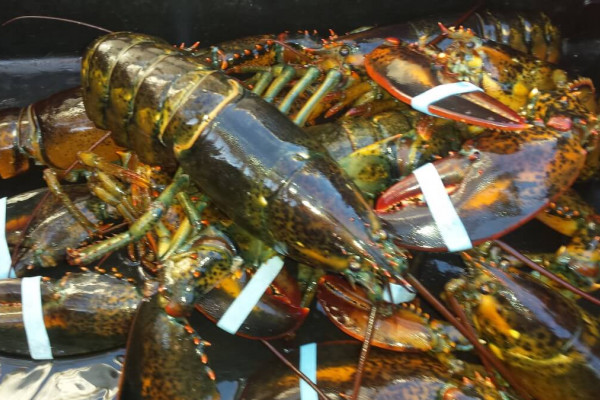
Jon Grabowski played a video of a cute baby lobster in a tank, scuttling out of his rocky hideaway only to be quickly eaten by a blue crab with a black sea bass looking on.
The stuff of nightmares, joked Grabowski, professor and assistant director at Northeastern University’s Marine Science Center. Grabowski, along with several other researchers, was speaking as part of the National Sea Grant American Lobster Initiative, meant to address critical knowledge gaps about lobster in a changing ocean.
The initiative was launched in 2019 and focuses on increasing the industry’s resilience to biological, economic, and social impacts of ecosystem change.
Plumbing the Depths
Low carbon fishing fleet fellowship begins
Captain Dean Karoblis has a close relationship with the John Deere engine that powers his fishing vessel Molly May. He trusts it; as with all fishermen that’s crucial, for lobstermen perhaps even more so.
“Everything I fish is right whale critical habitat,” he said, adding the season is so short, missed days are disastrous. “If any lobsterman is down and out when it’s on, you’re screwed.”
Still, he is willing to experiment with something new.
Ways to the water in peril
Known as much for its shifting sands as 66 miles of coastline, Chatham relies on dredging and town officials believed they had permits in hand to do the required work.
“We thought we were approaching the finish line, but we were not,” said Greg Berman, Chatham’s director of natural resources. “We are hitting our heads against the wall.”
Communication delays with regulatory agencies meant they discovered last-minute they weren’t going to get a comprehensive dredging permit. The town barely had time to re-direct essential projects out of the larger permit application.
The secrets scallops keep
By Doreen Leggett For about a year, Captain Glen LeGeyt carved out half an hour, twice a month, to step inside the shucking house of his vessel the Tricia Lynn and write down precise measurements, as well as take multiple pictures, of a dozen or so scallops his crew...
Stem to Stern: A dive into local fisheries
Fishermen’s Alliance Policy Director Aubrey Church, Shelley Edmundson, Executive Director of the Martha’s Vineyard Fishermen’s Preservation Trust, and Joshua Reitsma from WHOI Sea Grant Program and Cape Cod Cooperative Extension, joined Mindy Todd from National Public Radio WCAI’s public affairs show “The Point” to explore fishing and aquaculture. It was a great conversation, ranging from federal cuts to how fishing permits work. Below is an edited version.
Mindy Todd: Commercial fishing has been part of the cultural and economic fabric of this region for generations. Fishing has always been hard work, but changes to the climate, water quality, fish stocks and restrictions on where, when and how fin and shellfish are caught have made the profession even more challenging.
What are the major fishing ports on Cape and how has that changed?
Fishermen experiment for industry benefit
By Doreen Leggett
Captain Mark Leach has been fishing for close to 40 years and has many opportunities to try different baits, when it comes to lobster they often don’t work.
He and his son Sean, now a captain himself, recently had the opportunity to experiment again, this time with Asian carp.
“More options are better than no options,” said Sean. “No one has actually cracked the code on this, but we’ll see.”
Working Waterfronts front and center in San Diego
During an unseasonably cold February week in San Diego, California, hundreds of people from across the country gathered to explore how to protect one of the country’s greatest assets – working waterfronts — and talk about success stories like these:
The 100 percent Great Lakes Initiative aims to demonstrate how 100 percent of commercially-caught fish from the Great Lakes can be used for different purposes beyond just food. Fancy a whitefish skin wallet? Collagen-serum moisturizer?
With waterfront property a red-hot commodity, Maine legislators passed a bill that allows owners who protect commercial fishing wharves and other working waterfronts up to 40 percent off their tax bill.
Fishermen in Kodiak, Alaska were getting crushed by the low price of fish and high cost of fuel, so they made investments and now 99.9 percent of their electricity is renewable.
WaterWORKS highlights jobs in blue economy
Fisherman Will Nicolai, a tall, long-haired, easygoing 21-year-old, has two older siblings engaged in high finance, but the Sturgis West graduate tried college (two colleges) and decided that wasn’t for him.
Captain Eric Hesse has a degree in physics and a graduate degree in civil engineering, but the lure of harpooning bluefin tuna and longlining for groundfish was too strong.
Jake Angelo of Barnstable Seafood Company went to Massachusetts Maritime Academy, toyed with being a private yacht captain, but found his dream job on the water fishing for black sea bass and clams.
There is no one way to get into commercial fishing and opportunities abound if you know how to work hard, the trio told dozens who stopped in at the Cape Cod Commercial Fishermen’s Alliance table at WaterWORKS at Cape Cod Community College.
Two million dollar grant to help research, commercial fishermen
On an unseasonably warm fall day, fisherman Denny Colbert stood with researcher George Maynard looking at an image on his phone showing warm water punching into two spots along the edge of the Outer Continental Shelf.
Colbert, who owns three fishing boats, has seen “warm core rings” that spin off from the Gulf Stream yank his lobster and crab gear around, ruining what would have been profitable fishing trips.
Categories
e-Magazine PDF’s