
By Doreen Leggett
Family lore has it that when Clint Austin was a baby his mom, Barbara, would drag him around in a fish tote when she harvested shellfish; his first memory, when he was around four, is watching his mom shuck hundreds of oysters.
Other childhood memories: On his mom’s grant watching sunset and playing with crabs, getting his junior shellfish license at 13, harvesting in the wild fishery and on farms. Austin likely spent more time on the flats in Wellfleet than anywhere else; when he graduated from Nauset Regional High School he headed to Westfield State to pursue an environmental major.
He wasn’t gone long.
“After a couple of years away from the Cape, away from the water, I wanted to come back,” Austin said.
He started working on his mom’s grant on Indian Neck when he returned home in 2004. He also partnered in a wholesale shellfish company, delivered some of his mom’s product to restaurants, and started a raw bar company called Pirate Shellfish, homage to famous Sam Bellamy of the Whydah.
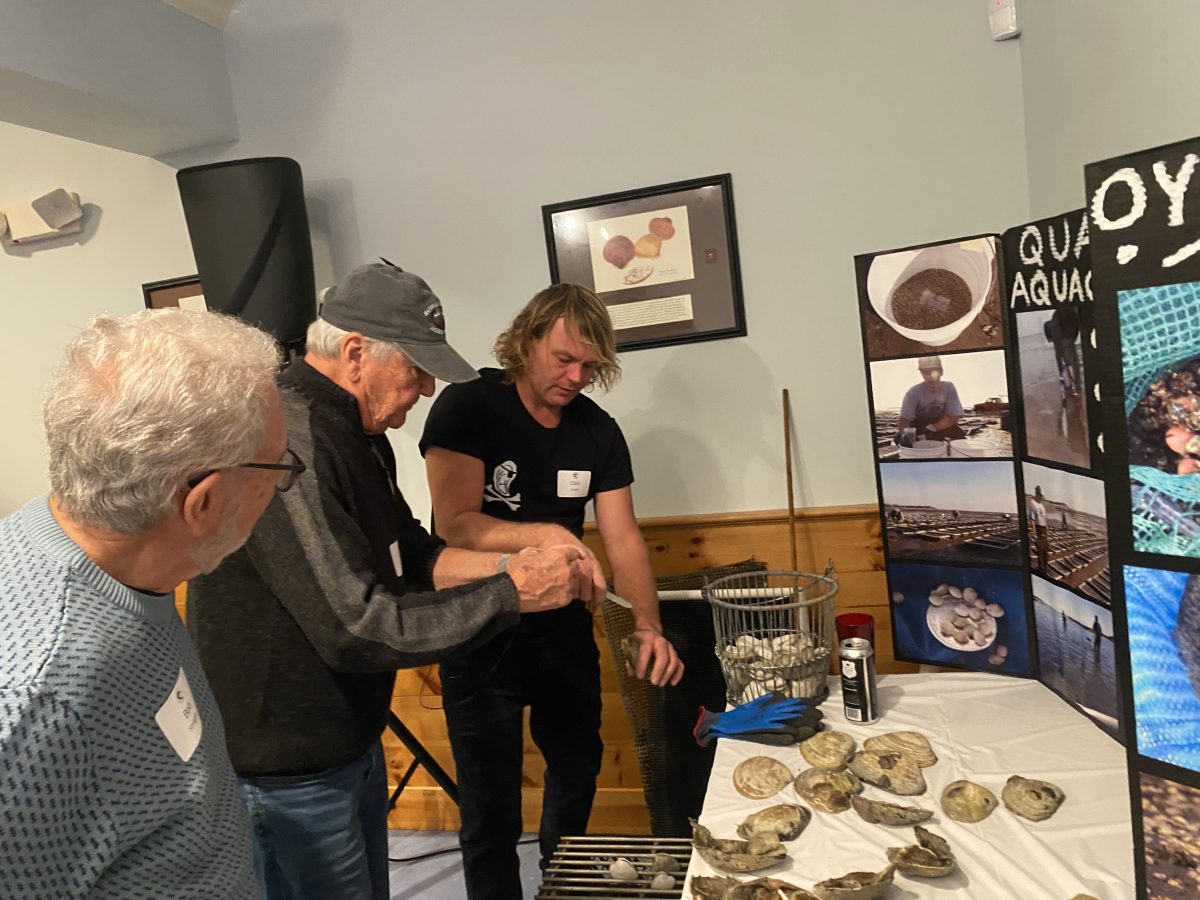
Austin, in black jeans and a black Pirate Shellfish t-shirt, with his 10-year-old son Asher in sweatpants with a skull-and-crossbones logo, shared stories and the trajectory of his business with a rapt crowd gathered at the Fishermen’s Alliance’s last Meet the Fleet of the Year.
“I don’t know how you top yourself every month,” longtime attendee Victoria Chane told Fishermen’s Alliance staff with a smile.
Austin had props galore, including bags, a bullrake, and hundreds of oysters of various sizes. Although the audience loved seeing oysters and clams up close, and marveled over stories of amorphous baby oysters settling on their older brethren, a different oyster stole their heart:
Oysters with pickled onion mignonette, enjoyed at the close of the evening. The recipe was courtesy of Chef Garrett Smythe of The Wicked Oyster, who came to Wellfleet a more circuitous way than Austin.
Smythe said his life path changed when he graduated from college in Virginia with a degree in archaeology that he wasn’t keen on using. Smythe had met a guy who lived in Wellfleet whose mom supposedly needed help with her landscaping business. But when he arrived it turned out she didn’t need help at all, he said to chuckles.
Shortly after he got the bad news, the duo was eating lunch at The Wicked Oyster and he snagged a job there.
“21 years later I own it,” he said.
Smythe didn’t stay all that time, he left after a year and a half and spent close to two decades at a double Michelin-starred restaurant in San Francisco, in Boston and New York.
Working at the New Deal Fish Market in Boston turned him on to the value and importance of serving local fish. That lesson stayed with him and guides how he sets up the menu at The Wicked Oyster.
“I was introduced to whiting and scup … I had no idea,” Smyth said. “It was on none of the menus and that seemed wrong.”
Back on the Cape, worked on his father-in-law’s grant (Smythe is married to Chelsea Rose), and after working at Sunbird in Orleans and The Pheasant in Dennis he wanted more freedom. He partnered with Alex Hay and Sebastien Taffara to buy The Wicked Oyster in 2024.
The menu offers everything from skate to monkfish to scup, and “bluefish without Ritz crackers.”
“The customer has to meet us halfway,” Smythe said. “You have to be adventurous enough to try it.”
Mel Sanderson, chief operating officer at the Fishermen’s Alliance and emcee for the evening, said Smythe was preaching to the choir: The Meet the Fleet audience always asks where they can get local fish.
Sanderson and Smythe spoke about the ecological benefits of oysters (one adult oyster can filter 50 gallons a day) and how to store them in the fridge (a colander with ice on top of an empty bowl, making sure to regularly dump out the water).
Smythe demonstrated how to shuck an oyster although he was nervous about it, considering Austin is a pro and it was Austin’s “pet” oyster. So he didn’t actually cut in.
“You have to shuck a few thousand oysters before you know what you are doing,” Austin said. Sanderson said you could also put them in the oven and they pop open, no shucking involved.
The pet oyster, which was a couple of pounds and 12 years old, was among the myriad shellfish Austin brought to the event.
Austin’s mom, who he described as “kind of the wild woman of the flats,” got one of the first farms on Field Point when the town expanded its aquaculture program in the late 1980s. Barbara, nee Sandblom, a native of Eastham, had fallen in love with shellfishing when she went with her father. Later, she and Austin’s dad had a sea clam boat, F/V Hizzoner. She worked the wild fishery and shucked clams at a small processing plant with other local women, so the farm was a natural progression.
Clint struck out on his own in 2008 when the town again expanded opportunities. His grant by Blackfish Creek is a little more sheltered from wave action than other spots in town, out of the water at low tide.
“People have told me my oysters have a sweeter flavor,” he said.
He also expanded on a practice started by Elton Atwood in the 1960s. Back then ARC, Aquacultural Research Corporation, was in its infancy and not supplying seed that most farmers rely on today.
Atwood started an oyster reef made of shells so wild spat – free floating babies – would have someplace to land, and grow.
“Back then they really had to figure it out,” Austin said, explaining the learning curve extended through the 1980s and 90s, including a lot of welding and cutting rebar to make gear.
“Now every farm has thousands of grow bags. Back then there were just a handful of people who were trying to grow on a serious scale.”
Austin started his oyster reef with sea clam shells he has brought in month after month after month.
Austin held up several hand-sized sea clams with oysters on them, from very small to full-sized. His reef is now an acre and a half and Austin harvests from that as well as his bag and rack system.
“I can go up to the farm and harvest a couple thousand a day,” he said.
Those oysters are shipped to spots across the country, but happily for audience members, and people across the Cape they are also available locally — oysters from several farms are on the menu at The Wicked Oyster.