
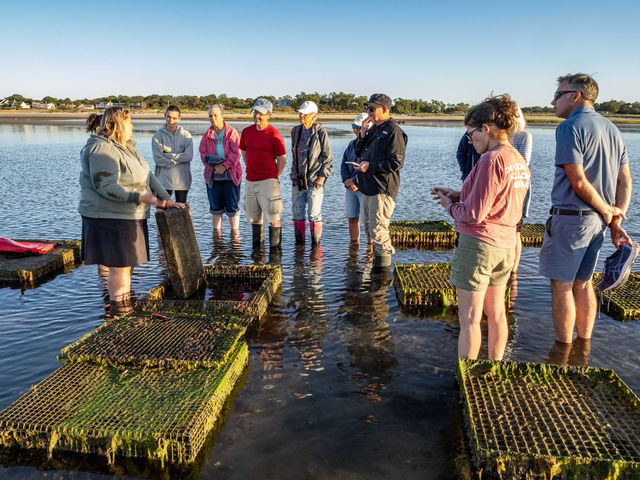
A Harwich Conservation Trust sponsored tour was held at Emily Lindblad’s farm in Brewster earlier this fall in collaboration with the Brewster Conservation Trust (BCT). Photos by Gerry Beetham.
By Eric Williams
Most farmers don’t have to worry about the tides. The carrots and tomatoes tend to mind their own business on solid ground, always available for a look-see.
But if you wrangle oysters for a living, the ever-changing moods of the ocean are front and center. Low tide is your time to work. You’ve got to make those precious hours count. Sure, the oysters aren’t going to run away, but they need love and attention along the lengthy journey to market size.
This was just one takeaway from an action-packed Harwich Conservation Trust (HCT) Oyster Farm Tour, a splendid outing on a beautiful evening, with the tide rolling out and the sun sweetly sinking into Cape Cod Bay.
A cheerful and curious band of attendees met oyster farmer Emily Lindblad, the namesake of Emily’s Shellfish Company, and Lisa Bourassa, Hatchery Manager at Aquacultural Research Corporation (ARC). The dynamic bivalve duo shucked open a cornucopia of cool oyster facts and provided intriguing insight on what it’s like to farm shellfish.
The HCT-sponsored oyster odyssey was held at Mant’s Landing in Brewster in collaboration with the Brewster Conservation Trust (BCT). The flats off the lovely beach are home to Lindblad’s oyster grant, which she works with her father, Charlie Sumner, HCT’s Director of Operations. Charlie also happens to volunteer as President of the BCT Board of Trustees.
‘It helps keep families on-Cape’
Aquaculture plays an important role in the Cape’s economy, and along with oyster farm tours, HCT also offers Preschool Explorer visits to the Harwich Shellfish Lab led by naturalist Andrea Higgins.
Lindblad works full time for the Town of Brewster’s Department of Public Works, so oystering is a way to augment her income. “I think it’s a great way for people to make a little bit of money, or a lot of money, depending on the size of the operation,” she said. “It helps keep people on-Cape. It helps keep families on-Cape.”
Her farm consists of 250 cages, which sit slightly above the surface of the flats, allowing seawater to freely circulate and provide nutrients to the oysters. The animals are filter feeders, which helps clean the water, reducing nitrogen levels. And the cages may be helping with shoreline erosion by tempering the wave action into the beach.
Inside the cages, oysters of various sizes are working their way to a length of three inches, when they can be brought to market. “It takes about two to three years for an oyster to get to market size,” said Lindblad.
Where baby oysters come from
Lindblad buys tiny baby oysters, known as “seed,” from ARC, a Dennis-based company located near Chapin Beach. “When we get it, it’s about the size of your fingernail,” she said.
ARC Hatchery Manager Lisa Bourassa described how her company produces the seed. “We have the ability to pump in natural seawater that we filter and heat year-round,” she said. “Someone is there 24 hours a day, every day of the year to make sure that the operation is running smoothly.”
Bourassa said the goal was to create “spa-like” conditions to produce oyster babies, with the perfect amount of food and perfect water chemistry. “We bring in the moms and dads two months before we plan to spawn them,” she said. “We’ll condition them, so that they’re naturally ready to produce their eggs and sperm so they can start to fertilize.”
Lindblad opened up one of her cages and we all got a good look at shelled treasure of various sizes. Lindblad also showed us a special cage, home to incredibly giant oysters, perhaps eight years old. “My dad has a science experiment going on,” said Lindblad. “How big can he get an oyster to grow?”
Hard work in rough weather
Much of the work on the grant is centered on sorting and sizing the oysters. Market-sized shellfish are counted into bags and readied for transport.
We also learned that the oysters spend part of the winter onshore. “If the ice sets in the bay, it will destroy your cages,” said Lindblad. “It will take everything and you won’t have any oysters.”
Lindblad’s cages come ashore around the end of December. It’s a significant effort, and she and her dad are helped by family and friends who are rewarded with chili and beer. The oysters spend the heart of winter in a shed, in cool temperatures, then return to the flats in late February or March, another big lift.
While the weather conditions for our tour were delightful, Lindblad said working on the flats in cold and windy conditions was challenging. “We’ve been out here in five inches of snow before,” she recalled.
But for Lindblad, the benefits of working out in nature, spending time with her father and adding to her income make it all worthwhile. “Working the land is fun,” she said. “And it can be so beautiful out here.”
This story originally appeared in the Harwich Conservation Trust newsletter. Williams is the director of communications. Photo of ARC’s Lisa Bourassa, HCT’s Mike Lach and Farmer Emily Lindblad by Gerry Beetham