
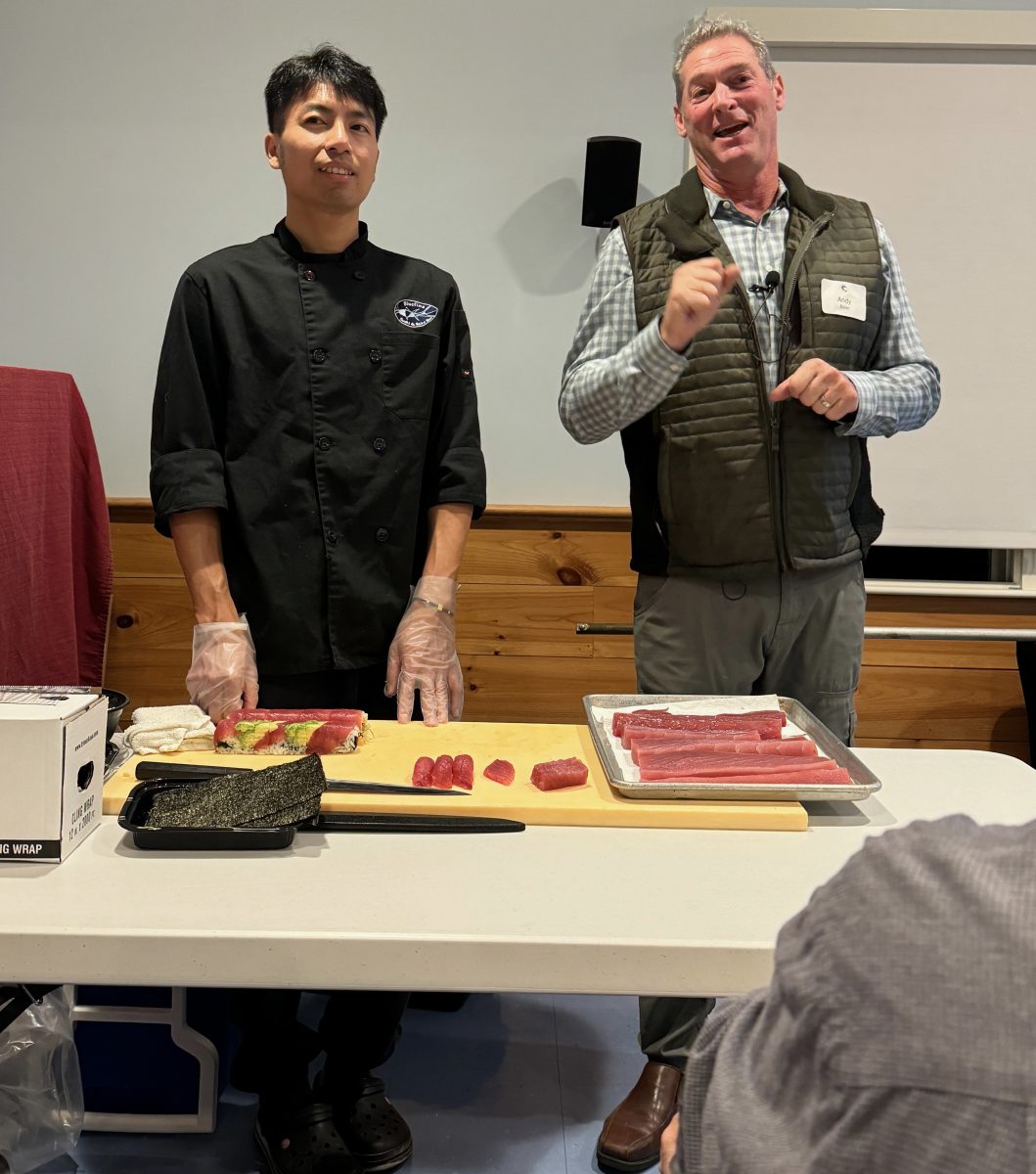
Sushi Chef Hong Chen and Andy Baler, owner of Bluefins Sushi and Sake Bar, talk to the crowd at Meet the Fleet. Photo by Cori Egan.
By Doreen Leggett
Eric Hesse majored in physics at Bates College and in addition to his normal courseload he did computations about refracting light on the ocean, and how the bending light shifts the image of Atlantic bluefin tuna.
“My old physics notebooks are filled with fishing diagrams,” Hesse, a tuna harpoon fisherman, told nearly 100 people gathered at the Fishermen’s Alliance last week for Meet the Fleet.
“I am uniquely qualified,” he said to laughter.
Hesse, also a longline fisherman, was joined by Andy Baler, owner of Bluefins Sushi and Sake Bar, to talk about the fish they love and know well. As a bonus, head sushi chef Hong Chen demonstrated how to turn a tuna loin into a scrumptious tuna roll.
Hesse, back from a long day on the water and planning for a 4 a.m. start on a research cruise, motioned to a picture of an iridescent, sleek, bullet-shaped fish.
“They can swim 60 miles an hour and grow to more than 1500 pounds,” said Hesse, who has been a harpoon tuna fishermen for close to 40 years. “They are truly a challenge to catch, and I have a lot of respect for them.”
Hesse is a lifelong Barnstable resident who fishes out of a variety of ports. When it comes to bluefin he leaves out of Chatham, rowing out in his “world’s smallest skiff” to find his boat moored somewhere in the fog and then crossing the bar to find tuna in thousands of square miles of ocean. He is one of about 35 fishermen who harpoon; the general category, mostly rod and reel, has about 100 times more Massachusetts fishermen.
His tuna fishing boat is named Mattanza, after the celebratory harvest portion of the traditional Mediterranean weir net fisheries. A good day of harpooning is a little like the Mattanza, he said.
His 30-foot vessel is a bit small for a typical tuna boat, but “it’s also a sneaky boat, in the parlance of harpooners.”
Her stealth allows her to get close to the apex predator which has made for some memorable moments.
One of those was captured in photos last year, to the delight of the crowd. Hesse said the day didn’t start well, wind created chop on the water and swells made it difficult to see tuna, but Hesse’s longtime crew, Dan Dean, saw two.
Hesse barely had to throw the harpoon to stick the tuna.
“This is by far the closest I have ever gotten to the fish,” Hesse said. “They are smart. They are really good at getting away.”
Hesse uses mountaineering sunglasses, which block peripheral vision, polarized and tinted to make the fish easier to see. He also looks for a distinctive V-shaped wake, and since he can only target fish 73 inches or more, can recognize the distinctive way the big ones swim, unlike somewhat spazzy smaller bluefin.
He was clad all in white in the pulpit, or extension, of the boat, where he walks out to throw the harpoon. This is more about human interaction, and camouflage:
If he dresses in black other potential fishermen will see him, assume he is on fish, and flock over.
“It’s a competitive fishery,” he said.
Some years a sneaky boat and all the skill in the world won’t help.
“From 2002 to 2006 the harpoon fishery just tanked,” Hesse said, “and we didn’t make a single trip in 2008.”
The data Hesse has of his revenue and number of fish caught clearly documents the change.
Before that the fish were in high demand in Japan and it wasn’t uncommon to see Japanese buyers on Cape docks buying fish.
Baler, a fish buyer at the time (still is), managed a cooperative that Hesse and 10 other fishermen started . The fishermen banded together to cut out middlemen and secure better prices.
“I ran the co-op in the late 80s and 90s, those were the heydays,” Baler said. “The fish were extremely fat and valuable.”
Countries overseas saw how much money the bluefin were worth and started catching them. Overfishing occurred and the International Commission for the Conservation of Atlantic Tuna cracked down. Baler was a member of the intergovernmental organization.
“Things turned around,” said Baler. “Domestic is sustainable now. There are a lot of fish.”
Hesse agrees, but said there are a few things, besides inflation, that are keeping his revenues at three-fourths of what they were in good years. In the 1990s fishermen were getting close to $20 a pound, now it is between $5 and $7.
Some people do not realize Atlantic bluefin tuna is harvested sustainably. They believe the population is at risk and that false narrative is pushed by some media and by the Monterey Bay Aquarium.
They have all tuna – including harpoon-caught – listed as red in the Seafood Watch report, meaning don’t buy it, which is maddening to fishermen.
The problems have prompted Massachusetts and Rhode Island to band together to try and increase demand and get the true story of sustainable tuna, and the industry it supports, out to the public.
An added complication is that farmed raised tuna overseas in pens, artificially fed, has a higher fat content than the majestic, speedy fish Hesse and others chase.
Baler, who sits on the Fishermen’s Alliance’s board of directors with Hesse, said the non-profit has tried to improve the situation by adding protections on herring, which adult tuna love and midwater trawlers have been scooping up enmasse.
One result of multiple issues is that the number of tuna exported has dropped from close to 80 percent to less than 20.
“That is not a nice trajectory for this fishery,” Hesse said. “The U.S. fish export market has been dying.”
Harpoon tuna is higher quality and more sought after.
Once the harpoon hits the animal, the crew will hit a button that sends electricity through a wire to stun the fish. This shortens the fight, which protects the meat and reduces lactic acid buildup; it is also more humane.
Since the harpoon fishery is much smaller than general category, and highly weather dependent, they can land more fish at a time. They also have a much smaller quota at 60 tons a year versus 700 to 900 for general category.
Since the U.S. fishery is closed in November (it should open back up again for awhile in December and close again until June), Baler had to procure a Canadian tuna for Chef Hong Chen’s sushi rolls. While Chen worked, Baler described the various cuts and types of sushi (otoro is the fatty belly for example) and answered questions.
In the summer, Bluefins in Chatham can go through more than 600 pounds of tuna in a week. In winter, Baler says he can split a 300-pound tuna between the original Bluefins in Chatham, which opened 11 years ago, and the newer restaurant in Falmouth.
Audience members were quick to grab samples of spicy tuna and cucumber, topped with mango and tuna sashimi, on their way out and Baler said he was looking into having a tuna cutting demonstration at the restaurant this winter.
Both Hesse and Baler stayed late to answer questions from the crowd, the biggest yet for a Meet the Fleet.
“It is really quite interesting to learn how the fishery is sustained and the passion these guys have,” said audience member Richard Foley, who was attending his first Meet the Fleet, the last one of the season.
He said he would be back for another next year.