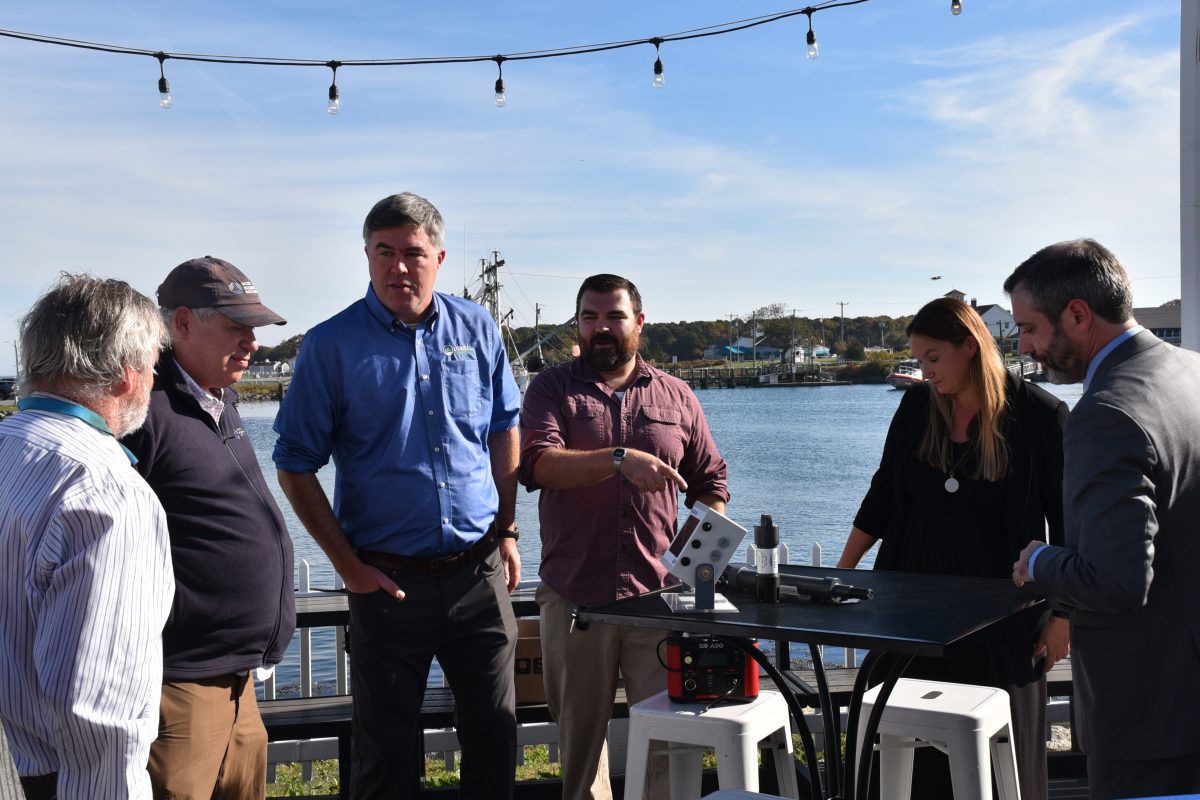
eMOLT brings together partners from research, business and advocacy. Sierra Sorrentino/MassTech photo
By Doreen Leggett
On an unseasonably warm fall day, fisherman Denny Colbert stood with researcher George Maynard looking at an image on his phone showing warm water punching into two spots along the edge of the Outer Continental Shelf.
Colbert, who owns three fishing boats, has seen “warm core rings” that spin off from the Gulf Stream yank his lobster and crab gear around, ruining what would have been profitable fishing trips.
The temperature profile Maynard and Colbert were looking at is part of a larger repository being gathered by commercial fishermen, providing clues to researchers about a rapidly changing ocean, including real-time information so fishermen can make better decisions on where to fish.
“This data is so important, and there is no other way to get it,” Maynard said.
Maynard of NOAA Fisheries and Colbert were at the Fishermen’s View restaurant in Sandwich, which Colbert owns with his brother Bob, to celebrate a major expansion of the environmental monitors on lobster traps and large trawlers (eMOLT) program: a $2 million grant to Cape Cod Commercial Fishermen’s Alliance from the Healey-Driscoll administration.
The funds, through Massachusetts Technology Collaborative’s Innovation Institute, will bring together the largest cooperative network of fishing boats and environmental sensors in the country to study changing ocean temperatures and boost the local blue tech economy.
James Byrnes, Director of Operations & Programs at the Innovation Institute, a division of the Massachusetts Technology Collaborative (MassTech), told those gathered the project will help mitigate the threat climate change poses to Massachusetts’ economy.
“Having the capability to share this data with fishermen and others in blue tech industries in near- and real-time has tremendous value. It will increase knowledge of ocean conditions that fishermen across Massachusetts can use,” Byrnes said.
Colbert has been part of the eMOLT program since 1996 when it was started by Jim Manning, of NOAA’s Northeast Fisheries Science Center and Erin Pelletier at the Gulf of Maine Lobster Foundation.
Now Maynard has taken over for the retired Manning (who was on hand for the announcement) and said there are currently 70 participating vessels between the northern reaches of Maine and Cape May, New Jersey.
“We put environmental sensors on fishing gear; each time fishermen haul back they learn information about fishing grounds,” he said.
Maynard said the multitude of snapshots of data retrieved when fishermen haul gear reveal what is happening with salinity, oxygen and temperature in different layers.
Provincetown captain Mike Rego has had sensors on his lobster gear for four years. He first got involved to help answer questions about the so-called “blob” in Cape Cod Bay, a low-oxygen warm water mass that has killed lobsters and other shellfish.
No one had a good answer as to why it was happening, Rego said, so he figured he should try and find out. Up until eight years ago, he said, he just went fishing, believing that any data he collected would be used by regulators to further hamstring his industry; now when any scientific or research project comes up he gets involved.
“I just got out of that mentality of they will use that against you,” he said. “That is not the case.
“I had a lot of questions about how big (the blob) was, if it was always there; hopefully we’ll figure out something. This is my livelihood. I love the ocean. I don’t want to be a bank teller.”
He added that this year conditions in the bay weren’t as bad, and that it may be related to winds in the spring – southerly winds don’t bode well. Rego is also able to match what he sees on the data hub in his wheelhouse, which displays information from the sensor, to the success of his trawls.
“I can tell by looking at the tracker there wouldn’t be (lobsters). There is a trawl that is just blank, nothing in that trawl and the bottom is rotten,” Rego said.
Rego wants to be proactive, make sure fishing is sustainable and continues to be an industry to be proud of like when he was growing up, learning from the old-timers.
“I have a kid. I want to show her there is a lot more to fishing; it’s a cool industry,” he said. “I can show my daughter that you can be involved and try and figure stuff out.”
With the new grant, another 150 boats with deck data hubs and 450 additional sensors will be able to collect information.
“Being able to scale up so much will really give us a much better understanding of the changes,” said Glen Gawarkiewicz, a physical oceanographer at Woods Hole Oceanographic Institution. “We are seeing temperature changes in the ocean in the order of 10 degrees Fahrenheit,” which he called “shocking.”
Gawarkiewicz added that with a rapidly changing environment we need to come up with new tools for sustainability and this data will help.
“The science community has a lot to learn from the fishing community,” he said.
One of the benefits of these sensors is they are low cost and can be placed on fishing boats most every day. As Gawarkiewicz spoke, the F/V Miss Julie, owned by Colbert, cruised into the Sandwich Basin with a catch of Jonah crabs and lobster that would be served in the restaurant. On her heels was the research ship Tioga which costs several thousand dollars to run and is not always available to collect the data F/V Miss Julie gathers for free.
Nick Lowell, of Lowell Instruments, designed the sensors and has worked with the Fishermen’s Alliance and others for close to a decade.
Lowell told the crowd he remembers Manning visiting his former boss at another company to talk about the benefits of having a low-cost monitor to gather information about the ocean. His boss didn’t see the allure, but Lowell did, so he started his own growing company.
The information also will support workforce training opportunities by enabling cadets at the Massachusetts Maritime Academy to train on the equipment. Project partners will also develop a new curriculum for Massachusetts high school students to understand how the equipment works.
This expansion of the eMOLT program will provide blue tech companies with access to affordable ocean observing technology, and data collection that will aid search-and-rescue operations, support marine transportation planning, and help study the impacts of a changing climate on commercially harvested species of fish.
Nick Rotker, Mitre Corporation’s Chief Blue tech strategist, said the Northeast is well-suited to pioneer blue-tech innovation. Last year, Mitre, opened a Blue Tech Lab in Bedford, Massachusetts, with a 620,000-gallon test tank.
“This grant strengthens the bridge between the working offshore economy and the scientific community,” Rotker said.
Massachusetts fishermen who used the first generation of these sensors report improved catch rates, an ability to better avoid spawning stocks, and proactively moving gear to avoid “dead zones” with low oxygen levels, said Melissa Sanderson, chief operating officer at the Fishermen’s Alliance.
“The need for additional observations and better forecasts is compounded by the rapidly changing climate,” said Sanderson, “which can cause massive economic impacts on commercial fisheries. For example, the value of the $200-million Alaska snow crab fishery has evaporated in recent years due to a population crash followed by regulatory shutdown. New research indicates that the population crash in the Bering Sea was caused by subsurface marine heatwaves, something that has been difficult to measure in real time.”
This project relies on a diverse, multidisciplinary network of partners that will support outreach, installation, design and manufacturing, data modeling, information sharing, workforce training and education, to benefit our local fisheries and the Massachusetts Blue Economy: Cape Cod Commercial Fishermen’s Alliance, Lowell Instruments, Northeast Fisheries Science Center, Gulf of Maine Lobster Foundation, Neil Brown Ocean Sensors Inc, Center for Coastal Studies, Coonamessett Farm Foundation, Commercial Fisheries Research Foundation, Ocean Data Network, Massachusetts Lobstermen’s Association, Massachusetts Division of Marine Fisheries, UMass Dartmouth School for Marine Science & Technology, Massachusetts Maritime Academy, MITRE, New Bedford Ocean Cluster, Woods Hole Oceanographic Institution, Rutgers, and NERACOOS.