
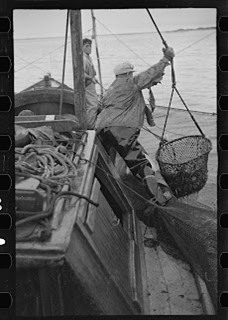
Library of Congress photo
By Doreen Leggett
Weir fishing almost disappeared on Cape Cod. For those who may not understand how surreal that is we compiled excerpts from a random sample of newspaper articles and other accounts about the historic practice. The items show how important the industry was, with ups and downs. Although these historical gems are focused on the Outer Cape, trap fishing was a bustling industry across the peninsula.
First, our favorite recollection: “The various trap crews are hard at work and the trap sheds are busy spots. The invigorating aroma of dry kelp and tarred nets leaves a pleasant fragrance in the nostrils. The trap crews thrive on it and maybe there are many hidden vitamins in the smell because trap fishermen are for the most part big, rugged and healthy fellows.” — Jan. 24, 1946, Provincetown Advocate, Irving S. Rogers.
“Trap fishing is an ancient practice utilized by Indigenous peoples for more than 5,000 years, with early fish traps constructed from tree branches and stone. More contemporary iterations arrived to Cape Cod in the early 1800s and soon transformed the area’s commercial fishing industry. Provincetown’s first weir traps were set in the 1850s, but the 1920s and ’30s were the industry’s true heyday. During this time, Provincetown Harbor was filled with about 100 weirs. Most of them were owned by one of seven cold storage plants in town, which also owned the trap boats and employed the fishermen. The state leased each company “grants,” or specific areas of the ocean where they could set traps; this arrangement prevented feuds over prime locations. The cold storage companies divided profits 50-50 with the crew and paid the captain 2 percent of the total catch profit. However, the companies were notorious for short-changing fishermen, who had no insight into the real prices the companies received for the fish. Despite this, most trap fishermen made a reliable living. The job had other benefits, too. Because the traps were inshore, fishermen could spend their days at sea and nights at home. At its peak, the trap fishing industry yielded about 25 percent of the fresh fish available on the Northeastern seaboard. In 1935, Provincetown fishermen landed 30 million pounds of fish, with 20 million pounds being brought in by trap boats. At that time there were seven “cold storages,” as they were called, with the Cape Cod Cold Storage in the West End employing 50 to 100 workers in the cold storage itself, along with the crews operating their three trap boats. The site also had a wharf, power house, pump house, machine shop, blacksmith shop, fillet plant, freezer and cannery. But eventually, depleting fish stocks in Cape Cod Bay led to the industry’s decline. Commercial trap fishing disappeared from the area entirely in the 1970s.
– Provincetown Year Rounder, August, 2012
Captain Manuel Motta brought in 100 pounds of mackerel from his trap this morning. The bluefin catch was also very heavy with the price around 9 cents a pound. Striped bass is 15 cents a pound. A fisherman who had been near the traps told the story of how there were so many striped bass in the nets that the water was frothing; the next morning they were all gone. “Seems like this is the only kind of fish with brains enough to get out of a fish trap,” it was reported.
–Thursday, July 12, 1957, Provincetown Advocate
Using long ash and hickory poles, the trap season has begun. Captain Ernest Tasha, on the trap boat Nordic brought in eight barrels of herring yesterday and was counted as the first catch of the season. On the same day, Captain John Fields was driving poles for National Traps and the vessel Harbor Bar was launched by Wells Rego.
— Thursday, March 25, 1954, Provincetown Advocate
“We were wakened even earlier today by the hopeful rush of trap fishermen’s cars toward the Cold Storage. Fishing is still poor. Tuna are scarce, mackerel are scarce, whiting are scarce and there you are. We have mentioned before how important it is for men in this particular fishery to make hay while the summer sun is shining for the season is short and the fish must come to them rather than, as with drags and trawls and seines, the fisherfolk chasing the market. Trapnet fishing evolves with relatively little change from primitive stone and brush weirs. Netting has largely replaced brush, but essentially the design is the same. The weirs are usually set at a point of land extending into the water for some distance or in channels, between flats or shoals where the tide runs strong, to take advantage of the tendency of fish to run in strong current. The main body of the trap is a circular or heart-shaped enclosure made up of long heavy posts driven into the bottom and then hung with netting. A single line, or “lead”, is driven from shorewards to the mouth of the trap to aid in the deflecting fish into the heart of the trap. Leaders can be up to 800 feet in length, the heart of the netting about 72 feet across. From here fish are usually impounded into another section called the “crib” made of heavier twine and it is from here that the catch is unloaded. An attendant dory enters the heart, drops a net to prevent any fishes escaping , and then eases the haul into the heavier bag. Then it is laboriously (when the catch is good) loaded into dories and carried to the nearest market.”
— Provincetown Advocate, Aug. 21, 1952 – Dorothy Captiva in North Truro notes
Provincetown “trappers” organized to oppose harbor seining and travelled to the state house. Purse seiners from the mainland (Gloucester) were accused of chasing mackerel out into Cape Cod Bay and ruining trap gear. Trappers won partial victory as seiners were ordered to “keep clear of an imaginary line drawn between Mount Ararat in North Truro and Long Pond Light.” The trappers were not happy because it excludes many of the trap sites. One state representative told the group it is doubtful whether the state can cede a body of water to one class of fishermen. The charge was that purse seiners have chased mackerel out into Cape Cod Bay and ruined trap gear.
–Thursday, March 24 1949, Provincetown Advocate
“The way in which trap fishing can boost landings here is seen in the report for Monday when four draggers brought in 5,000 pounds, a line trawler 1,000 pounds and three trap boats 42,000 pounds consisting entirely of herring.
— April 7, 1949, Provincetown Advocate
An overloaded scow of Atlantic Coast Fisheries turned over and trap poles and gear valued at $1,000 was lost.
— Oct 28, 1937, Provincetown Advocate
A more discouraging outlook for trap or weir fishing than the present could hardly be conceived. Yet, the old adage, “It’s always darkest just before the dawn,” serves to keep up the spirits of the fishermen. Nothing like such a scarcity of all kinds of edible fish has ever been observed in the waters of the New England coast. The only noticeable increase of the finny tribe in any instance is that of menhaden, but even they have given us the shake lately and have almost totally disappeared.
We have heard of all sorts of famines but we hardly anticipated a fish famine around the shores of Cape Cod.
This town has probably $100,000 invested in this enterprise; it has helped to decrease the rate of taxation in former years and given employment to over 130 men and boys. A failure to secure profitable returns for two or three years in succession would entail additional burdens upon the town and cause no little hardship among the older citizens, who have depended upon these weirs for the support of their families. The canning house of the Messrs. Underwood, in the absence of a supply of mackerel, are putting up bluefish at North Truro, where the latter fish can be obtained.
The doubt is often raised as to whether or not the augmented condition of the traps has a tendency to reduce the quantity of fish taken. The remarkable conditions of the present season would seem to dispel the theory of “too many traps.” It is not a lesser number of fish in the immediate vicinity of the weirs, especially, but the same conditions exist along the whole coast and even out on the deep sea. The ways of the denizens of the deep are past finding out. Probably for some good and sufficient reason they have sought, not strictly “new fields and pastures green,” but new waters and a richer supply of food. Like a bad penny they will return, sooner or later, to their former haunts. Hasten the day.
— From the Aug. 2, 1890 issue of the Provincetown Beacon, selected and edited by Kaimi Rose Lum for the Provincetown Independent