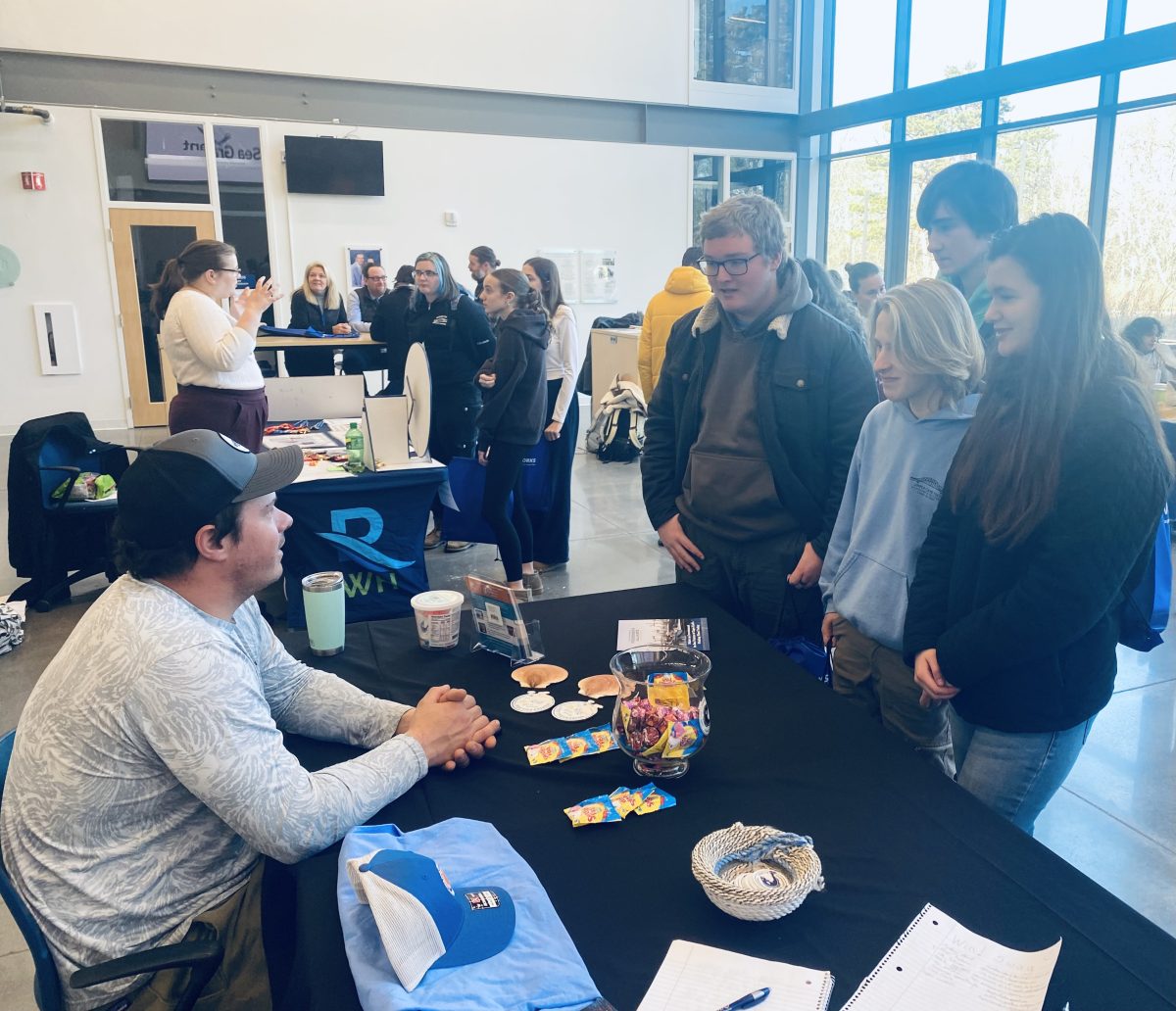
Captain Jake Angelo speaks with students from Upper Cape Regional Technical High School.
By Doreen Leggett
Fisherman Will Nicolai, a tall, long-haired, easygoing 21-year-old, has two older siblings engaged in high finance, but the Sturgis West graduate tried college (two colleges) and decided that wasn’t for him.
Captain Eric Hesse has a degree in physics and a graduate degree in civil engineering, but the lure of harpooning bluefin tuna and longlining for groundfish was too strong.
Jake Angelo of Barnstable Seafood Company went to Massachusetts Maritime Academy, toyed with being a private yacht captain, but found his dream job on the water fishing for black sea bass and clams.
There is no one way to get into commercial fishing and opportunities abound if you know how to work hard, the trio told dozens who stopped in at the Cape Cod Commercial Fishermen’s Alliance table at WaterWORKS at Cape Cod Community College. The Fishermen’s Alliance has had a table at the educational event since it was started by the Cape Cod Chamber’s Blue Economy Foundation in 2019. The all-day event is an opportunity to highlight how commercial fishing is a rewarding and profitable career.
There isn’t one type of fishery, Angelo said. You can choose from close to a dozen fisheries and do more than one. The Cape is near some of the richest fishing grounds and has a diversity of species because of the warm Gulf Stream and cold Labrador current.
“The thing about working on fishing boats is, say you don’t like it, you can try a different boat,” he said.
Angelo, joined by Nicolai and later Hesse, was sitting at a table in the middle of the college’s Life Science and Engineering building. WHOI Sea Grant, MITRE Corporation, Aquaculture Research Corporation and more than 40 other businesses, non-profits and educational institutions were arrayed nearby.
College students and members of the public could stop in and learn about careers in the Blue Economy and how they could get involved. Mitre alone has close to 1,000 intern opportunities.
A Cape Cod Academy senior approached Angelo and Nicolai with a group friends.
Nick Kowalski was a familiar face to Nicolai, as Kowalski unloaded fish on the right side of the Chatham pier while the boat Nicolai works on, F/V Constance Sea, unloaded on the left. Kowalski told the group that he had bought a small lobster boat with a gasoline-powered engine. Angelo – who has had several boats in his relatively short career – was interested.
Angelo said if there is a leak in a gas engine it could turn into a problem fast. Watch the hoses, he advised.
“Be very vigilant with those engines,” Angelo said. “When I bought my first boat it blew up.”
Next to Kowalski was Andrew Dumaresq, who also spent the summer moving fish, albeit in smaller numbers. He worked on a charter boat and spent his time cutting bait and helping customers.
He scrolled through his phone and pulled up a picture of him and a black sea bass longer than his torso. Twenty-two inches, he said with a smile.
A quiz the Fishermen’s Alliance had set up to see what attendees know about the fisheries was easy work for this group. People were asked to name a fish whose numbers are increasing because of warming waters, caught in traps or by rod and reel, often served whole. The answer was black sea bass.
That’s Angelo’s favorite fish, and he has been fishing for them since he was young. Shellfish was his entry to the commercial fisheries, but as he began saving money, he wanted to grow his business and buying a permit to catch black sea bass was his next investment. Now permits cost around $50,000 but Angelo said if fishermen have a limit of 500 pounds a day at $3 a pound, the expense can be recouped quickly.
He said one of the draws of commercial fishing is how you get rewarded for hard work.
“If you don’t want to make money you don’t have to,” he said.
Fishermen today are trying to anticipate what fish will be around, how markets will change, what regulations are on the horizon. Having been harmed by inaccurate government assessments in the past, fishermen are trying to gather accurate data regulators can use to set quotas.
Hesse has paired scientific research with fishing for most of his career. He spoke about work he has done measuring changing water temperatures as well as a long-line survey he has been involved in for more than a decade.
The scientific work was of particular interest to students going into ocean research or policy, such as Samantha Covell of Nauset Regional High School.
“I’m majoring in ocean engineering to combat the industrialization of the ocean,” she said.
Hesse explained nets federal research boats use can give an inaccurate portrayal of certain fish populations for reasons including wrong gear and being in the wrong area. The Fishermen’s Alliance is working with fishermen and other organizations to try and adjust regulations so fishermen can take advantage of climate winners such as black sea bass.
Students in Cape Cod Regional Technical High School’s marine services shop also had no problem identifying sea bass. Mike Ryder, a marine services instructor at Tech, had fished out of Chatham for 20 years before working for the harbormaster and then teaching.
Ryder asked Nicolai how winter fishing was going.
Nicolai said when it wasn’t too windy – like that day – they were making 12-hour trips with Captain Connors on the Constance Sea to Southern New England for skates and monkfish. The other day, he said, he hauled gear from 2 a.m. to 10 a.m. Although he prefers the summer weather, he wasn’t complaining.
“I don’t want an office job,” he said, adding there is a sense of pride that comes with fishing; “You look at everything you caught and are, like, that’s awesome.”
Although he convinced some passersby to try monkfish or skate for an upcoming meal (most is shipped overseas), Nicolai wasn’t familiar with skates until recently.
Nicolai remembers going down to the Chatham Fish Pier on Sundays after church to watch boats come in. But he had no idea skates were a mainstay of the fleet, or even what they were, until he started working offshore.
He came to commercial fishing by chance. A friend of his worked on Connors’ boat and told the captain Nicolai was looking for work. Nicolai was told to come down to the pier.
“About 10 minutes later I was a fisherman,” he said with a laugh. Now he doesn’t like taking time off and thinks of those he works with as family. Nicolai plans to be a captain himself.
“There is really nothing stopping you from getting your own boat one day,” he told students.
Others are born into fishing families, such as Glenn Svenningson, a senior at Cape Cod Tech, who has fished with his father, has his own lobster license and sees a career in the industry,
“I like being out there. It is better than being on land,” he said.
He goes lobstering as well as fishing for black sea bass and conch with his dad and other captains. “Every chance I can get I go,” he said.
Brad Morgan, an eighth grader from Monomoy Regional High School, attended with his friend Tristan Smith and Cheri Armstrong, a career planning and education coordinator. His dad is a lobsterman, Morgan also has a student license and his own small boat. He sometimes takes Smith with him.
“I just love the water. It’s a different world,” he said.