
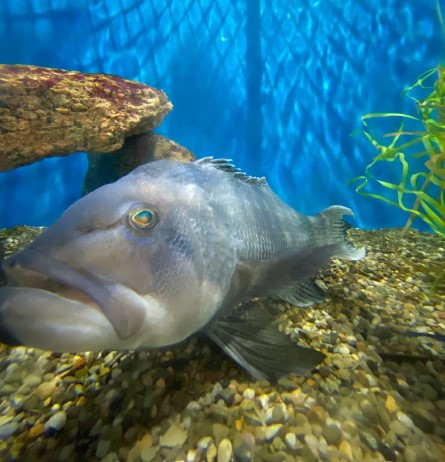
A changing ocean may mean more lobsters become dinner for black sea bass. Photo courtesy of The Lobster Initiatve.
By Doreen Leggett
Jon Grabowski played a video of a cute baby lobster in a tank, scuttling out of his rocky hideaway only to be quickly eaten by a blue crab with a black sea bass looking on.
The stuff of nightmares, joked Grabowski, professor and assistant director at Northeastern University’s Marine Science Center. Grabowski, along with several other researchers, was speaking as part of the National Sea Grant American Lobster Initiative, meant to address critical knowledge gaps about lobster in a changing ocean.
The initiative was launched in 2019 and focuses on increasing the industry’s resilience to biological, economic, and social impacts of ecosystem change.
This foray, sponsored by the Woods Hole Oceanographic Institution’s Sea Grant program, focused on lobster predation.
Grabowski said climate change is influencing species range and more and more black sea bass and blue crabs are moving into the Gulf of Maine, abundant years correlating with warming events, most recently from 2018 to 2020.
He said it is rare to see a black sea bass (more still a blue crab) eat a lobster, but lobsters do hide from the shimmery fish and if their numbers are increasing it could affect the industry, worth close to $850 million in Maine and Massachusetts.
“Even if it is just five percent (of the black sea bass diet) that is a lot of mouths to feed,” Grabowski said. “We need more data from areas where they overlap.”
Data being collected by researchers, including Bart DiFiore at Gulf of Maine Research Institute, and shared as part of a recent briefing, shows climate change shifting species’ range and appetites.
“In warmer waters things tend to need to eat more,” DiFiore said.
He pored over more than 50 years of data, 1970 to 2023, and looked at every species that has ever eaten a lobster.
DiFiore said lobsters are shifting into deeper waters and so are their predators.
“Higher ocean temperatures tend to concentrate predators and prey in one area. If you have more predators and more prey in one area you are going to have more consumption,” he said.
Climate change is restructuring how species act, he continued. To manage lobsters, regulators need to know how many are being consumed.
Grabowski said lobstermen are worried about the increase in black sea bass, half saying it’s a harmful change.
“If you think black sea bass eats lobster (you) almost entirely see black sea bass as negative,” he said.
Although black sea bass is a delicious fish and successful fishery, there are hurdles to overcome before it can become commonplace for fishermen to catch in the Gulf of Maine.
“Developing new fisheries sounds very easy but is challenging,” Grabowski said.
Fishermen are already traveling farther from homeports to catch species their historic communities were built on, others are shifting to stocks with less market value.
“The social and economic impacts of climate change can have severe consequences for fishermen and fishing communities,” he said.
The lobster initiative is attempting to mitigate those challenges.