By Doreen Leggett
When Caitlin “Caity” Townsend was in elementary school she divided her free time between her family’s seafood business on Cabral Wharf in Provincetown and her dad’s lobster boat.
Close to 20 years later, her world has widened to fishing for salmon in Alaska, selling sockeye on the Cape, recycling fishing gear, as well as advocacy, but lobstering with her dad is still at the heart of it.
“A little girl on her dad’s boat, still doing it (and) now I get to sell my own seafood. That is just a nice full circle moment,” Townsend said. “Everything I do is because of Provincetown Harbor.”
Townsend, 26, shared her experience growing up in a fishing family — she is third generation — to a sold-out crowd gathered at the Fishermen’s Alliance for the October Meet the Fleet.
This time of year, she is spending her days on F/V Heidi Lyn – named after her stepmom – lobstering with her dad Chris.
“We fish a full 800 (traps) in Stellwagen, mid-May to about Christmas. Right now is kind of the best fishing,” Townsend told the crowd.
Windy weather had kept her onshore, which meant she had time to shuck and pick dozens of lobsters to prep for a tasting that is always part of Meet the Fleet. The task took almost all day, but worth it as attendees were very complimentary of the resulting coconut lobster ceviche tostada, courtesy of Chef Pete Allard of the Chatham Squire.
Townsend told the audience that when she was little, every time her dad went lobstering she begged to go. Her father took her a lot, but she did have to go to school. Now she is a valuable member of the crew and sometimes runs the boat. She learned there was a name for a person like her. A meme of sorts.
“I’m a ‘Hey Dad,’” she said to laughter, meaning if she has a question she’ll ask her dad.
Townsend said the Cape’s waters have changed since her childhood. She remembers having days when they caught 1,000 pounds of lobster, a rare event now. There are also days when some traps are empty.
That is partly because of the so-called “blob,” an area of water in Cape Cod Bay – whose size and presence varies from year to year – which is devoid of oxygen.
The F/V Heidi Lyn is one of dozens of boats on the Cape that has environmental sensors on gear to help gather information about the blob and other changes in the ocean.
Townsend’s entire life is geared toward helping the fishing industry, but she almost took a different path.
She graduated from Massachusetts Maritime Academy wanting to work on offshore oil rigs, but COVID derailed those plans. Instead, the Truro resident found herself bartending while interning at Center for Coastal Studies in Provincetown. She worked on a program where fishermen were hired to grapple up ghost gear – fishing gear that has been lost – from the bottom of the seafloor.
When funding ran out, Net Your Problem, a company that recycles end-of-life fishing gear, was expanding into Massachusetts. Townsend applied right away and got the job.
Nicole Baker, a former fisheries observer, started the company in 2017 when she saw huge piles of fishing nets in rural Alaska. Baker had heard about sneakers being made from recycled nets and figured it was worth trying.
“She had a little dream and now we have recycled over two million pounds of gear. It’s pretty epic,” Townsend said.
Nets become small plastic pellets, which become everything from sunglasses to board shorts, and Townsend said she loves giving fishermen knives with handles made from recycled nets.
“This is gear that fed America and provided livelihoods,” Townsend said. “It is so cool.”
Townsend’s connection with Net Your Problem and trips to Alaska led to yet another opportunity for her.
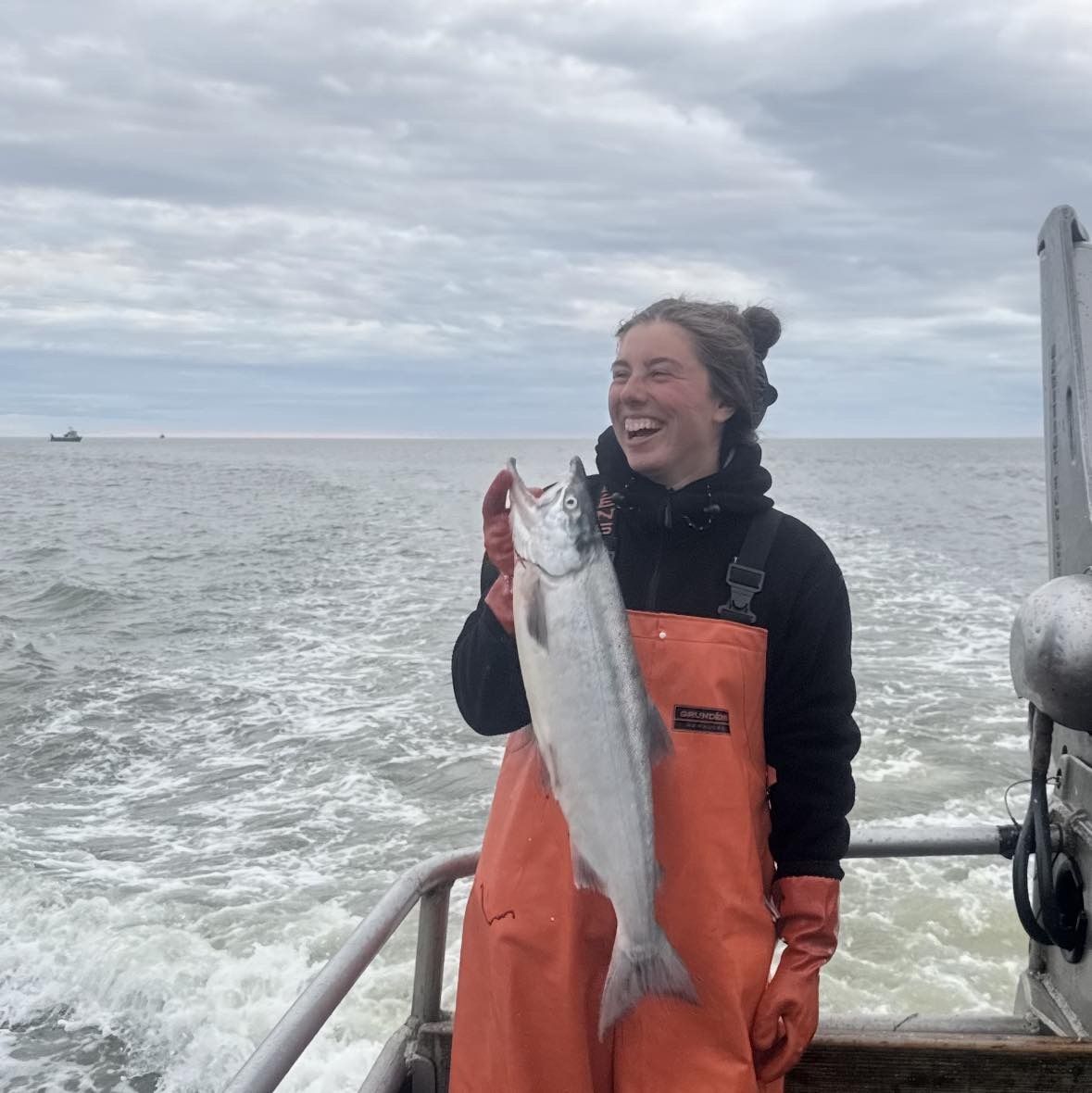
While in Alaska she heard that a family friend, Jessica Normandeau, was working in Bristol Bay and needed a deckhand; this year Townsend found herself on the Leila M fishing for salmon. She headed up in early June and when the fishery opened later that month the Leila M, and about 1,800 other 32-foot boats, are straight out through July.
“I went 38 hours at a time without sleeping,” she said.
Townsend said her summer fishery is one of the best-regulated in the world and is very sustainable. Managers determine how many fish can be caught and how many will go up the area’s six rivers to keep the largest population of sockeye salmon in the world healthy.
Fishermen catch the salmon swimming into the rivers when fishery managers broadcast which is open. They submerge a 900- to 1,200- foot-long net 150 or 200 fathoms into the water before using a hydraulic reel to pull the fish onto the deck. The salmon are then put in refrigerated seawater systems on the boat. Larger boats, or tenders, come out and pick up the fish to take them to shore.
Normandeau came up with the idea to direct market her seafood through her company, Slipstream Sockeye, in her hometown in Vermont, and where she currently lives in the Teton Valley area. While waiting for a fishing opener in 2024, they decided that Townsend would sell sockeye on Cape Cod.
There has been so much interest on the Cape that she has already sold out.
Her time in Alaska was another full circle moment for Townsend, but in the other direction.
She remembers lobstering with her dad when she was 14 and hearing about how Normandeau, now her captain, was in Alaska fishing with “a bunch of girls.
“It stuck in my head because I thought it was so cool, and I told myself I would do that someday,” she said.