
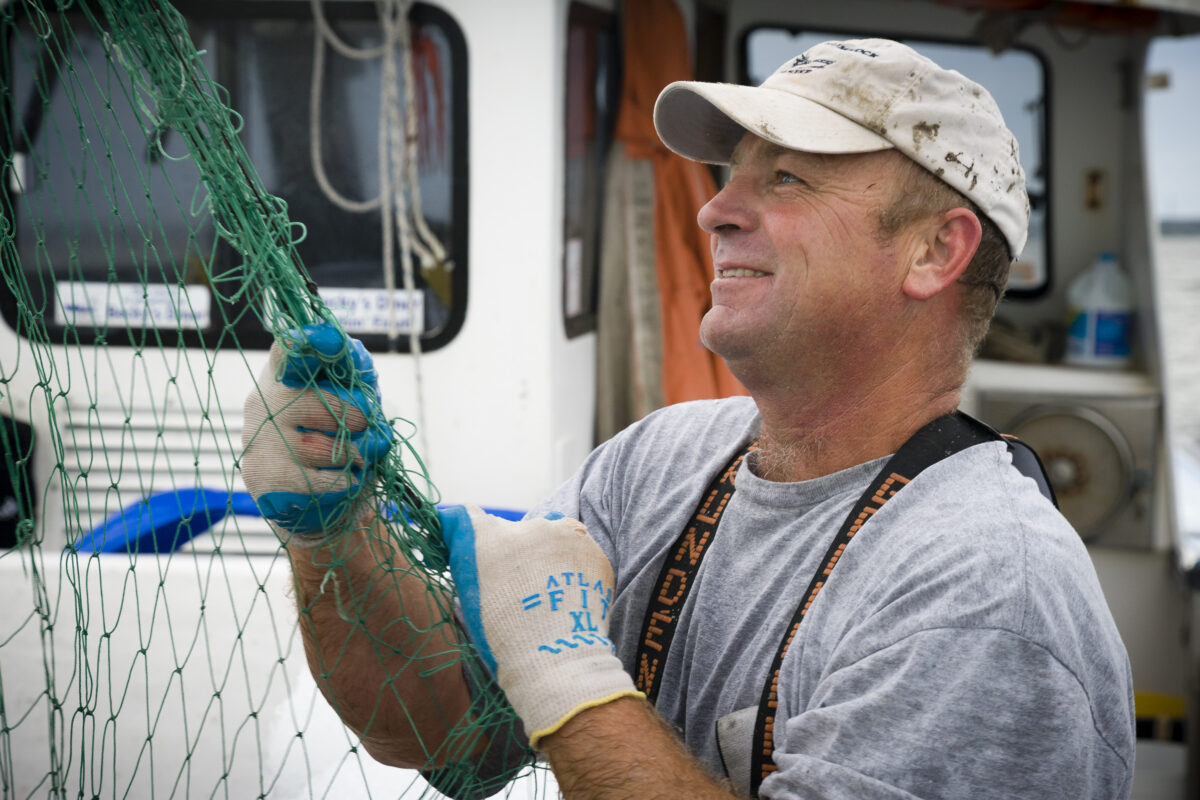
Tom Smith bluefishing on the Sea Wolf. David Hills/Fishy Pictures
By Doreen Leggett
Hatch’s Fish Market in Wellfleet has a basement smoker with a pipe through the roof, and on certain summer days the cloying scent of sunscreen in town is replaced with a savory, maple-wood, campfire smell.
“The smoke goes all through the town,” said Tom Smith, Captain of F/V Sea Wolf.
The smell of bluefish on the smoker is so good that people are drawn to the Main Street fish and produce market, a stone’s throw from town hall.
“I call him the Pied Piper,” Smith said of Adrien Kmiec, who owns the popular spot.
No tell-tale smoke was needed to draw a crowd to Nauset Marine overlooking Pleasant Bay in Orleans earlier this month as folks lined up to enjoy Smith’s bluefish, smoked earlier at Hatch’s. The event was part of the Meet the Fleet series held by the Fishermen’s Alliance for more than 10 years, connecting people with local fishermen, chefs, and the Cape’s delicious catch.
Those who turned out on a warm, breezy summer evening also heard about Smith’s decades-long career on the water and enjoyed cured bluefish and avocado canapes prepared by Chef Tyler Hadfield of the Barley Neck Inn, also in East Orleans.
Smith, an Orleans resident, said a lot has changed since his teens when he first went fishing for bluefish on charter boats out of Rock Harbor.
“They got a bad rap,” he said, because “they weren’t treated right.”
He said the forked-tail fish, abundant in the 70s and 80s, were brought in by the boat-load after eight–hour trips, no ice.
“I called them mashed potatoes,” he said.
That isn’t the case today. Smith’s catch comes aboard alive, quickly bled (which makes for a milder taste) and then dunked into a salty, cold-water bath.
“It gets them to 32 degrees in no time,” he said. “They are an oily fish by nature, so they need extra care.”
Smith uses 2,000 pounds of ice a day.
“He is real particular about it,” said David Hills, a professional photographer who often crews with Smith.
Smith, experienced in other fisheries including quahogging and tuna, has been bluefishing since 1981.
After graduating from Cape Cod Tech, he went to Stuart, Florida with a couple of friends and looked for a job in a boatyard. He ended up in nearby Port Salerno, and saw a fish house, a bunch of boats and lots of nets and fishing gear.
“Right away I was in my element,” he said.
In Florida, they fished for bluefish with a tactic known as strike netting. It’s a gillnet, reminiscent of a chain link fence that extends vertically in the water column. But unlike gillnetting around here, when fishermen leave the gear to soak often overnight, a strike net (which can be the length of five football fields) is set only when Smith finds a school of bluefish. He captures them then quickly hauls out, bleeds and ices, to ensure the freshest, best quality.
Smith spent his winters bluefishing in Florida for decades, since fishing on the Cape was slow in the winter. When he decided to stay on the Cape year-round, he thought he’d try strike netting bluefish up here, so he bought a boat, the first of his Sea Wolfs.
“The first day we caught 4,000 pounds,” Smith said. “Well,” he figured, “this works.”
Depending on where the bluefish are, Smith will leave out of Hyannis, Stage Harbor in Chatham, or Provincetown, but most of his trips are out of Provincetown.
Because strike netting was new here, Smith (who now holds the only state permit for this fishery) helped write the regulations. He did so with an eye toward protecting the species. Since then, the state has periodically tightened further, most recently because recreational fishermen were catching too many young.
“We have the most restrictive laws on the whole East Coast,” he said.
When Smith finds a school, he will circle them and then drive them into the mesh.
“We’ll make a bunch of noise; we’ll beat on the deck; we do donuts,” he said.
While Smith was talking, Hills came sprinting up from the back of the crowd, shouting, “Hey, hold on!”
Hills said Smith made it seem like they left the dock and just regularly fell into some fish but it’s not like that.
“He will drive around the ocean for hours looking,” Hills said to laughter.
What Smith looks for are oil slicks. Bluefish are voracious predators, so they will eat as much as they can, regurgitate (producing slicks) and eat again.
Smith also has a nose for bluefish.
“It smells like watermelon is the only way to describe it,” he said.
Once the net is full, they’ll harvest, being very careful to avoid razor-sharp teeth; Smith has had to have more than one fingertip re-attached over the years.
Because of his high quality, Smith’s bluefish are in demand and retail outlets will call in with a request for a specific number of pounds that he’ll deliver, which avoids having fish on a shelf for too long.
Hills said bluefish fresh for the grill, transformed into pate or smoked, are so popular that people will line up at markets like Hatch’s waiting for Smith to arrive.
“When he is backing the truck up, they’re whistling and clapping,” said Hills.
The crowd at Nauset Marine were fans as well, going up for multiple samples.
“It’s delicious,” said Phillip Coons, who attended with his wife Deborah and friends.
The cured bluefish canapes made by Hadfield, who had to rush back to his crowded Barley Neck Inn restaurant nearby, were also a big success, attendees getting a recipe they could try at home.
Smith said bluefish come around Memorial Day, and leave after Labor Day, just like the Cape’s summer visitors.
“They are here for the beautiful weather. And everyone is in a good mood,” said Smith. “That’s what I equate bluefish with.”