
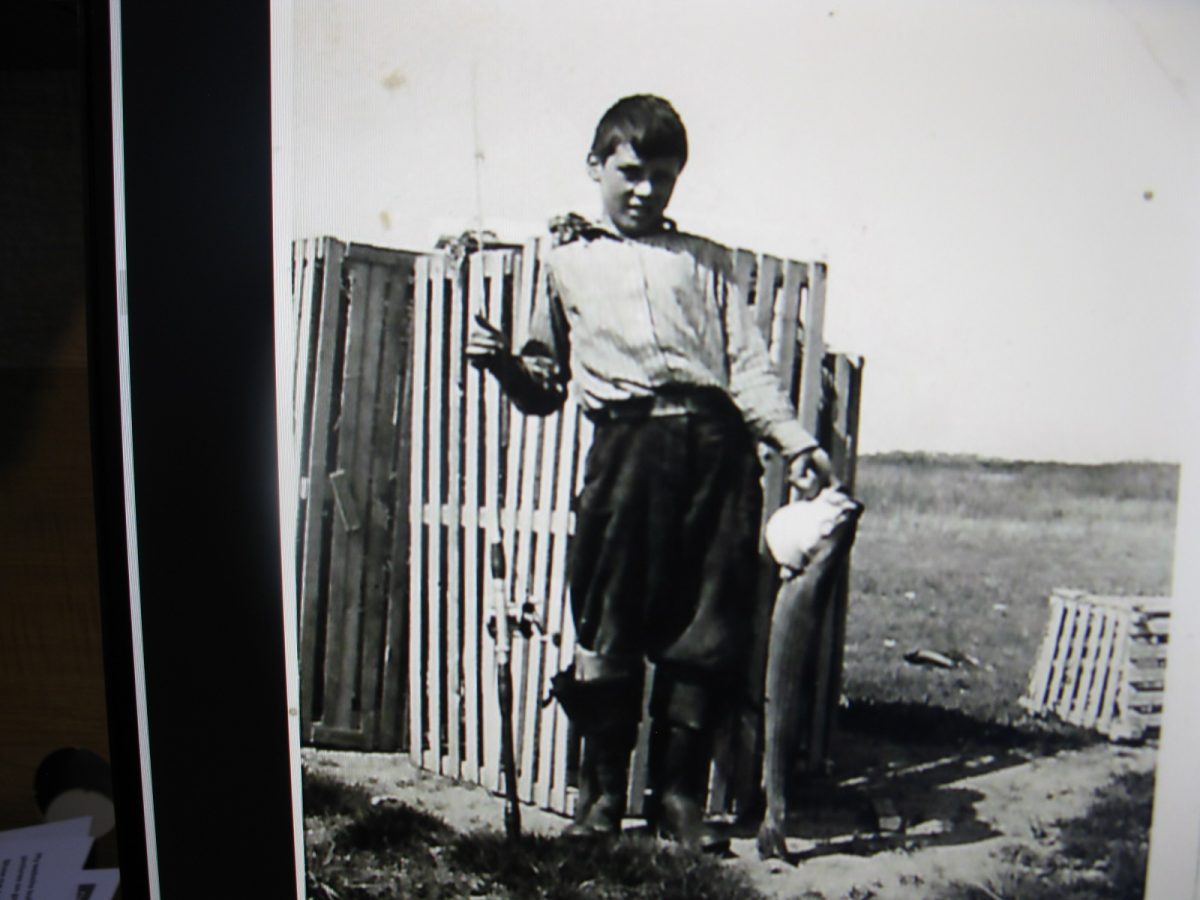
Jon Tolley in his younger days.
By Doreen Leggett
Captain Jon Tolley was off the water and the sun was beating down in an empty dirt lot in Yarmouth, but a bad storm was forecasted.
He stood by his grey pickup truck, three big coolers filled with lobsters and ice packs and a billboard advertising just-out-of-the-ocean crustaceans. Thunderous booms 17 miles away didn’t drown out shrieks of joy and thumping of waterslides from Wicked Waves waterpark next door.
A customer asked if weather would close Tolley’s sales window; he spends seven days a week, from 4 to 6:30 p.m., on the corner of Route 28 and West Yarmouth Road.
“I sell them rain, snow, sleet or hail. Nothing stops a Tolley,” he said.
Then he turned to show the Tolley family seal of sorts, emblazoned on the back of his t-shirt: the American flag shaped as a lobster with the words Fishing, Farming, Family, Friends, Fairness, Freedom For all of Cape Cod in a surrounding circle.
For the past year Tolley has had a lot more problems with Yarmouth’s Zoning Board of Appeals than with Mother Nature. He had to lean on his and the town’s fishing heritage, family and friends, to continue a business that extends back close to a century.
“A Tolley doesn’t give up. I couldn’t. Plus, I was a 100 percent right,” he said.
Tolley had been selling lobsters, seasonally, for close to 50 years from his home on Iroquois Boulevard. His dad, Fred, sold them from the same spot since 1957 and his grandfather, Walter, sold from his house, which was in Yarmouth Port, starting in 1930.
Things unraveled last year, when a complaint was made about an off-premises sign, the only complaint Tolley said he ever received. The building inspector issued Tolley a violation, with potential fines, for selling lobsters at his home.
Tolley applied for a variance, but, coming as a surprise to him and many others, it was denied and he could no longer sell lobsters from his house.
“It just really tore at my heartstrings because we are losing what makes Cape Cod such a special place,” said Chery Ball, a Yarmouth resident and founder of Cape Cod Concerned Citizens. “His family goes back generations. It is an industry the Cape needs.”
Ball, a realtor who spoke in Tolley’s defense, said she used to rent houses and visitors would write in guest books about buying lobsters from Tolley. Wrong-headed zoning edicts don’t just hurt Tolley, they hurt tourism, she argued.
With the blessing of selectmen, Tolley, 66, is selling on town property through October 31, a stopgap measure. His presence on a recent afternoon brought a chorus of supportive beeps and waves with a steady stream of customers.
The town’s planning board, sympathetic to Tolley’s plight, public comment and news articles supporting the lobsterman, is working on a zoning amendment to bring to November’s Special Town Meeting.
“I have been the subject of 172 news (reports),” Tolley said matter-of-factly.
Chipping away at traditional fishing (and farming) practices is a widespread issue. With land on the peninsula at a premium, and some new property owners focused on investments, complaints about gear storage, boats in yards, and other signs of fishing have increased.
Sometimes what many thought was a protected use is not. A Sandwich lobsterman had to bring a bylaw to town meeting to store lobster traps in his yard, and hang buoys on his fence, after a neighbor complained.
In Orleans recently, residents advocated moving gear off property lines to be screened from view. After fishermen and others pushed back, that was abandoned and this year an amendment to the “right to farm” bylaw was added that protects “commercial fishing and other activities necessary thereto.”
John Pappalardo, CEO of the Fishermen’s Alliance, said working waterfronts are the heart and soul of the Cape’s coastal towns: They support local fishermen and preserve maritime traditions. But they don’t work without protections on the land as well.
“It’s about finding a thoughtful balance. With tools like zoning bylaws, town charters, and easement protections, we can plan with intention to ensure our shores, and our coastal communities, remain both vibrant and working for generations to come.”
Tolley is allowed to store traps on his property, although Yarmouth is considering prohibiting storage of boats in front yards. The planning board, led by chair Joanne Crowley, spoke to a packed room in May about potential changes they would work on to permit Tolley “and others like him” to sell live lobsters in a residential district.
Joseph Polloni with Senie and Associates in Brewster, Tolley’s attorney, brought several suggestions to the board.
They included adding a footnote to permitted sale of agriculture products in most residential districts to include fishing, allowing it as a special category similar to Farmer’s Markets, and adding it by right.
There was also the option of grandfathering this specific use, which predates 1982, when the bylaw was changed. Before 1982 the original zoning bylaw had a provision that allowed for the handling and sale of fish in a residential area, said Polloni.
At a July meeting, the board was supportive of Town Planner Kathy Williams’ draft of a zoning amendment that would allow Tolley to sell lobster from his home by requiring a special permit from the Zoning Board of Appeals. She added a new use category for sale of agricultural products that includes the sale of fish and shellfish caught by the owner.
The planning board meetings were in direct contrast to the zoning board a few months before. Tolley was denied a variance at an October meeting last year, this year he retained Polloni for the March meeting.
Polloni planned to argue how Tolley’s sale of lobster from his home was grandfathered, a protected use, as well as other arguments Tolley did not bring up in his original hearing.
The chair of the zoning board said the application was repetitive and did not allow Polloni to argue that the retail sale of lobster is pre-existing and permissible. The rest of the Zoning Board agreed and Tolley was told he could sue if he wanted.
A tape of the meeting showed board chairman Sean Igoe asking for the police to be called to clear the room of dozens of residents who came to support Tolley, some of whom voiced their disappointment with the ZBA.
Police were in the room when the roll call vote was called, and the crowd, while taking their time, did leave.
Tolley filed suit in Barnstable Superior Court, but in early July a judge’s decision sent the case back to the town. Tolley isn’t confident he will get a positive result unless public pressure continues.
He is hopeful he’ll be able to sell lobsters from his home next year. It’s his livelihood, but also his heritage and connection to the past.
He first went fishing when he was three, had a permit when he was 16.
“I have sold millions of pounds of lobster. I’ve sold to everybody. I have people calling me from all over the Union,” he said.
Setting up at the corner of Route 28 takes an additional two hours compared to sales from home.
His “sweetheart” Camille, who helps him set up, said he gets up around 3 a.m. That morning he trailered his boat to Sesuit Harbor in Dennis, headed out on the bay solo, and pulled 100 traps.
“When he gets home, he has dinner and goes to bed,” she said, as she opened a lawn chair to get some sun.
Some people stopped by to support Tolley because of the controversy, others have bought from him for years.
“This is our first time this year,” said Paula Galvin who came with her son. “We love fresh lobster and know he goes out every morning. Guys like Jon are hard to find. He is a Cape Cod treasure.”
Tolley enjoys talking about the profession and how his grandfather started lobstering before the outboard motor was invented, rowing from trap to trap.
“People ask me all sorts of questions,” he said.
If Tolley’s business is permitted, it could pave the way for other lobstermen to sell from home, continuing a long tradition.
His dream is personal, simpler:
“I just want to sell a few lobsters before I die.”
For more information on Jon Tolley’s lobster sales, click here.