
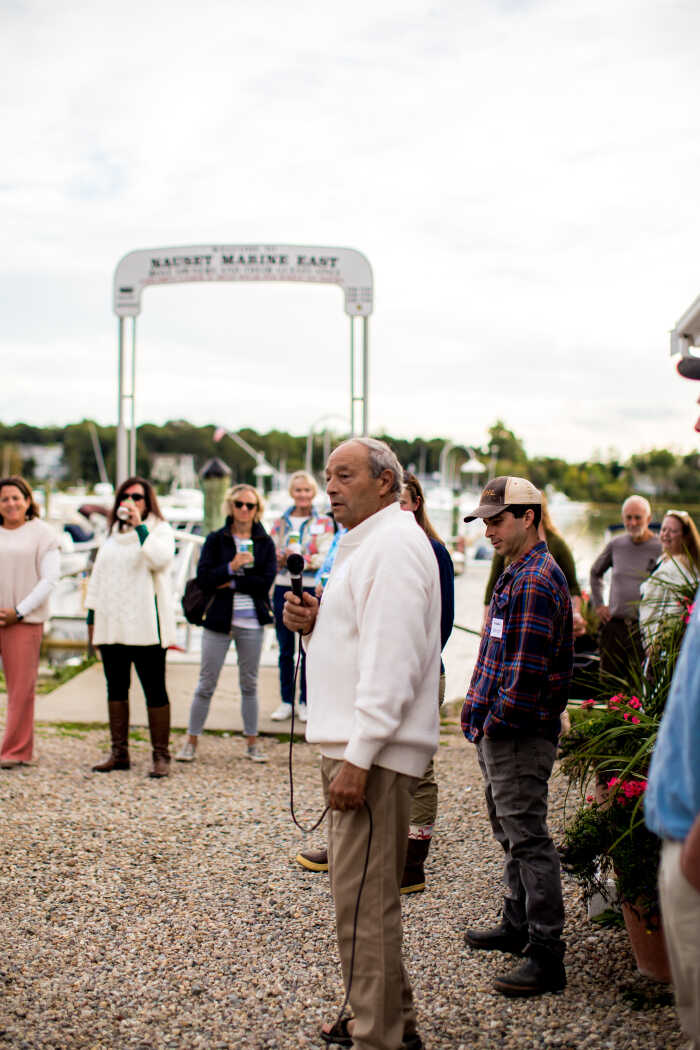
Longtime captain Bill Amaru, speaking here at a Meet the Fleet, keeps the stories of the Cape’s fisheries alive in presentations and stories.
By Bill Amaru
I have written stories of the risks encountered while at sea. But the ocean surrounding our Cape shores also provides many a life-long living. The bounty we take from our waters sustains and enriches us. The sea has, for millennia, given of its stores for the betterment of man and continues to do so. However, it does so at a cost. It’s important to remain aware not only of the wealth the sea provides but of the tasks it demands of us as well. When at sea in small boats remaining aware of the surrounding waters is not only necessary but critical. An experience we once had serves as an example of this contrast.
It was in the fall, perhaps twenty years ago. We were aboard F/V Joanne- A lll, fishing the waters east of Cape Cod. The crew and I were trawling for yellowtail and black-back flounder about five miles east of Chatham Light. Flounder were a mainstay of Chatham’s mobile fleet at the end of the twentieth century. Mobile gear boats actively pursue fish or shellfish by pulling a net or dredge. In the case of fish, they eventually give up trying to out-pace the forward motion of the net and literally turn and surrender into the terminus of the net. In the case of scallops or other shellfish, a certain length of time collecting the mostly inactive bivalves is followed by the “haulback”. When a net of fish is lifted back aboard the boat, the catch is released by means of a puckering rope that when closed prevents the fish escaping. When on deck and released, the fish pour out of the net and onto the deck. They are properly sorted, washed, and put below or into an insulated box on deck.
The day in question was a perfectly beautiful October day. Back several decades ago, fall days with temperatures in the sixties or seventies were rare. With the climate now warming so rapidly, beautiful late summer days seem to linger far longer into fall. But the day of which I speak was warm, bright, and calm; the fishing was good. One and one half hour tows were yielding between five and seven baskets of flounder. A basket holds about 75 pounds so the catch was adding up nicely. We had close to two thousand pounds aboard when it was time to head for the bar and Chatham fish pier. Our usual routine included heading to the west at around 9 knots so we could get inside the demarcation line as soon as possible.
The demarcation line is an imaginary line that runs parallel about a mile from shore throughout the entire fishing range of the northeast. When a federally licensed commercial fishing boat in our region is at sea, its time at sea, which is limited, is tracked and recorded by the National Marine Fisheries Service, the agency tasked with managing our marine fish resources. This is accomplished by means of a vessel monitoring computer device or “VMS”. The demarcation (demarc) line separates those actively fishing from a boat that may be transiting to or from port and not actively fishing. Most boats try to get inside the line as quickly as possible to save their precious hours at sea. Time at sea is one of the many ways commercial fishermen are regulated (some would call it strangulated) by the National Marine Fisheries Service. We were heading for the demarc line when something unforeseen happened.
After the last haul-back of the net, the deck-hand collects, sorts and cleans the fish for the final time. He also cleans the net and washes the stern deck area thoroughly as it has received the fish during the day. Our boat is a “stern trawler”, which means the net is retrieved over the stern and onto a reel. To make hauling the net aboard easier and more efficient, the stern of the vessel is open to the deck level and about a foot above the water line. There are heavy wooden “stern-boards” which fit into grooves and close the stern for safety and to prevent the fish from escaping back into the water. A “stern man” or crew, is tasked with the duties of the deck, including placing the heavy stern boards into their tracks. This can be difficult as each is 10-feet long and about fifty pounds. My crew was finished with handling fish and cleaning the net and deck areas. He reached for the first board and apparently misjudged proper placement to secure it into the runner and he and it went over the stern together. We were heading due west at nine knots.
I was at the helm and reporting by GPS computer the trip results (species caught, how much, what net we used, where we will land and what time, among others) to the Fisheries Service. This is required before we cross the demarcation line. This takes time and concentration and causes the operator to be preoccupied for a while. As a result, I was not aware my crew went overboard.
It was perhaps two minutes, no more, when I left the helm. I had a strong premonition that something was not right. Looking around and not seeing the crew, I headed forward to the foc’sle. Perhaps he was cleaning up and changing into dry clothes down below — no one was there. At this point I ran back to the helm station, pulled back the throttle and scanned the water astern of the boat. In the distance, just above the now dimly lit horizon, I made out two arms held just out of the water. Running back to the helm, I hauled the wheel over, executed a Williamson turn and ran full throttle back towards him. It was a short time, perhaps two minutes before I was back with him. They were some of the longest minutes of my life. I prayed those arms would keep waving as I approached. They did. The stern board which had been his undoing was also his life raft. He was hauled up on it like a surfer waiting to catch a wave. His embarrassed smile told me he was not worse for wear and when I got him aboard over the stern, he insisted he was ok. I had to order him below for a change into dry clothes. He was as red as a cooked lobster, the shivering beginning in a few minutes. Fortunately, the mild temperature that day helped but the water temperature was still in the low fifties and he had been in the water long enough.
We were over the line in a few minutes and unloaded an hour or so later. My friend and crew got a land job shortly thereafter. He was a great guy, hard worker and wonderful family man. I don’t know where he is now but I trust he is keeping dry and doing just fine.
God bless him and all: “Those who go down to the sea in small ships”
Bill Amaru writes from his fishing shanty in Orleans