
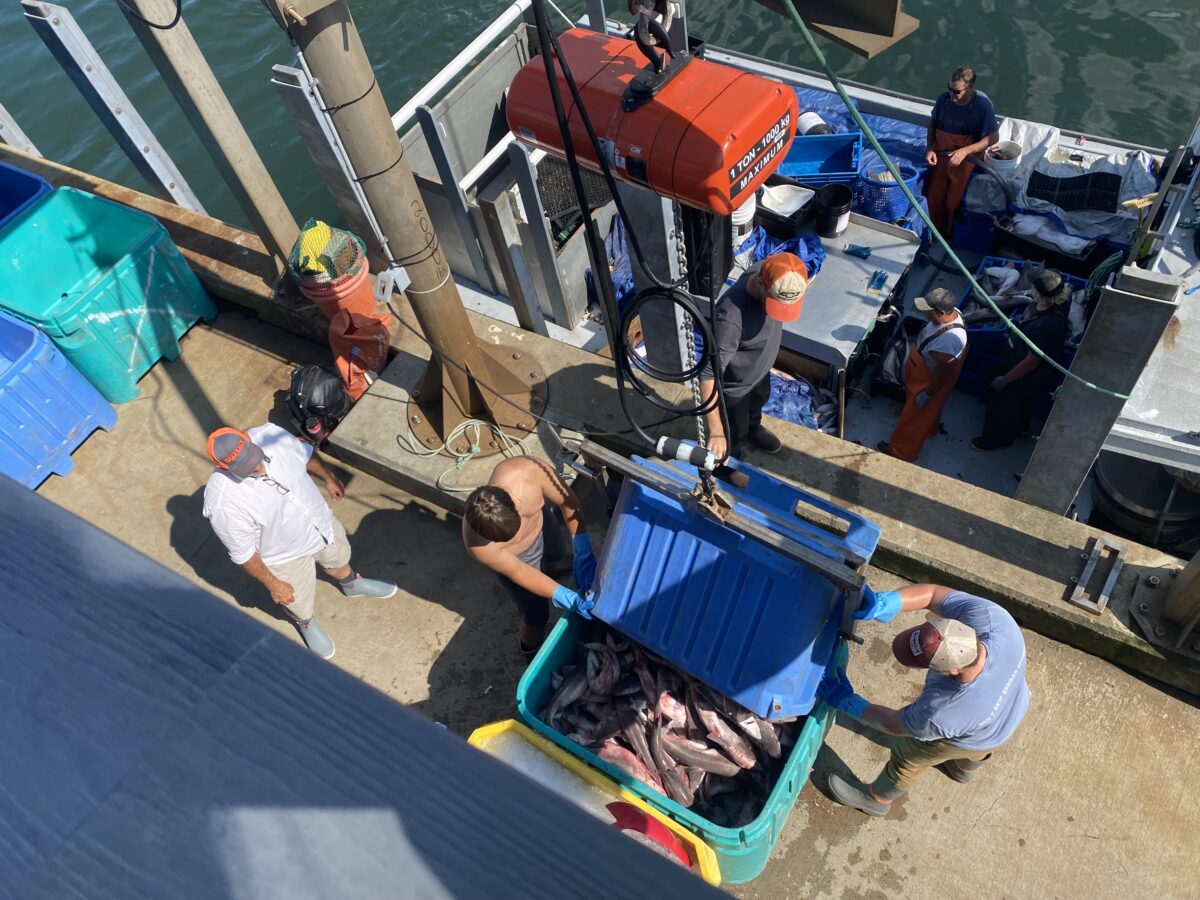
Shellfish Brokers did a trial run at the pier in 2023.
By Doreen Leggett
A gleaming white fishing boat, clearing Chatham Bar, makes a wide circle to come into the Fish Pier and a gangly, red-haired crew member with a full beard makes sure the vessel is secured before a team onshore spring into action.
While dozens of people on the observation deck above crane their heads to see, thousands of pounds of skate are loaded into a man-sized metal bucket operated by Sophia Weinstock that slowly climbs tracks to be tipped into an enormous vat of ice.
The process is repeated as a crew of three shovels ice onto the winged fish. When full, the more than 1500-pound container is picked up by a forklift and zips over to a refrigerated truck waiting in the bay.
A different team is using a boom to unload another vessel on the south side of the building, and a tan, dark-haired teenage girl with a Ruth Bader Ginsberg sticker on her yellow Hydro Flask runs paperwork around. Meanwhile, Jamie Bassett gets work done in a small office with windows that look out on the scene.
“It’s definitely action-packed here. We have moved close to a million and a half pounds of fish,” Bassett says.
Bassett owns “Shellfish Brokers” with Matt Belson, leases the south side of the fish pier, and is no stranger to the waterfront or Chatham.
“I was born and raised here and my family has deep roots in town,” says Bassett. “But it is still funny to me that I am here.”
He sees himself more as a caretaker than the man in charge.
“I think the fish pier is an entity unto itself. It has a pulse,” he says. “The fish pier does what the fish pier wants to do. We’re just here to help.”
It looked for a while that the packing bay on the south end was going to stay dormant. The north side was bustling with Red’s Best, which has held the lease for more than a dozen years, but when Marder Trawling left in 2022, no companies stepped forward.
Boats need to be unloaded fast, fish is perishable, and that is harder to do with only one packing bay.
Chatham, which owns the facility, put out bid requests that went unanswered. Bassett and Belson had helped unload, the town had bought booms so fishermen could more easily unload on their own, but there was nothing official.
Then Bassett got a call from Carlos Vassal, who owns Nebula, a fish processing and distribution company.
“We need you,” Bassett remembers Vassal saying in a voice reminiscent of Vito Corleone in Francis Ford Coppolla’s “The Godfather.” “You have got to see me in New Bedford.”
Bassett did and was impressed.
“Carlos, what a guy, he has definitely forgotten more about the fishing industry than people will ever know in their lives,” Bassett says.
“We are proud of our product. We are very careful with reputation, it takes a long time to earn a good one and can be lost so quickly,” Vassal says. “Everybody in France and everybody in Korea knows Nebula.”
Vassal arrived in New Bedford on Dec. 15, 1967, 13 years old, from the island of St. Michael in the Azores, and never left.
His father had done some fishing back home. Vassal went to SMU, as UMass Dartmouth was called then, for accounting. But after he graduated he got a job in sales and met a lot of fishermen, including his soon to be father-in-law:
“I saw how much money they made. I was young and married and when you are young that dollar sign influences your brain tremendously.”
He fished for close to 20 years, didn’t love it. It wasn’t like Chatham, where boats go out for a day or two and then home. They stayed out for more than a week a time, six men on a 90-foot boat.
Vassal went to work at Nebula, moving instead of catching fish. He worked his way up and eventually his boss offered to sell him the business on an installment basis.
When he first started at the plant, on the pier in New Bedford, the federal government was providing funding to increase processing capacity to handle more skate.
Vassal said skate was abundant but underutilized and that processing investment was coupled with a marketing program. Skates’ success in places such as France is rooted in those decisions made in the 1980s.
Decades later, Vassal does not want to lose that market, especially with growing competition from Argentina and Vietnam, and Chatham lands the most skates on the East Coast.
So, he reached out to Bassett to unload skate, and truck it to his plant. Some fishermen unload on the southside with Bassett’s crew, but drive their own trucks up to Nebula.
“We are not the primary buyer, we unload and pack for a fee,” says Bassett. “We are logistics.”
“I look at it and say would I eat it? If not it does not go in a box,” Vassal said.
Nebulla picks up virtually every day, about 28 vats, from June to October. Each vat is labelled with two travel tags in case one gets lost, and multiple copies of slips are given to fishermen that detail weight. There is a chain of custody for every boat — name, time, number of vats and totes.
The boats also bring in dogfish, which travels to Nebula with the skate. Since Nebula doesn’t process dogfish, those are sold to SeaTrade, says Bassett.
“I need Jamie. He is vital,” says Vassal. “I love working with him.”
The town has also been impressed with Bassett’s time at the pier.
“He has done a great job,” said longtime wharfinger Craig Pennypacker. “He is innovative … and runs an excellent business over there. He is very cordial, very communicative.
“He is a local and a lot of people know him and they like doing business with him.”
Bassett tries to make it as easy as possible for the captains. He takes a picture of the packing slip and texts it to captains before they leave the parking lot. If there is an issue, they can walk back in.
“Carlos is old school, he pays every single day,” says Bassett.
Still, even with the assistance of Nebula, the fishing business is not for the faint of heart. Vassal lucked out with Bassett who launched the first kelp farm on Cape Cod (which is doing well), piloted shucked shellfish in containers, and found new markets for the invasive green crab.
“I’m up for risk,” he said with a grin.
The skate fishery was uncommonly slow this June and July. Bassett and Belson had bought a new winch, two pallet jacks, a forklift and were fully staffed, so that created cash flow worries.
“We were fully staffed with no fish to unload; we made payroll without making any money,” said Bassett. “It was really tough.”
Things turned around by mid-July and Bassett seemed to take it in stride.
Last year they had a top-notch crew of young men and women, Bassett says, and it’s the same this year; so many applied they had to turn some away.
Joshua Bradley, 18, just graduated from Sturgis Charter School, and has worked on aquaculture grants and clam boats. Working at the pier seemed like a logical step and good fit.
“It’s been nice working in my hometown, and it’s a really great place to work,” said Bradley, who is attending Massachusetts Maritime Academy. “I really like the view.”
As staff goes in and out, Bassett offers facts and tidbits: Nick is a master fisherman, Colleen worked as a lobsterman in Maine, two brothers are phenomenal sailors.
Serena Mirisola has been known to pin the boys with a stare as she works at double speed while they slow down talking about sports.
“Are you guys going to pick up a shovel or not?” she’ll say.
Bassett said he noticed a lot of girls peering down from the observation deck as young women run machinery, packing and unloading fish.
“‘Look Mommy there is a girl working,’ they’ll say,” Bassett recalls. “They are in awe of seeing these young women work and sling fish.”
This is the second year for Sophia Weinstock, a Barnstable resident who goes to the University of Hawaii.
“It’s a lot of fun and always exciting,” she says.
Weinstock is studying marine biology and will be doing an internship at Woods Hole. She said in her major one tends to hear a fair number of negative comments about commercial fishermen and the industry.
“But everyone here is doing what they are supposed to be doing,” Weinstock said. Work has prompted her to think about shifting her focus to fisheries policy.
She and most of the crew are now back at college or high school, but Bassett isn’t worried.
“They all want to come back next summer,” he says with a smile.