
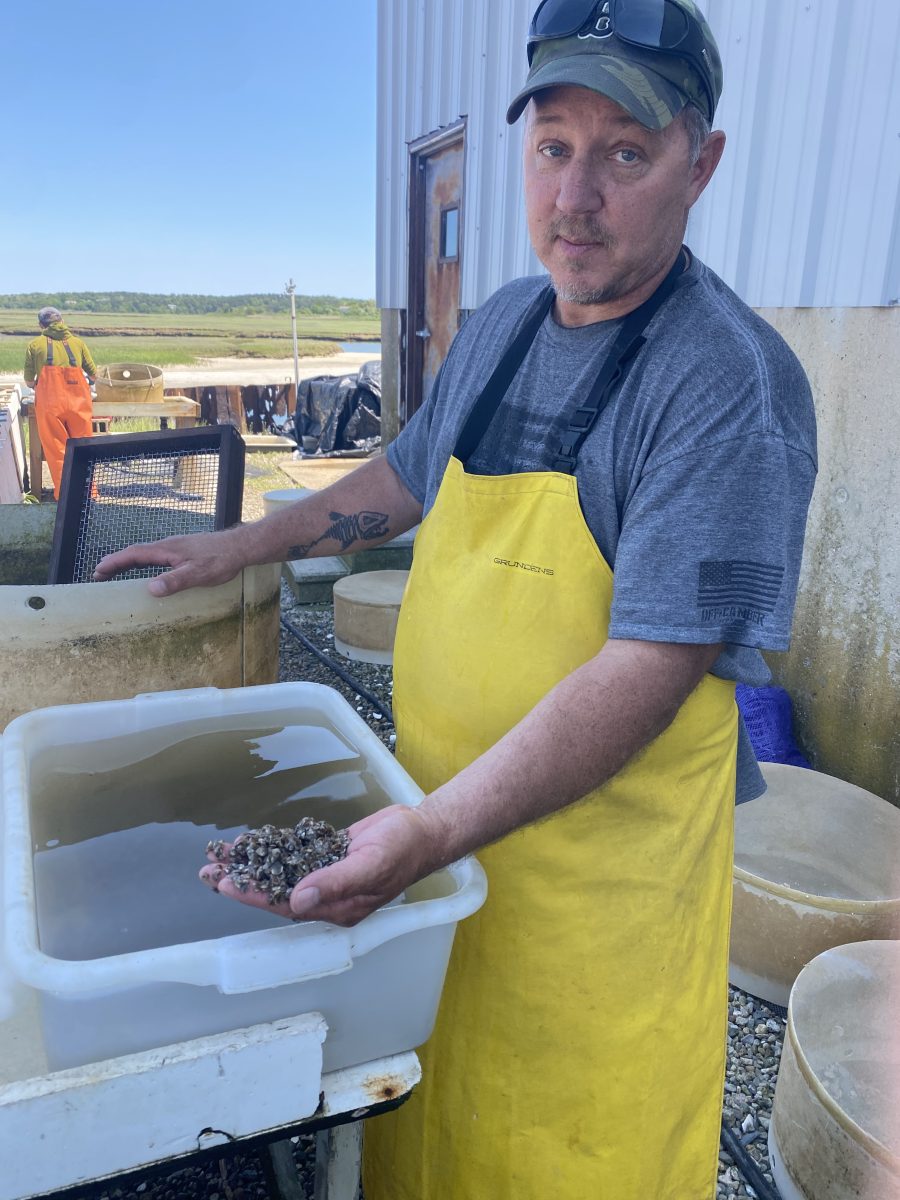
Keith Wilda, president of ARC Hatchery, has dived into his new role.
By Doreen Leggett
Keith Wilda was sitting at a butcher block table at Aquaculture Research Corporation, ARC, looking at Chase Garden Creek and a line of upwellers full of clams.
“I’ll be right there,” he said, pointing with a grin, about to begin his next job: “Grading seed.”
Wilda started work before sunrise and recently marked his 100th day at the Cape’s epicenter of shellfish production, which lies hidden among northside Dennis dunes not far from Chapin Beach.
“ARC has a great story,” said Wilda, who stepped into the 60-year narrative as executive director in February. “There are very few places that have the resources, human and natural, to do this.”
Once known as Cultured Clam, ARC is the Cape’s long-standing hatchery and supplies about 80 percent of quahog and oyster seed used by local shellfish farmers, also supplying town programs plus running a wholesale company that markets shellfish.
Separating bigger clams from smaller brethren was one of many jobs Wilda has undertaken; he also has packed shellfish for shipping, hit the tide on offsite farms, worked in the hatchery with see-through baby bivalves, helped in the indoor nursery where heated seawater and cultured food jumpstart growth, overseen tanks that steadily darken as algae grows, and toiled with the phytoplankton crew to put ingredients together for the perfect meal.
“I get to use all my different skills here,” he said. “The building of things, the designing of things, the biology of it. I am interested in it all.”
Wilda began on a land-based farm before constructing aquaponics facilities, running fish hatcheries, directing aquaculture educational programs, managing budgets and fundraising, helping manage a 48-acre oyster farm and serving as the executive director of a livestock institute.
“He has an expansive range of skills and experiences,” said John Pappalardo, CEO of the Fishermen’s Alliance and on the board of ARC. “He has also built markets for seafood products and innovated novel approaches to sustaining our blue economy. Keith understands the importance of a triple bottom line: environment, economy and nutrition.”
Now living in Harwich with his wife and twin daughters, Wilda grew up on his family’s 40-acre farm in Hadley, Massachusetts. His grandparents on both sides are farmers.
Some of his earliest memories are picking cucumbers, but they grew a number of crops, including corn, asparagus and cows – which he used to show as a 4H kid.
Wilda attended University of Massachusetts Amherst’s Stockbridge School of Agriculture for Farm Management. He planned to go into resource economics and yield forecasting.
But that changed when he strolled into Bioshelters Incorporated in Amherst to help his brother who was an engineer there.
“My junior year is where it all came together or fell apart, I can’t decide,” he said with a laugh.
He worked there through school and when he graduated became general manager, regularly turning out 500 pounds of fish and 800 cases of basil through a recirculating aquaponic system. (A filtration system converts some fish waste to plant food that goes on growing beds, before returning water, cleaner, to the fish tanks.)
Wilda went on to work at similar facilities, focusing on aquaponics or fish farming.
“I got to work all over the country. It comes in waves, whenever there is an energy crunch people come up with new ways to grow food,” he said.
During those years he met the late Dick Kraus, one of a trio of committed Cape Codders who bought ARC in 1984 and transformed the business into a place that primarily grew seed.
The new owners, who ran ARC until 2015, started with native quahogs, or hardshell clams. They planted the first crop of littleneck clams the first fall and harvested them for market sales in 1986. Oysters were added followed by attempts at bay scallops, razor clams and surf clams.
Traditionally, shellfishermen would seed their grants from wild spat, but as commercial aquaculture began to grow, using ARC seed proved a better investment. ARC has its own hardy broodstock, and staff have started new lines when farmers bring in what they believe is an exceptional shellfish with great genetics.
ARC also works closely with research facilities to help develop techniques and practices to sustain shellfish farming.
Wilda’s wife jokes he has taught far more aquaculture classes than he has taken, including as director of one of the state’s Centers of Sustainable Aquaculture in Western Ma., starting in 2002.
Wilda directed aquaculture extension programs, collaborated with state and federal hatcheries and co-led the Massachusetts Aquaculture Association among other things.
Scott Soares, who was aquaculture coordinator before running the Massachusetts Department of Agricultural Resources and later the USDA’s regional office, had known Wilda for several years and recommended him for the position.
“The farmer’s farmer,” Soares said. “He was always very creative and pragmatic in how he approached challenges.”
Soares said Wilda was a numbers guy adept at seizing opportunities and pivoting (a required skill in farming) but more than that:
“You could just see in the product that was produced the talent and experience.”
Soares added it was no small feat for Wilda to produce 1,000 tons of an Australian fish called Barramundi at a fish farm in Turner Falls, Ma. and that skill plays well at ARC, which does close to 25 spawns, 300 million animals a year.
ARC, like Wilda, has been reinvented a few times. A group of community partners – including the Fishermen’s Alliance – stepped up to invest in the hatchery that employs close to 30 people and supports 1,300 jobs with a 10-acre footprint. Twenty or so acres of the original property was sold to the town and conservation trusts.
Since then, ARC has started a wholesale business, Chapin Sea Farms, to market their oysters and clams – as well as buy some from local farmers — and sell them off-Cape.
“It is always a challenge,” Wilda said. “(Farmers) are great at growing stuff; we aren’t always great at moving stuff.”
Wilda intends to branch out even more.
“There are lots of things I am investigating,” he said. “In this day and age, you have to diversify.”
Josh Reitsma, Fisheries and Aquaculture Specialist with WHOI Sea Grant Program and Cape Cod Cooperative Extension, said Wilda’s understanding of nitty-gritty technical details as well as overarching economics, production and market trends, is valuable.
“He’s provided insight on potential green crab market outlets and is working on a liquid kelp fertilizer product! It’s great to have him at ARC,” Reitsma said.
Wilda’s work brought him to the Cape, and Martha’s Vineyard, about a decade ago. He was chief operating officer of Blue Stream Aquaculture which had locations in West Barnstable and New Hampshire.
Blue Stream focused on growing brown, rainbow and brook trout. Wilda balanced that job with work on Martha’s Vineyard where he was, at turns, executive director and Farm Hub Director for the Island Grown Initiative.
“I work seven days a week, 365 days a year,” Wilda said. “I am a hands-on person.”
But when COVID hit, Blue Stream had to adjust because ponds were not being stocked. They started a fish fertilizer using waste from the farm and an enzyme.
“We started a brand, ‘Fish Brew.’ My wife and I did all the marketing and sales. We had some incredible clients, like the Dallas Cowboys,” he said.
During that time, Wilda stopped into ARC to buy seed for Blue Stream Shellfish, an oyster farm in Fairhaven that he helps manage.
Wilda said it was meaningful to be connected to a place that is so well-regarded, so necessary and so deeply rooted in the community; his association goes back years, but he works with farmers who have been buying seed from ARC for close to 50 years. Seed that is fed from the descendants of the original diatoms taken from the creek right outside his office window.
“There is no end to this story,” he said.