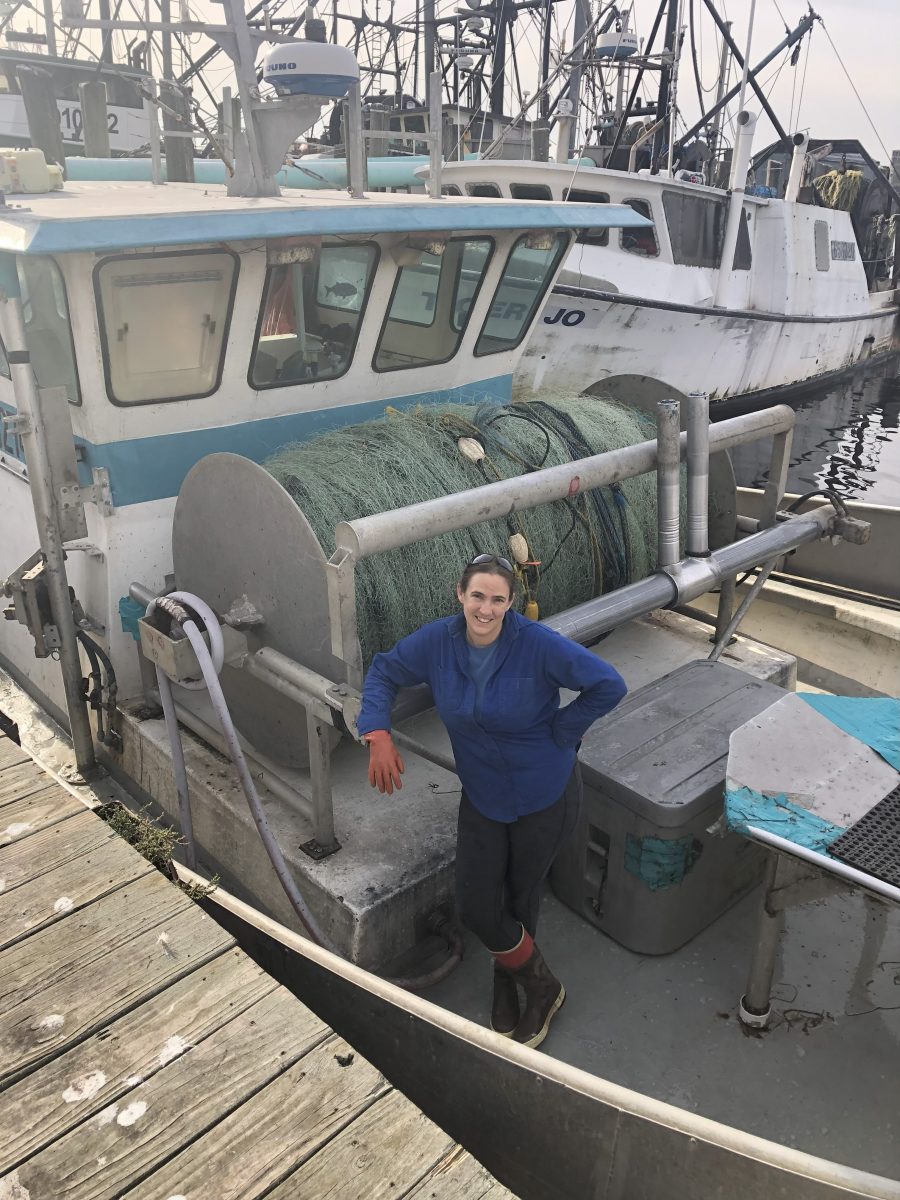
Sarah Schumann fishes commercially out of Rhode Island and Alaska and joined four other researchers to publish a lengthy report, “Transition to a Low Carbon Fishing Fleet,” finished earlier this year.
By Doreen Leggett
Captain Dean Karoblis has a close relationship with the John Deere engine that powers his fishing vessel Molly May. He trusts it; as with all fishermen that’s crucial, for lobstermen perhaps even more so.
“Everything I fish is right whale critical habitat,” he said, adding the season is so short, missed days are disastrous. “If any lobsterman is down and out when it’s on, you’re screwed.”
Still, he is willing to experiment with something new.
“I’d go with a hybrid-electric boat. I tie up every night,” he said, gesturing to the electric hook up a few feet from his slip at the Sandwich Marina.
Karoblis’ decision to apply for the Fishery Friendly Climate Action Campaign’s “Low Carbon Fishing Fleet” fellowship was born of experience, forethought and temperament.
For stability and to supplement income, Karoblis recently got his CDL, commercial driver’s license, and learned the state is mandating more energy-efficient trucks, phasing in decarbonization. He has seen fishermen’s businesses upended by changing regulations they had no input on, so he wants to be proactive. And, already seeing the benefits of advocacy as an elected delegate for the Massachusetts Lobstermen’s Association, he wanted to do more to help the industry.
When he saw a Facebook post from Sarah Schumann – director of the fishermen-led Campaign – asking for applications for funded fellowships, he applied.
“I had to do a resume for the first time,” the 40-year-old said with a chuckle. “AI (artificial intelligence) helped with that.”
Schumann fishes commercially out of Rhode Island and Alaska and joined four other researchers to publish a lengthy report, “Transition to a Low Carbon Fishing Fleet,” finished earlier this year.
She said wild seafood harvest already has one of the lowest carbon footprints among protein sources and plays an essential role in national food security. But maritime clean energy solutions lag behind innovation on land.
“Climate and energy issues are defining features of what it means to be a seafood harvester today,” Schumann said when the report was released. “Whether we’re grappling with ocean acidification, warming-induced volatility in our catches, or the impacts of ocean-based renewable energy development in our most precious fishing grounds, fishermen are feeling the heat. This research meets the moment head-on and shows the fishing community – and the working class in general – have what it takes to lead.”
The eighteen-volume report is the product of interviews with 148 fishermen across eight states, including a half dozen from Cape Cod.
The volumes detail real-world experiences, motivations, and barriers to adoption for numerous energy conservation strategies, as well as next-generation power systems such as electric propulsion, alternative liquid and gaseous fuels.
The bulk of the volumes evaluated a patchwork of funding supports that were already on the books, many unknown by fishermen and confusing.
An example: A lobsterman in Cutler, Maine (a town of just over 500 people) may access funding for highly efficient LED lights under the USDA’s Rural Energy for America Program. The fisherman’s cousin in Portland (a city of almost 70,000) can access the same funding opportunity, but only because she also grows kelp and oysters in addition to lobstering. Their uncle in New Bedford, who owns and operates a scalloper, will continue to run his inefficient sodium lights because there is no program available to support urban fishermen not also engaged in aquaculture.
Schumann said there are a lot of small energy-efficient fixes commercial fishermen would benefit from if funded. She said it is often assumed fishermen have already made those upgrades, but regulatory, market and environmental uncertainties make investments difficult.
She considers the last volume, which contains fishermen’s recommendations for new policies and programs, the most important.
The fellowship is meant to take the information gathered and develop action plans to fill gaps, educate and involve fishermen. Schumann said she looked for fishermen in Maine, Massachusetts and Rhode Island who were curious, emerging leaders invested in making the next few decades a success.
“(Karoblis) is exactly the kind of person I was looking for,” she said.
Karoblis, from Plymouth, has a lobster pedigree. His late father, also Dean, fished out of Sandwich as well. The younger Karoblis has been on the water since he was five and began lobstering in earnest during summers in high school.
He started full-time in 2003, offshore with the Colbert family, of Sandwich’s Fishermen’s View restaurant fame, six-day trips for several years. Karoblis got a lobster permit in 2008 but fished out of a skiff. There was no dockage available, he couldn’t even put his name on waiting list then, so went back offshore before running his dad’s boat for nine years and then taking over.
Karoblis has already made changes on his boat, primarily weight reduction. He used coosa, not plywood, and glassed over it. He also is having a flow meter installed to optimize fuel and hydraulic systems.
“That turns into real dollar value,” he said.
The idea of a diesel hybrid engine intrigued him, but there are pitfalls; he isn’t sure “the lemon is worth the squeeze.”
There are unanswered questions, he said. The first is the batteries weigh more than his current engine. His engine is also “bulletproof,” can be rebuilt for about $25,000 (far less than a hybrid) and fixable.
“So much electronics is designed for obsolescence,” Karoblis said.
The hybrid engines are experimental prototypes, he said, far from ready for the real world. Success in the commercial fisheries is even a step beyond that, as vessels are built to the particular needs of the captain and the fishery – they aren’t mass produced like cars.
Still, he figured that piloting technology through a grant-funded program could answer many questions and improve design.
Schumann said those grants have stalled.
The campaign’s work began in 2022 when record-high diesel fuel prices resulting from Russia’s invasion of Ukraine caused the highest energy burdens among the fishing fleet in over a decade. Many boats were tied to the dock, she said. Around the same time, state and federal policies, including the U.S. Inflation Reduction Act, established new funding streams to promote a transition from fossil fuels. The Fishery Friendly Climate Action campaign was meant to garner energy efficiency and clean power within commercial fishing.
“What is so unfortunate is the complete 180 the administration has done,” she said.
There is still forward movement, for example a pilot program in Alaska to outfit a salmon troller with a hybrid engine. And there is a bill in Congress that would provide resources to help transition fishing vessels from diesel to alternative fuel sources and fund research and development on fuel technologies.
Karoblis remains optimistic, knowing nothing stays the same.
“A lot of wind has been taken out of Sarah’s sails, but that is today,” he said. “Let’s just stay the course.”