
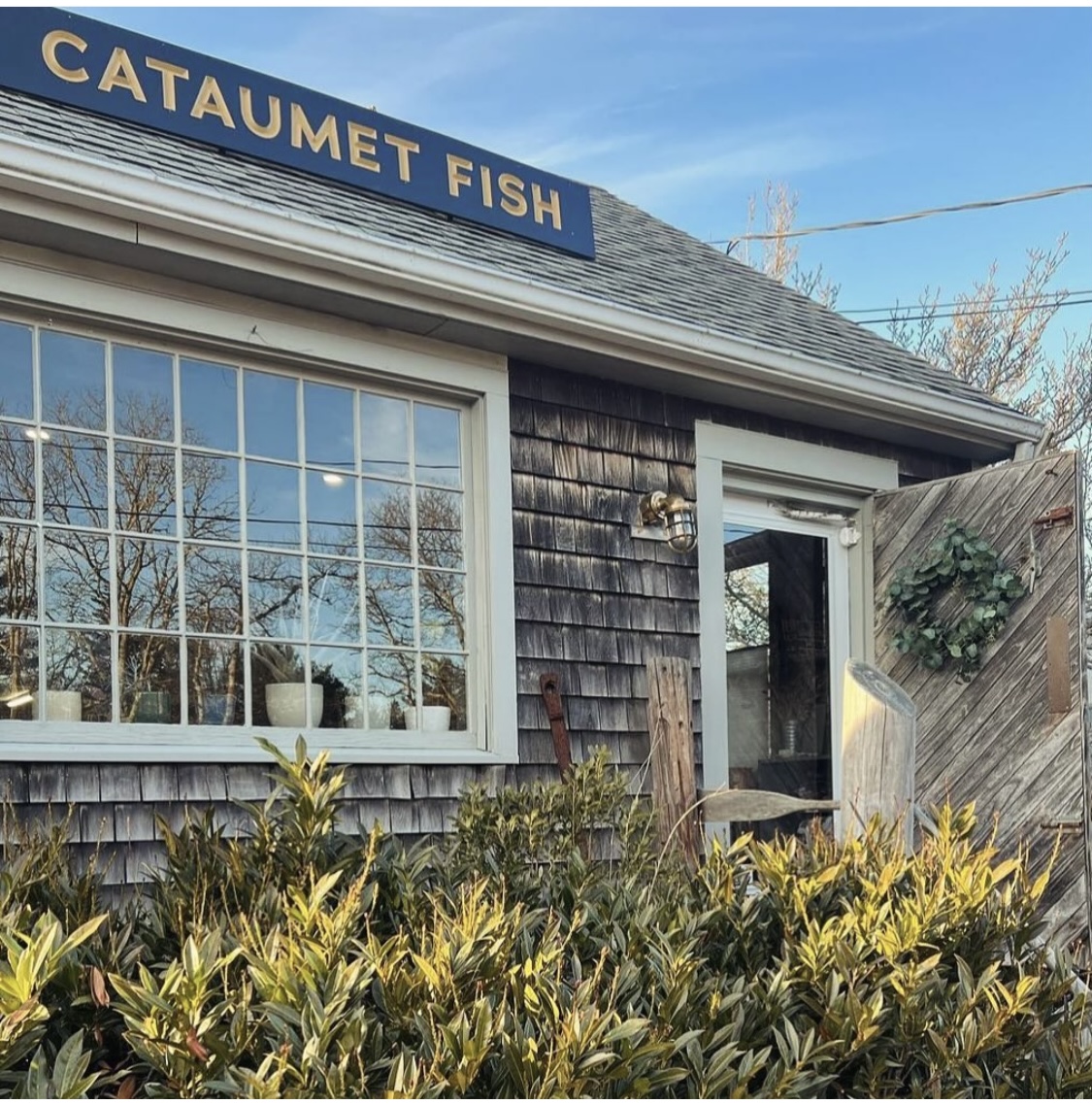
Jenny and Patrick Ross, of Cataumet Fish in Bourne, make it a point to explain where local seafood comes from and provide information about the species on social media as well as on a chalkboard outside their market. They also try to share recipes to show how to use local fish, like one for Monkfish Stew.
By Doreen Leggett
Cataumet Fish is committed to buying and selling local seafood and oftentimes uses social media to share the name of the boat that brought in the catch of the day. But owners Patrick and Jenny Ross have found an old-school approach works wonders as well; a sandwich board set up right outside the Bourne market with fish specials highlighted in bright-colored chalk.
“The chalkboard is effective even for regular customers,” said Patrick, adding it works even better if they pair specials with a recipe.
Business owners and fishermen across New England have been working for years to get more local seafood onto plates, a difficult challenge for a variety of reasons.
“We know how things are today, we want to figure out how things might work differently going forward,” said Kyle Foley, sustainable seafood director at Gulf of Maine Research Institute, GMRI.
GMRI, with funding from the United States Department of Agriculture, is working with Fishermen’s Alliance and Maine Coast Fishermen’s Association on a multi-year project to figure out barriers to local seafood, and eliminate them.
Earlier this year, in meetings in Portland and Boston, representatives from those advocacy organizations gathered with fishermen, restaurant owners, institutional buyers and small markets like Cataumet to talk about everything from embracing frozen fish to getting college students to choose more than salmon.
Fishermen across New England are only harvesting 26 percent of the flounder that regulations allow, only 27 percent of pollock, 37 percent of skate and 42 percent of scup and 42 percent of redfish.
For skate, Chatham’s biggest harvest, increased demand and full allotment landed would increase the value of the catch from $5.5 to $8 million.
The monetary gap isn’t due to the taste; skate fetches a premium at restaurants overseas, and is sought after at the popular Row 34 in Boston, which serves it three times a week.
Jeremy Sewall, the owner of Row 34, which has four other locations and hosted the strategy session, said skate got a bad rap years ago, and it’s been tough to shake. He said education is needed to cut through those misperceptions.
Another misperception: Scup is too difficult to fillet.
“It isn’t any harder to cut than rainbow trout,” he said, adding you can eat it whole. “We clean it very well and give them a fork. On a really busy day I’ll sell 100 whole fish,” he said.
Part of the issue, said Steve Gennodie, a former chef who owns Rocky Neck Fish and Chatham Pier Fish Market, is there needs to be more focus on expanding training and education of the next generation of chefs.
“If we don’t teach them that skill set, or show them that species, then no one knows how to cook it and it doesn’t get served,” Gennodie said. “We write that fish off the menu.”
He added he went to a popular chef’s restaurant and diners could choose black sea bass prepared three different ways – not a common occurrence.
“It was nice,” he said with a smile.
Gennodie has a soft spot in his heart for black sea bass landed at his doorstep by the Chatham Fish Pier. The jumbo and large black sea bass seem to sell themselves, getting a good price for the boat and Gennodie.
He has had less luck with the mediums, which are beautiful and just as tasty; it hurt him to take less than they were worth. But at the strategy session earlier this spring he got talking to some buyers at some colleges.
“They thought that would be a good fit,” Gennodie said. “It helps because we get to take a premium fish, put it in the spotlight at a university, stay in their price point and get a higher price point back to the fishermen.”
Another plus, he said, is that colleges are willing to have fish frozen. In the past, frozen fish was seen as having less nutritional value and less taste, but now the quality is outstanding.
By giving the colleges the opportunity to plan in advance, dining hall chefs can try different fish. As it stands now, Massachusetts has $24.8 billion in seafood sales, but it is primarily two species.
“We want to see more diversification, so all of our eggs aren’t in those lobster and scallop baskets,” said Foley.
And it’s not just college students that are interested in more fish (which is good for your heart and brain); it’s all ages.
“GMRI has done dozens of taste tests and all the students loved all the seafood,” said Adam Baukus, sustainable seafood program manager at GMRI. “We beat pizzas every day.”