
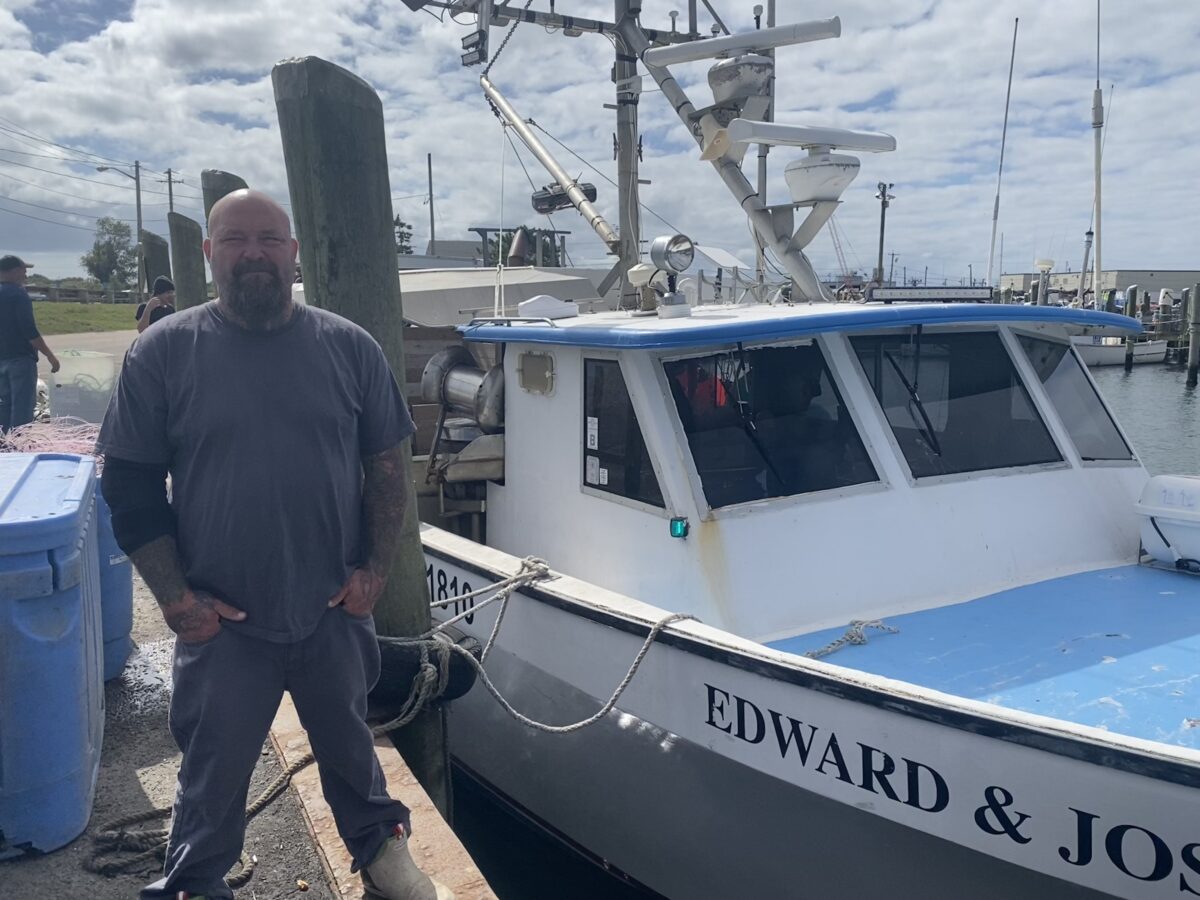
Josiah Dodge and his boat F/V Edward & Joseph split their time between Port Judith and Chatham.
By Doreen Leggett
Leaning against his grey pickup truck on a windy day at Point Judith, Rhode Island, Josiah Dodge looked at fishing boats in the busy harbor.
“I started right on that dock on a boat called the Betsy,” Dodge said.
Thirty years ago, his captain was an older Russian guy nicknamed Sunbeams, mainly because he did too much acid and would trip out when the sun came up over the water. He thought 17-year-old Dodge, stocky, tattooed, a father to be, was several years older so he gave him a shot. Dodge didn’t let him down.
“They weren’t bashful about hard work down here,” Dodge smiled.
Dodge’s first boat came years later, a $3500 fib fab (Fiberclass Fabricator) from Wellfleet. He heard about her through his father Charlie Dodge, who was fishing in Chatham.
“I was going to go dogfishing, but the infrastructure in Rhode Island isn’t as good as the Cape, which has freezer space and baiters,” Josiah said.
Although he was living in Westerly, a small fishing town about 30 minutes from Point Judith’s burly port of Galilee, Dodge’s next four boats were from the Cape; Josiah speaks fondly of the third one that once belonged to well-known captain Michael Anderson.
Dodge’s fishing life has been a blend of the Cape and Rhode Island. He fished out of Chatham intermittently, first with his dad, then with captains running his dad’s boat, now running his own boat, F/V Edward and Joseph, listing both Point Judith and Chatham as home ports.
The elder Dodge, who fished out of Stage Harbor seasonally for years before he moved, left Rhode Island when Josiah was eight and because of family dynamics they didn’t reconnect for at least a decade, after Josiah was fishing.
“When I was younger,” Josiah remembered, “I used to visit my grandparents on Block Island and hand-haul lobsters with my grandfather. I think fishing is one of those things that if you take it to it, you can’t really shake it.”
Dodge is descended from commercial fishermen. Some roots go to Norway and England and then there is Trustrum Dodge, of Newfoundland, hired by the settlers of Block Island in 1616 to teach them how to fish so they wouldn’t starve.
He says his talent with his hands comes from his dad as well, or perhaps Block Island genetics. His father was a mechanic before, during, and after he became a fisherman, and Josiah is adept at taking stuff apart and putting it together.
“I am very much my dad’s child,” he said.
Another talent became apparent about 20 years ago when his then-wife saw an ad for a tattoo parlor and said, “I bet you could do that.”
He took that bet and in 2006 started tattooing and by 2013 had opened his own tattoo parlor and still owns one today. Josiah also ran trucks for a while. He says both trucking and fishing have been substantially harmed by misguided federal policies: “I have yet to find an industry that the government got involved in that they haven’t destroyed.”
Josiah’s range comes in handy right about now as he ruefully glances at the brace on his arm.
“I kind of trashed three tendons and a ligament. It was a combination of brute strength and ignorance,” he said; he’s spending more time at the tattoo shop to help pay the bills. Dodge has quite a bit of ink himself; a lobster, sea bass, youngest daughter’s name (he and his wife Stephanie have eight children) and a lighthouse covering his throat, to name a few.
His injury happened off Chatham on August 8, his 47th birthday. A tangle of gillnets and a buoy ball were stuck fast to the side of the boat, and he tried to yank them aboard. It didn’t work out.
He is trying not to use the arm, counting down the hours until his surgery in November.
Unlike most working waterfronts on the Cape, Point Judith is purely commercial. More than 300 vessels use the port in Galilee, gillnetters, draggers, lobster boats. Last year, the port was responsible for about 70 percent of the state’s fisheries landings, worth about $56 million. For comparison, the ports on the Cape combined landed around $80 million.
Rhode Island recently invested in the state-run port, building a new commercial fishing pier that cost $46 million.
The port has a split personality with small boats one side, hand-made signs that advertise lobsters and Jonah crabs for sale. Fifty-foot boats or smaller unload catch with small booms and move it around with fork lifts, much of it going to New Bedford, about an hour and 10 minutes away.
Dodge moved the F/V Edward and Joseph to Point Judith about three years ago. He was fishing a smaller boat, named after two of his children, relying on a state permit, but he needed a bigger boat. His father was downsizing so they traded. Josiah has a federal permit and landing license in both states.
He’ll land skate all summer in Chatham, but admits that winters in Point Judith, without the high-risk Chatham Bar and dead-low tides, are preferable:
“If you want to leave at midnight you can; if you want to leave at 2 a.m. you can.”
Although the F/V Edward and Joseph, named after his two brothers who live in Chatham, is new to him, they share a history. There is a picture of him and his brother in the Cape Cod Times taken about a decade ago, mock strangling each other in the net box.
“I don’t get the boat named after me. I get the boat,” he said with a laugh.
Josiah was trying to avoid a spot near the channel where she was tied up. “I would love to haul gear, but I would inherently grab something, so I am staying away,” he said.
He did stand onshore while his crew, now captain Paul Hunt and mate, untangled gillnets. There were about a dozen white bags piled on the cement bulkhead, more to go.
The mate, Josh, had a positive attitude. “I could be at the motocross track. This is way better,” he said with a laugh.
Hunt improved Dodge’s attitude. “I’m very lucky in that I have a guy who can run the boat,” Josiah said.
The other half of the port, to the left of the entrance road, has a different personality altogether.
Big facilities include one of the largest producers of frozen seafood on the East Coast, SeaFreeze, owned by Glen, Kyle and Richard Goodwin. SeaFreeze is in the building that formerly housed a fishermen’s co-op founded in 1948. The co-op closed in the 1990s.
A vertically integrated company called Town Dock, launched by a musician in 1980, sits nearby. Now run by the son Ryan Clark, the company focuses on squid and owns a fleet of draggers. Josiah has sold them flounder but finds a larger profit in selling direct.
Also in the complex is Superior Trawl, famous for designing a net that reduces haddock bycatch, and New Bedford-based Atlantic Red Crab Co., which opened there in 2022.
Josiah said 90 percent of the fish goes overseas. Most of what’s left is shipped to Las Vegas or somewhere West, he added.
Over the summer, Josiah worked on a USDA-funded project with Gulf of Maine Research Institute, Fishermen’s Alliance and other fishermen in Maine and Massachusetts to improve the marketability of fish by using more ice; if small-boat fishermen can’t compete with massive quantities of imported fish, maybe they can win on quality.
“He really believes in quality and boat to table,” said his dad, Charlie. “He is smart and articulate. He understands all sides of an argument and if he doesn’t he’ll dive right in and do the research.
“If you saw him in an alley, you would probably run away, but he is a nice guy,” he added with a laugh.
Josiah also helped start Fresh Harvest Kitchen in Westerly, a market that sells only seasonal local seafood, caught by local fishermen. The idea is to connect people with fish and even personalize cooking whole fish. Josiah said ready-made fillets fit into Americans’ need for convenience but starve our relationship with food.
He wanted to sell off the boat, more directly, but was told federal agencies are loathe to issue the permits.
“If they allowed us to do it, it could jeopardize all of the state’s fish for export,” said Josiah. “Talk about convoluted. If we could process fish and move it directly to the public, people would get better quality and we’d get a better price.”
He’ll keep trying to new ways to move the needle while contending with rising costs of insurance, gear, fuel, you name it. “At the end of the day,” Dodge said. “the only thing that gets cheaper is the price of the fish to the boat.”