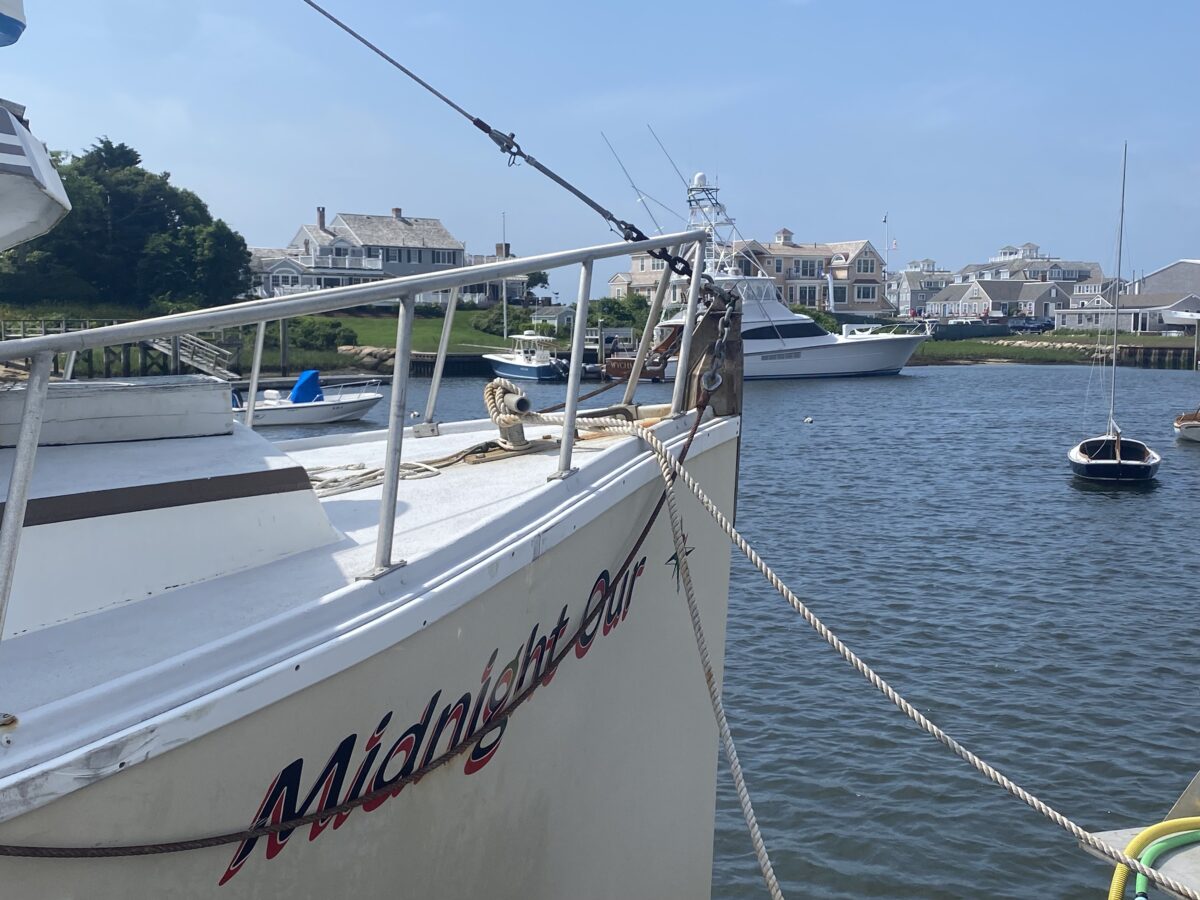
Midnight Our at Wychmere in Harwich.
By Doreen Leggett
To emphasis how important commercial fishing is to the economic health of the entire Cape, we attended the Cape Cod Commission’s “OneCape” summit, and offered a presentation entitled “Seven Degrees of Connection between the Cape and the commercial fisheries.” It was a play on “Six Degrees of Separation,” or “Six Degrees of Kevin Bacon,” as you prefer, a little whimsy and personal touch meant with serious intent. The idea: Pick one boat, one captain, and explore how the Fishermen’s Alliance’s work connects the economic dots.
In any harbor, with any boat, this idea could apply. Since the summit was held at Wychmere Beach Club, next door to Wychmere Harbor in Harwich, we started there, with a photo of a boat familiar to many:
The boat pictured, F/V Midnight Our, well-known, does dockside sales of scallops and sells to Farmers Markets, connecting people to local seafood and educating them about the industry. The money and seafood stay in the community.
Connection 1: The Fishermen’s Alliance worked with fishermen to get state approval for dock-side sales during COVID, still allowed. Many people buy easy-to-prepare scallops but you can also buy whole finfish. Since people aren’t always comfortable cooking whole fish, we have Meet the Fleet events where a chef will come in and talk about how to prepare local fish after a fisherman tells people how he caught it. We also have a series of instructional videos that people can watch for tips and tricks.
The captain of F/V Midnight Our owns another boat, F/V Nemesis, which often fishes right off the beach in Wellfleet and the sea clams harvested come to local restaurants and markets, to the delight of residents, visitors and small business owners alike. The shells are used for driveways, adding to the Cape’s charm.
Connection 2: The Fishermen’s Alliance also uses those sea clams for the most recent addition to our Small Boats, Big Taste program, a clam chowder to add to a haddock chowder and skate stew. We have distributed more than 1.5 million servings of these chowders and stew to food banks and pantries across the Cape and Massachusetts.
F/V Nemesis docks in Provincetown and Hyannis, depending on where she is fishing. This is a great example of how Cape ports link together, making the whole greater than its parts. Captains are part of a centuries-old multi-town tradition. Fishermen meet with town leaders and often serve on committees in their hometowns.
Connection 3: The Fishermen’s Alliance worked with the Commonwealth on a port study that shows the value of our working waterfronts. The report has been used by towns to justify critical infrastructure projects, including a new bulkhead, hoist and safety features at Rock Harbor in Orleans. One goal is to be sure we don’t lose a working port, possible given investments necessary to repair deteriorating infrastructure and piers that are falling part. That loss would create a death knell for small businesses surviving on small margins, if fishermen must travel further to land their catch, or buyers won’t come to a port.
MacMillian in Provincetown and Bismore in Hyannis draw thousands of visitors to see fishing boats and eat local seafood. Visitors also buy art, sold in small shanties in sight of the boats. In Provincetown, artists became famous by painting scenes of the fishing industry.
Connection 4: The Fishermen’s Alliance partners with artists to celebrate the industry, most recently Mike Palmer for a show at Barnstable Town Hall. Our office is filled with paintings and photographs. And the Chatham Fish Pier is home to our pier host program which educates visitors about the industry at perhaps the most popular tourist attraction on Cape Cod.
Sea clams landed by F/V Nemesis, as well as other shellfish, are processed in Chatham at a facility owned by the captain that employees more than 20 people.
Connection 5: The Fishermen’s Alliance spends a lot of time on economic development. We secure grants, advocate on behalf of fishermen, and partner with others, including Community Development Partnership, to lease fishing quota at a reduced price and make permits more affordable.
Since Captain Jesse Rose can’t personally run a business and three boats, he employs captains. One of the captains is a young man who grew up in Harwich, went to Cape Cod Regional Technical High School and graduated our Fishermen Training program. Mike Van Hoose now volunteers his time to speak about the importance of the fishing industry, and how much better it is to process seafood here rather than send it off-Cape only to truck it back.
Connection 6: The Fishermen’s Alliance has partnered with Cape Cod Tech and taken students down to Saquatucket Harbor in Harwich to meet with captains who gillnet, lobster, and scallop, each requiring a different skillset. We have also offer trainings to get people into the industry, most recently with the Brazilian Resource Center to graduate a dozen Brazilian-Americans, many of whom have gotten jobs in the industry. We also work with the Blue Economy Foundation on WaterWORKS, an annual jobs fair at Cape Cod Community College that introduces hundreds of high school students to Blue Economy careers.
Captain Rose has spent his career participating in research projects that provide valuable information used to protect and grow the industry. Now some of his time off the water is spent working with local schools as well.
Connection 7: The Fishermen’s Alliance is involved in a USDA grant-funded project, working with partners like South Shore Community Action Committee and Community Action Committee of Cape Cod & Islands, to serve our chowders and stew in pre-schools and high schools. We also have collaborated on many research projects over the years, including putting sensors on fishing gear to measure temperature in the water column and collect other data to help measure and plan for the impacts of climate change.
These seven degrees of connection emerge from one port and one captain. We represent more than 300 fishing families, creating our contribution to the goals of the OneCape session: to support a resilient, inclusive, and diverse year-round community with access to housing options, high-quality business, education and employment opportunities, and thriving natural resources, building on the historic and unique characteristics that have drawn people to Cape Cod for centuries.