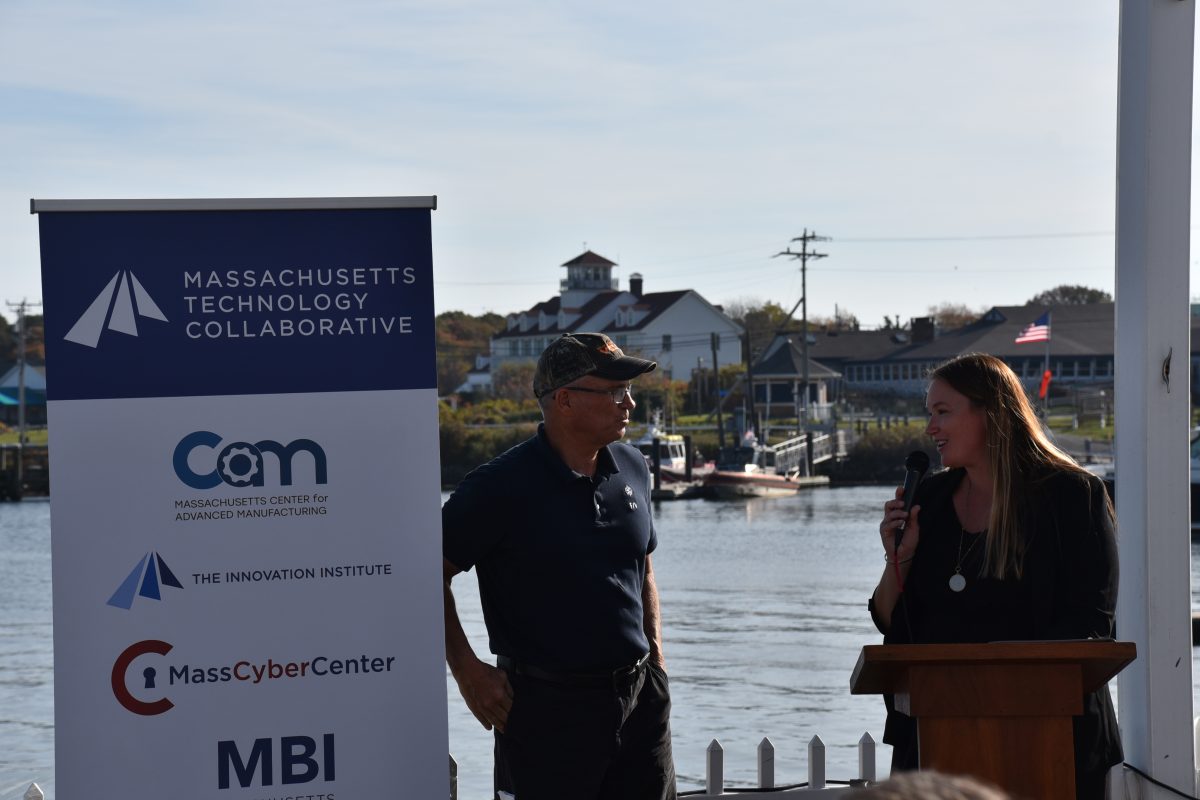
Fishermen, including Captain Denny Colbert, partner with researchers and Aubrey Church, policy director at the Fishermen’s Alliance, to improve our understanding of the ocean.
By Doreen Leggett
Maritime trade, forecasters, fishermen, scientists, the Coast Guard and many others rely on ocean models to make predictions, and those models can be wrong.
George Maynard, a marine resources specialist at the Northeast Regional Science Center, said without real world information those models can become further and further “divorced from reality.” That’s where commercial fishermen come in. Sensors on their gear gather data about the ocean’s current conditions every time they fish.
“By working together we can improve on our collective understanding of the ocean environment and hopefully that will lead to better outcomes for everybody,” said Maynard.
Maynard spoke at the annual meeting of the Fishermen’s Alliance. He noted that work fishermen had done through eMOLT (electronic monitors on lobster traps and trawls) has already provided benefits. As an example, some fishermen in the room had gathered data allowing managers to have a better understanding of the lobster population and increase the amount of lobster allowed for harvest.
As the eMOLT program expands through a $2 million grant the Fishermen’s Alliance received through the Commonwealth of Massachusetts, Maynard updated members on the program’s value, data collection and what lay ahead.
“Environmental data helps you decide when, where and how you want to fish,” said Mel Sanderson, chief operating officer of the Fishermen’s Alliance, who added there was capacity for more fishermen to get involved.
The late January meeting was also an opportunity to share news about a variety of Fishermen’s Alliance programs. Ray Rowell, permit bank manager, updated attendees on activity at the Cape Cod Fisheries Trust.
He said that in 2024, 230,483 pounds of groundfish and 53,643 pounds of discounted scallop quota was leased to strengthen 19 fishing businesses and foster $1.2 million dollars worth of economic development.
Other staff worked on close to a half a dozen regulatory, management and advisory boards, including the New England Fishery Management Council.
Aubrey Church, policy director, advocated for fishermen who rely on skate, monkfish, dogfish, scallop, groundfish and herring, and wrote letters on behalf of fishermen, focusing on concerns with offshore wind and the value of ecosystem-based fisheries management.
In several trips to Washington, D.C., Church and other staff – often with local fishermen – advocated for financial support for regional fishery councils, fishery surveys, data collection, and pushed for a national strategy for data modernization.
Side by side with fishermen and other fisheries advocacy groups, the Fishermen’s Alliance also worked with local, regional and state entities to push for investment and protection for working waterfront infrastructure.
Chief Executive Officer John Pappalardo emphasized the importance of fishermen having a voice at policy and regulatory meetings where decisions are made. He said he became “terrified” during COVID and was determined to make sure that no matter what happened to the Fishermen’s Alliance, there would be an endowment-funded position to advocate on behalf of the Cape’s fishermen.
To help accomplish that, the Fishermen’s Alliance started a capital campaign that is about $1 million away from its $3 million goal. While those efforts continue, the Fishermen’s Alliance is looking to add another policy position to address the multitude of challenges the industry faces.
At the annual meeting, Board members Richard Banks and Barry LeBar were re-elected to their seats, joining Eric Hesse, Jesse Rose, Greg Connors, Beau Gribbin, Kurt Martin, Andy Baler, Sam Linnell, Bradley Louw, Brian Sherin and Charles Borkoski.