
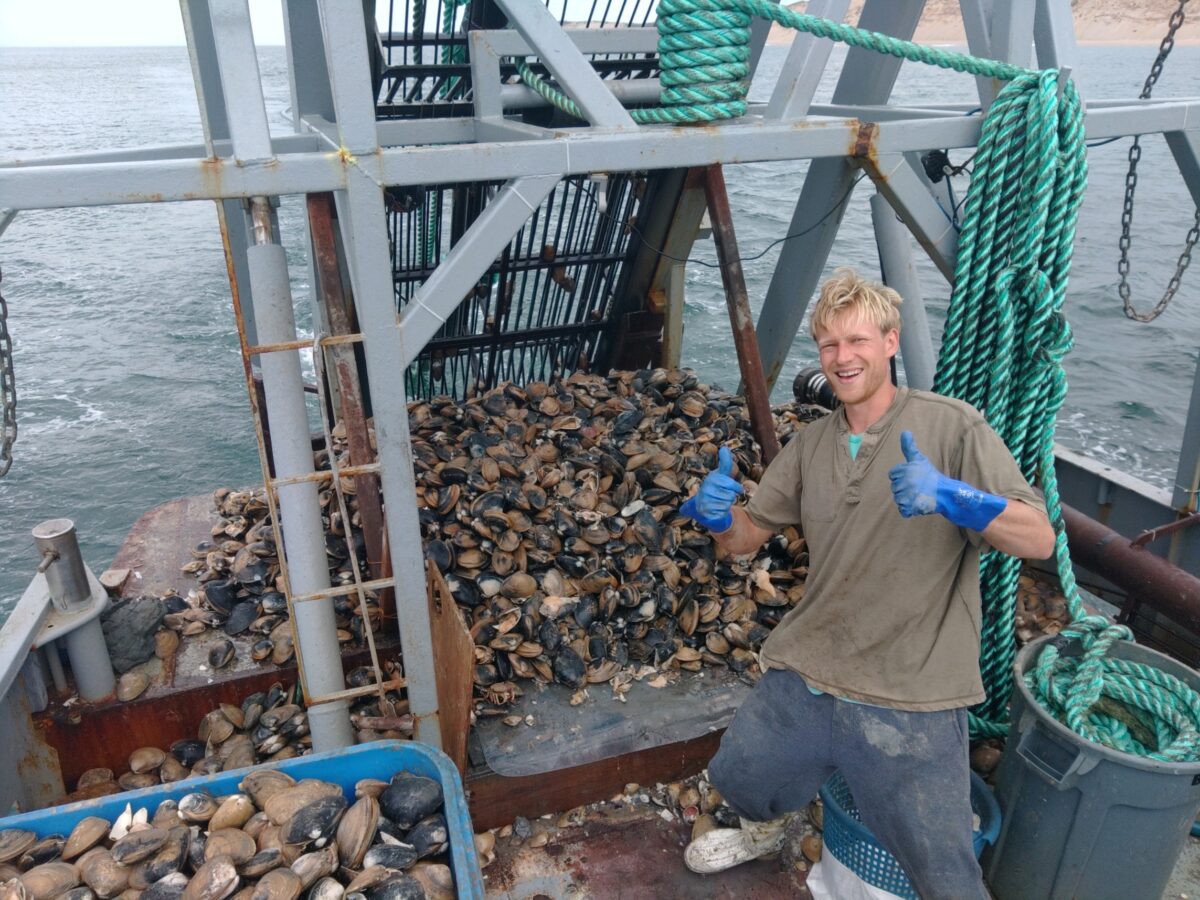
Ray Rowell in his earlier clamming days.
By Doreen Leggett
On Wednesday, Aug. 13, Ray Rowell got up before his 2 a.m. alarm. Rowell has worked for the Fishermen’s Alliance for a year and a half, but much of his adult life has been spent fishing and he always woke up before the chimes on his phone. He hates the sound.
That day he was going sea clamming, something he spent years doing on boats out of Wellfleet – where he lives – and Provincetown.
The trip had been set up at the Hookers Ball, the annual fundraiser and celebration put on by the Fishermen’s Alliance. Rowell was talking to Mike Van Hoose, captain of the sea clamming vessel Nemesis, owned by Jesse Rose, a Wellfleet native now Chatham transplant.
Van Hoose, 28, is one of four captains involved in a new experimental fisheries permit, an EFP, the Fishermen’s Alliance got through National Oceanic and Atmospheric Administration to help small boat fishermen on the Cape. The EFP is designed to help businesses like Rose’s compete with larger boats and offer more flexibility.
Rowell wanted to go out and get more information, with the thought that maybe the Fishermen’s Alliance should advocate that these EFPs become permanent. Van Hoose was willing enough, but hey, this wasn’t party talk.
“I’m serious man, I’ll touch base with you Monday,” Rowell said.
Rowell had meetings every day that week after the ball, but the following week Van Hoose called to ask, “Do you want to meet me around 4 in the morning in Hyannis?”
Rowell left his stuff by the door the night before; boots, gloves, extra clothes (he had picked up a few shirts for a dollar at the flea market), food. His go-to meal is imitation crab meat in tubes, not much taste but you can dip it in cocktail sauce. He had some coconut waters and Body Armor, a sports drink.
He drove to Whitecrest Beach on Wellfleet’s backshore to see if anyone was on the water, an old habit left over from his clamming days. Then on the road to Hyannis to meet Van Hoose. Rowell was early, he always is, another habit of a good crewman: If you are on time, you’re late, the saying goes.
At 3:30 a.m. he pulled into the small lot at Bismore Park to check a dozen or so commercial boats lined up beside the ferry terminal. A pickup truck pulled in front of Nemesis and Rowell walked up to introduce himself.
Trevor Bates, 31, is from Maine. Stocky, six-foot, he’s a scallop boat captain who ran a lobster boat, the Lobstah Mobstah, out of Rockland, Maine with his dad, and a boat out of Hyannis at one point. He had met Van Hoose and liked him, liked the pay too, so he joined for a trip. That trip turned into several and Bates typically drove down from Maine, did a few trips, stayed on the boat or wherever he could, and drove home.
Bates, who left Maine at 11 p.m., told Rowell that until meeting Van Hoose he had tried everything but clamming, figured it would be like scalloping, maybe easier because you don’t have to shuck. He had spent time in Alaska and was happy enough to fish, telling Rowell, “It was all the same, only the names have changed.”
Rowell texted Van Hoose to see about parking and found out Mike was with the other Mike, Mike Otowchits, the deck boss, at Stop & Shop picking up food.
The duo rolled in with rotisserie chicken, sausage, bacon, lots of waters and other supplies, a happy surprise for Rowell, who moved his grey Mustang to a Steamship lot and came back in time to help bolt a new section to the four-foot-wide dredge to make the cutting bar work the bottom better. The dredge benefited from Van Hoose’s Yankee mindset; he had snagged a big block that the dredge’s nylon towing rope runs through while fishing in the Gulf of Maine and brought it aboard, figuring he could use it.
After Cape Cod Fuel filled up, the Nemesis steamed at first light. Van Hoose was in a good mood. He had planned to go to one area to clam, but word had come from Jesse Rose that restaurants needed their orders early, summer rush, so he had to change course.
Rowell, Bates and Otowchits spent the ride talking clamming, areas they had been, who they had been with, what they had found – old bottles, pieces of anchors, whale bones, a bomb. Otowchits gillnetted after high school and liked clamming more. Didn’t hurt that Nemesis is a nice boat, built by Brewster Welding, modern, clean, comfortable, with a raised Fo’c’sle (forward deck) and captained by someone known to be safe and profitable.
The steam was longer than Rowell expected, he figured the boat would straight shot it, but she remained in the channel because Nantucket Sound is famous for its shifting shoals. Otowchits watched the wheel for a bit while the captain got some sleep.
They arrived around mid-morning and it was all systems go. Van Hoose, with help of a camera in the wheelhouse but mainly experience and skill, is able to run the boat and hydraulic dredge, without tangling the hose, steel cable or tow rope. The dredge is raised and lowered on the steel cable and the rope guides the angle, which controls whether the dredge skips or bites so it is adjusted and cleated off regularly.
VanHoose first turned on the pump and opened the intake system which draws in water to the hose attached to the manifold, multiple nozzles, on the dredge. There’s no fishing if the pump isn’t running as the water that courses through the manifold pushes a few feet of sand out of the way. Clams get caught up by the dredge and tumble into the cage and bag. Small clams slip through the bar of the cage.
Before the dredge goes into the water, the crew throws out the black hose, wrapped like an accordion on the deck. The dredge sits on the rail until the crew maneuvers it off and then they get quickly out of the way.
On the Nemesis everyone knew their role but the weight of the equipment – the cage is close to 6,000 pounds – and the twisting hose make it dangerous.
VanHoose was clam searching, 10- to 15-minute tows. When the dredge came aboard, Rowell hooked it to the bridle high above the deck. The chain bag inside the cage was opened and sea clams were released. After the bag was shaken out, the end was gathered together and sealed up by a metal pin tapped in with a rubber mallet.
Van Hoose settled into a clammy spot where 40-minute tows were the norm. The tows were pretty clean, just a big rock or two, some moonsnails and sea cucumbers, a little bit of seaweed and no flatfish. With about a few dozen runs they were able to fill the vats on deck, a good day, but they have had better. There was plenty of time between tows and the Nemesis seemed alone on the ocean, which was unusual.
The Nemesis did get caught up at one point, snagged, which can roll the boat but Van Hoose, who was towing at 2 knots, got out of it. Rowell said they ran into an outrigger, a long steel pole that got caught in the blade.
Bates and Otowchits, who only met weeks ago, seemed like they had been friends forever, ribbing each other all day except not so much when picking the pile. If the catch was really sandy, they would rinse before putting it into bushel baskets and then totes. Rowell used his hands to break the fall of the clams into the vats. It was déjà vu, his habits of five years meant he didn’t have to think too much.
They fished for close to 12 hours; they had until midnight before they needed to head home so the clams could be processed at Rose’s shop in Chatham’s Commerce Park before delivery deadlines.
As they approached midnight, they disconnected the hose and brought it aboard with the dredge. Burlap sheets were put over the sea clams and sprayed with water. Live-ies going to fresh markets were treated with extra care.
After the deck was cleaned, the crew went below to sleep. Rowell, not having a sheet and not wanting to create laundry for someone else, sat in a lawn chair, his arms in his sleeves, and shut his eyes for a bit between 2 and 5 a.m. Van Hoose also got a little sleep when Otowchits did a wheel watch.
Before the Nemesis hit the Hyannis breakwater, Van Hoose woke the crew and they winched up the outriggers, set down at sea for stability because boats can be top heavy. Winching them up is easier than getting them out, which requires loosening and turning the boat hard.
They hit the dock around dawn, Rose’s refrigerated truck there to pick up product for local restaurants, as was a larger wholesaler for customers further afield.
Nemesis has a crane on the stern, Van Hoose calls it “the knuckle” because it can bend and contort like a finger, making unloading at any tide and harbor easier. Rowell said the experimental fishery permit makes the process easier still.
Current regulations require vessels get tags for 32 bushels of sea clams in each vat. Smaller vessels might bring in vats with half that amount. Sometimes weather will send them in earlier or the small ports on the Cape aren’t able to unload that much weight safely. Since the tags are allocating 32 bushels, that amount of quota – the amount of sea clams they can harvest in a year – is removed from the captain’s allocation regardless of the actual landings.
Fishermen were losing the difference and that meant losing money. Boats on the Cape, predominantly owner-operated, are already at an economic disadvantage, the sea clam industry dominated by corporations mostly out of New Jersey, boats twice the size of the Nemesis.
The new program Rowell is overseeing allows boats to land fewer sea clams, 16 bushels, and only get docked for that amount of quota, a major leg up to stay competitive.
Even with the knuckle, unloading can be a long process. Rowell intended to stay to help get ready for the next trip. But Van Hoose and Otowchits were heading to Stop & Shop again and told him to head home.
So he went to Wellfleet, slept from about 8:30 a.m. to noon, got up and tackled Fishermen’s Alliance work he missed. Later on, his girlfriend sent him a video from that morning:
She was on Whitecrest Beach, where Rowell always stops on the way out of town, and saw the Nemesis.