
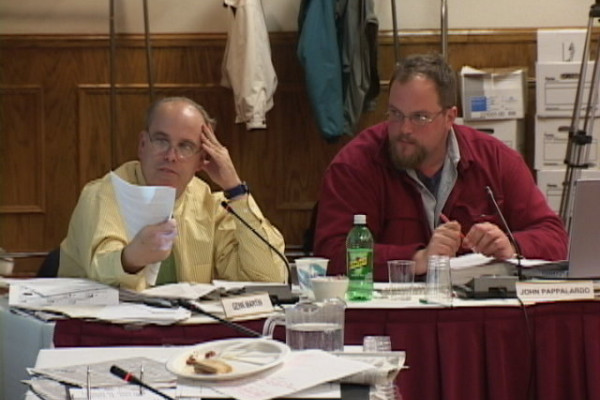
John Pappalardo’s early days on the New England Fishery Management Council.
By Doreen Leggett
In 1996 the mobile flip phone hit the market, Hubble Space Telescope captured the first surface photos of Pluto, Fox News was launched, Beanie Babies were big and John Pappalardo attended his first New England Fishery Management Council meeting.
“I went up with Fred Bennett. There were a couple of carloads of guys,” remembered Pappalardo, 24 at the time. “I had never seen anything like it. I knew from the fishermen these are the people who make the rules.”
Now 54, Pappalardo, CEO of Fishermen’s Alliance, recently celebrated his 100th meeting, 20 years on that council, honored at its June meeting when he “retired.”
“Your enduring contributions to the sustainable management of New England’s fisheries, resources, and traditions is unmatched in the history of the Council,” Chairman Dan Salerno said. “You have been a staunch advocate for science-based management approaches and an innovator in applying emerging scientific concepts into management options. You have served on nearly all council committees and chaired most of them as well.”
After that first meeting 30 years ago, Pappalardo had no designs on serving on the council, but Cape fishermen felt they had no voice in the process and that sustaining the industry and habitat protection were not priorities for decision-makers.
“They felt this was a fatal threat to their way of life,” Pappalardo said.
So he threw his hat into the ring. He wasn’t appointed that first year, but the second year, after dozens of fishermen marched the Freedom Trail with giant fish heads, he was tapped by Massachusetts Governor Paul Cellucci for one of 18 seats in 2001.
The years leading up had been difficult for the industry and Council members. As livelihoods were lost, meetings were contentious, fishermen throwing chairs. Fishermen had gone from no quotas to strict limits on their catch after the near-collapse of groundfish species such as cod and haddock.
Phil Coates, head of Massachusetts Division of Marine Fisheries, had to be escorted from a meeting by police shortly before Pappalardo was sworn in.
Contentious issues continued, like rolling closures and buy-outs.
Pappalardo said buy-outs and closures were signs of failure, but there were few if any good options.
“If you believed the science there wasn’t enough fish,” Pappalardo said.
Pappalardo believed. He and other council members thought stocks would recover by protecting spawning areas and habitat.
“We thought it was going to be a tough five years and the fish will come back and the fishery will bounce back,” he said.
It didn’t work out that way. Although haddock did recover, cod are still at low levels and heavily regulated. Warming ocean waters are thought to be one culprit for the slow cod recovery.
Council members remember Pappalardo’s steady leadership when tensions and emotions were high.
“It wasn’t always well received in this room or down on the Cape, but you always showed up prepared, you always were respectful of other people’s opinions when they differed from you and you were always fiercely devoted and committed to the communities you represent and the fisheries they depend on,” council member Geoff Smith said.
Pappalardo was a strong advocate for science, particularly when fishermen work collaboratively with researchers; one of his expressions is fishermen don’t just catch fish, they catch data. But science doesn’t stand alone. Decisions need to be made.
“I believe in better data. But we are never going to science our way out of all of this. Better science can help us understand the problem. It does not remove uncertainty, and it does not remove judgment,” Pappalardo said to the council.
Science was the cornerstone when the Magnuson-Stevens Act was re-authorized in 2007. The re-authorization mandated annual catch limits as well as accountability measures to prevent overfishing. The act also emphasized peer review and scientific committees to ensure decisions rely on best available data.
“During your first term from 2002 to 2011, including five years as council chair, you helped guide the council through the implementation of the reauthorized Magnuson-Stevens Act, oversaw the development of the groundfish sector program through Amendment 16, and ushered in scallop rotational management and IFQs (individual fishing quotas),” Salerno said.
During his last meeting, Pappalardo spoke about how he tried to keep the big picture in mind, representing the next generation of fishermen as well as this one. This was why he helped establish a permit bank on Cape Cod, to make sure access was anchored in the community when IFQs were implemented.
“People may say I’m too blue-sky minded,” he said. “When there is a crisis at hand, talking about systems, structure, or what the fishery might need 10 years from now can feel like a distraction. But somebody has to be thinking at that level too. Somebody has to be looking out a decade or more. If nobody is doing that, we spend all our time reacting and almost no time preparing.
“I annoyed people,” he said with a laugh. “There was no ‘c’ with council options. There was only ‘a’ or ‘b.’ I pushed for ‘c.’”
One moment stands out for him. The council was working on a regulatory framework and he advocated splitting it, so hook fishermen on the Cape could catch haddock and leave cod behind. Splitting the framework meant hook fishermen could fish in areas other gear types couldn’t, and dozens of businesses were helped. It was the first time it had ever been done.
“I really want to say how much I appreciate your ability and your commitment to think outside of the box and to push this council and the fishing community to think creatively and boldly about ways we could manage our fisheries better. ‘It’s the way we do it’ is never a satisfactory answer for you and you always push the rest of us to think what could be and not what is,” said council member Smith.
During his second stint, Pappalardo tried to get managers to step away from regulating fish in silos. Management plans do not consider species in the larger ecosystem, which may lead to unrealistic estimates in what regulators term maximum sustainable yield. Target species may have moved due to warming waters, for example, or one of their predators may have increased in one location, or they could be facing increased pressure from seals.
Pappalardo wanted species to be managed as part of the larger ecosystem, which is why he championed greater protections for herring, a key forage fish many species depend on.
“Following your reappointment in 2015, you continued to provide thoughtful leadership, deep institutional knowledge, and a steadfast commitment to supporting and maintaining the diversity of New England fishing communities,” Salerno said. “Your work on Omnibus Habitat Amendment 2, Ecosystem Based Fishery Management, and Herring Harvest Control Rules pushed the Council towards a more holistic management approach.”
To make cogent arguments Pappalardo had to know the issues. In the early days, council members would get 1500-page council packets in the mail; there were no laptops. How he approaches the work now is much the same:
“Use good science. Listen to people closest to the resource. And when facts change, change with them.”
Regional Administrator Mike Pentony, from NOAA’s Greater Atlantic Region Fishery Office, said with a laugh that serving on the council “requires a level of patience, dedication and maybe a touch masochism.
“You have provided more than just expertise, you have provided institutional memory and a moral compass that has guided many of the council’s most difficult decisions.”
Others said Pappalardo also stood out for his respect for staff. He consistently supported those doing the work required to make decisions.
Pappalardo left the group with this thought:
“One thing I hope this council is willing to do in the years ahead is … ask whether parts of our Fishery Management Plan structure and permit structure still fit the job in front of us. Not because the past was wrong. Because the fishery we are managing now may not look like the fishery those structures were built around.”