
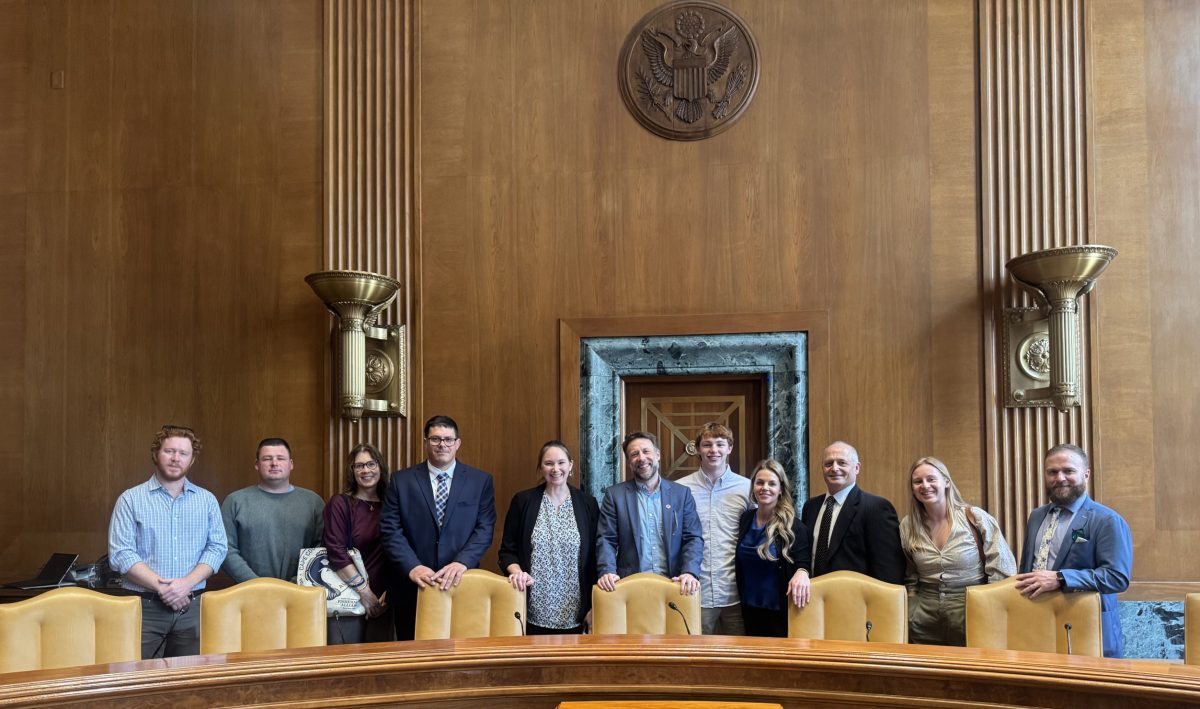
A Cape contingent travelled down to Washington, D.C. with Fishing Communities Coalition.
By Doreen Leggett
A group of commercial fishermen and industry advocates from across the country sat down at a table in NOAA’s Silver Spring, Maryland headquarters with Assistant Administrator Eugenio Piñeiro Soler, who runs the National Marine Fisheries Service (NMFS). Like many meetings they have had with policymakers, the fishermen talked about unnecessary regulatory burdens, needless closures, an unequal playing field, under-investment, instability, inadequate science, lack of training and other barriers to their success. It was clear that the leader of NMFS, on the job for a little less than a year, had been having many similar conversations around the country.
Piñeiro Soler nodded and said those hurdles “distract you from what you do well, which is fishing.”
He said the industry requires good science and support to fulfill its destiny.
“Why should you crash if you are doing the right thing? Especially in the United States,” said Piñeiro Soler, who got his start commercial fishing in Puerto Rico.
“Persevere.”
Jake Angelo, 34, a fisherman from Barnstable, had been thinking about tenacity when he prepped for a round of meetings with legislative and administrative offices in Washington, D.C. He was joining fishermen from around the country who are part of the Fishing Communities Coalition (FCC), made up of fishermen’s organizations from Alaska to Maine.
Angelo always wanted to be a fisherman and ignored his parents, teachers and other naysayers when he was young who suggested he find another career.
He isn’t put off by a struggle, always willing to walk into one fray or another, seemingly unbothered by adversity.
He is worried about others. Staying in commercial fishing is difficult, and there is so little support that few are left and too few are getting in.
Historical knowledge has been lost and Angelo has had to learn most things by himself as there are few old-timers around for advice.
“I would like to explain how important it is to have fish,” Angelo said in his typically direct manner. “We have done so much and they restrict the hell out of us.”
Angelo said he may be the only commercial fisherman going for finfish from his port this year, and he blames a lack of institutionalized support for young fishermen like him:
“What if instead of college loans you can get a fishing loan, what if instead of battling through it there was a path?”
The contingent from FCC focused on many issues Angelo is worried about. Devyn Campbell, a fisherman from Boothbay Harbor in Maine who’s not yet 30 years old, already is the last groundfish fisherman in his port.
He wants to purchase a larger boat, but no available loans make sense. Interest rates are too high and he couldn’t secure the loan against his boat, or his permit.
“I was going to pay back $250,000 on $50,000,” he said.
Vincent Balzano, also of Maine, in the industry for more than 40 years, said traditional lenders think fishing vessels are too high-risk.
He quoted an old saying that people who will make a loan to fishermen are “friends, family and fools.”
Sean Connors, a fisherman from Chatham, found a new friend in Farm Credit. His experience finding affordable capital using systems designed for farmers and ranchers is one FCC wants to replicate for others in the industry.
Connors went through Farm Credit in Western, MA. when after three successful fishing years he was able to invest in a new, larger boat.
“I checked banks and other non-traditional lenders and they wanted more assets, more years, but Farm Credit was able to write against the permit and the existing boat,” Connors said.
He told Maine Representative Chellie Pingree’s staff as well as those in the offices of Maine Senator Angus King and Massachusetts Senators Ed Markey and Elizabeth Warren, that without Farm Credit’s business loan and an interest rate several percent below the standard, “I wouldn’t have been able to grow, or do it that quickly, and keep guys [working on deck] employed.”
He said several of his crew are young, around 20.
“They want to stick around; people want to fish,” Connors said.
If fishermen’s access to capital were fully on par with farmers and ranchers, Connors’ loan would have an interest rate closer to 4, and Campbell could have grown his business, said Noah Oppenheim, coordinator for FCC.
“It’s time to put fishermen on an even keel,” Oppenheim said.
During meetings with staff from the House Natural Resources Committee, House and Senate Agriculture Committees, Senate Commerce Committee, Senate Appropriations Committee, and others, the group talked about lack of access to programs helping farmers and ranchers.
FCC has been making progress at the federal level. After several years of advocacy, the USDA is taking more of a proactive stance on seafood. “Fishermen are the farmers of the Sea”, Agriculture Secretary Brooke Rollins often says. And she’s right.
FCC members also had the opportunity to meet with USDA’s new Seafood Industry Liaison, who is working to integrate seafood into USDA programs and coordinate across agencies to benefit domestic seafood producers. The Liaison position was established by Congress last year; the FCC and commercial fishermen have high hopes for the role.
Although there is a lot of progress to be made, USDA grants and other programs have already begun to help the fishing industry. Maine fishermen’s organizations have been able to get more fish into schools. Before the program, fish that didn’t sell on the auction were scratched – and fishermen took the loss. Now there is a price floor set so when that number is reached the fish is bought.
That change resulted in a new product, flounder fish cake tots, taking elementary schools in Maine by storm.
Angelo reached more customers through a grant he secured and once people saw him selling scup and other under-loved fish they started coming by to purchase. Sometimes it just takes a small investment to be able to grow awareness of delicious seafood landed in ports every day.
Another win was the re-authorization of the Young Fishermen’s Development Act, which the group talked about with Tyler Allard, deputy legislative director for Massachusetts Rep. Seth Moulton, in a room filled with oil paintings of fishing vessels and historic Cape Ann ports.
Earlier this year, Moulton brought forward legislation that reauthorized this “small but mighty” workforce development program to support training and education of America’s next generation of commercial fishermen. The bill was named after Accursio “Gus” Sanfilippo to honor the captain and crew of the F/V Lily Jean, which sank with all hands lost on Jan. 30.
Some fishing problems the industry has been experiencing this spring required immediate attention, and the visit to the halls of power in D.C. was well timed. Fishermen on the trip spoke about loss of revenue due to red tape. They said management can be a “black box” and bottlenecks in the bureaucratic process mean that regulatory frameworks stall somewhere at the federal level.
Balzano said it has happened a half dozen times in recent years. Most recently with haddock and fishermen couldn’t catch their allocation.
“We probably left $2 million of opportunity of haddock in the water,” said Ben Martens, executive director of Maine Coast Fishermen’s Alliance and a member of FCC.
Another time it was herring; by the time the framework was approved there were only a few days left in the season and fishermen had pulled their boats.
“For the fishermen who are making business decisions it’s so much extra BS,” said Martens.
The partial government shutdown effecting Department of Homeland Security has added another wrench as fishermen who require Coast Guard sign off for Vessel Documentation and for permit transfers are left in abeyance.
Connors, with a new boat, falls into this category, and if the issue isn’t resolved before April 1, when the new fishing year begins, there is a lot to lose.
This in addition to longstanding issues fishermen grapple with, including erosion of the working waterfront, which is particularly acute in smaller fishing communities.
Lack of investment and encroachment of other uses have forced commercial fishermen into smaller and smaller areas with deteriorating infrastructure, if any exists at all.
Angelo currently unloads in a spot 50-feet long. Larger areas are shut down to him because piers have been condemned. To get to work and get his catch to market, he performs a time-consuming back and forth with his skiff, boat and landing spots. The exercise looks a bit like a cat’s cradle game when he sketched it out. It adds time, and time is money.
“If we don’t have the infrastructure, it deters people who want to get into the industry,” said Angelo.
Alaska is experiencing similar issues with infrastructure affecting their economy and cost of living.
Linda Behnken, a fisherman and executive director of Alaska Longline Fishermen’s Association, and others are looking for ways to keep their communities whole. Most of the fish landed in her community is caught in the summertime, and a lot of Alaskan seafood is sent out of the state and even overseas for processing. The high volume of fish at certain times of year also depresses prices.
FCC is advocating for investment in cold storage or other avenues to strengthen the year-round seafood economy.
Maine is also grappling with infrastructure issues. Much of the state’s working waterfront areas are small family docks. These places are essential parts of the seafood economy, but they weren’t eligible for some forms of disaster funding after major damaging storms in 2024 because they weren’t big enough. Making the situation more difficult is a lack of flood insurance eligibility, because most policies don’t cover piers.
The law is a relic of the response to Hurricane Katrina and doesn’t make sense for working waterfronts, said Martens.
Unforeseen, uncontrollable hurdles are nerve-wracking, said Angelo, so he is taking Assistant Administrator Piñeiro Soler’s advice.
“He wants us to be passionate and he wants young people to speak up,” Angelo said.
Angelo understands that in the past the voices of fishermen were often ignored, dismissed. Many commercial fishermen got sick of banging their heads against a wall and stopped advocating for change.
Angelo said if he had a choice he wouldn’t travel to D.C. – his suit felt like a strait jacket – or push for changes locally. He’d rather just be fishing. But he feels it is imperative that decision-makers know how their rules and regulations play out on the water.
“I do this out of necessity, but I also feel it works,” he said. “If I didn’t see results, I wouldn’t do it.”