
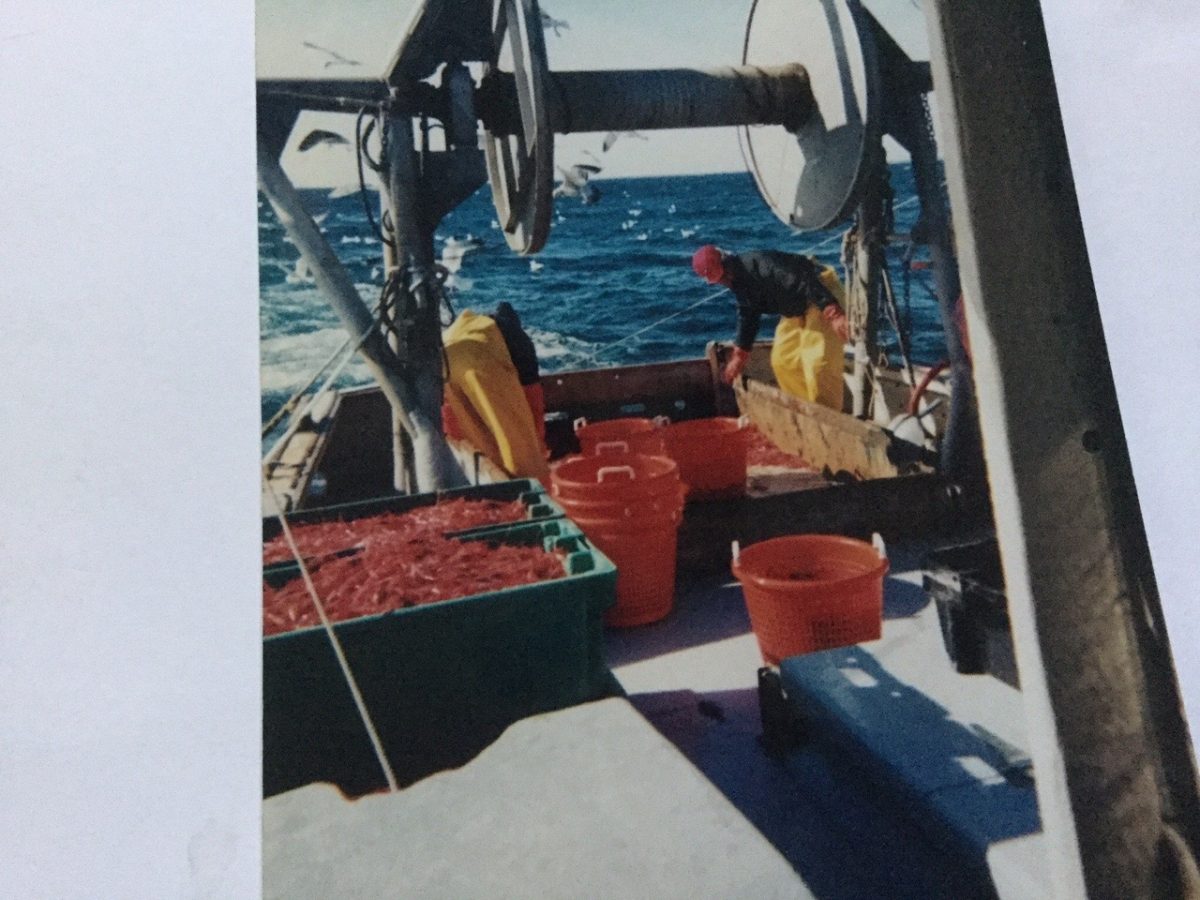
Arctic shrimp used to be a successful fishery but Bill Amaru, who used to fish for them, said warming regional temperatures have made them commercially extinct.
Photo courtesy of Bill Amaru.
By Bill Amaru
There is nothing more ubiquitous on Cape Cod and throughout New England than Homarus Americanus, more commonly named American Lobster. And there was once a tasty shrimp landed in our waters by the millions of pounds called Pandulus Borealis or Arctic shrimp. One of these two is now extremely rare in New England waters, commercially extinct. The other is still plentiful but could be heading in the same direction.
Thinking of Cape Cod without lobster is like thinking of Cape Cod without cod. But the reality is that Cape Cod doesn’t have a cod-fishery anymore.Cod have become so rare in the last decade, allowable catches so low, that directed fishing on that species does not exist from Cape ports.What few pounds are taken are as by-catch (fish not intended to be caught) in another fishery like flounder or haddock fishing.
Arctic Shrimp, with landings of more than 10 million pounds years ago, has been under a total moratorium for 10 years, just extended another three. There is no question for one reason why: Our regional ocean waters have warmed to the degree these cold-water loving crustaceans and finfish do not live here anymore.
Landings to our north, in eastern Nova Scotia and throughout Newfoundland and Labrador are strong and growing as populations of pandalus borealis and cod move into colder waters. It is an example of a pattern that repeats itself as warming waters don’t sustain regional fisheries that once flourished.
Very few who live in Orleans and on the Outer Cape remember the bright red delicious shrimp treats we once had in deep winter, the only time of year they arrived in our area. The flavor is remembered by those who appreciate local fare. The bright red shell – almost fluorescent – was dazzling. A bottle of Grey Goose, Roses lime juice and steaming hot red shrimp on a Friday night when the gang would gather round was something very special.
So the question arises: Could this be the future for the New England Lobster?
Make no mistake: Our lobster fishery continues to be very productive. The summer and fall, when lobsters migrate inshore, is remarkable for its production and has outpaced the value of all finfish landed here.
But a recent review by the federal agency monitoring and regulating the resource has issued a warning that over-fishing is occurring and recruitment (young animals) has fallen off. Could this be a continuation of the pattern described above? The lobster fishery south and west of our region, in Nantucket Sound, Rhode Island Sound and all the waters west into Connecticut and New York, has fallen dramatically. Very few seemingly warm-water tolerant lobsters persist in this region. In these western waters temperatures have risen above tolerable levels and populations of species like black bass and dogfish that love to munch on small lobsters have exploded.
While it is difficult if not impossible to predict the outcome of all the shifts that are occurring, it is safe to say that things will not be the same in the near future in our fisheries or anywhere else here on the Cape. Communities are having numerous meetings to plan for sea level rise, more powerful ocean storms and impacts on our infrastructure. But the reality of our consumption stands in stark contrast to the hand-wringing going on.
I admit to being guilty of angst without being willing to do much to change the pattern. We burn wood in the Amaru household rather than oil or propane. I have convinced myself (and I believe for good reason) that re-introducing the local surface carbon back into the atmosphere to keep my pipes from freezing is better than carbon that comes from oil or gas that has been a mile underground for 20 million years. Yet in this warming world, virtually all societies are forging ahead with more vehicle traffic, more and larger buildings, and consumption the likes of which would have shocked our grandparents’ generation.
So please enjoy your seasonal feast of lobster.And enjoy the cod that was likely caught a thousand or more miles away in Icelandic or Norwegian waters.It’s good fish but takes a cargo jet as well as a fishing boat to get it here.
Once upon a time I caught a plethora of cod three miles from Nauset Inlet, easily brought to Nauset Fish and Lobster in Orleans a mile from where I landed it, to feed the citizens of Orleans and the Cape. So keep eating fish you can still find there, but remember if it says it’s local, it only means it was local “somewhere.” If it says North Atlantic, it could easily have been the other side of the North Atlantic—and that’s a big, big ocean.
William Amaru writes from his fishing shanty in South Orleans. Drop by sometime and he’ll show you some old pictures of Arctic shrimp.