
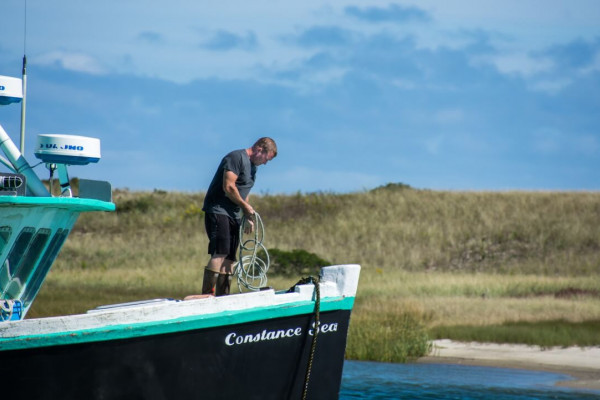
Greg Connors aboard his boat Constance Sea. File photo by Christine Walsh Sanders.
By Doreen Leggett
If no one catches fish in the ocean, are they still there? Commercial fishermen say yes, but fisheries science has been saying otherwise.
The disconnect between what fishermen experience on the water and the information regulators use to manage stocks has always been a bugaboo, but it’s a particular problem when it comes to monkfish.
Since scientists can’t age monkfish, they tie the total allowable landings to an incomplete federal survey and fishermen’s landings over the last few years – which plummeted during COVID when the markets shut down.
When fishermen began targeting the ugly, yet delicious, big-mouthed fish again, they were faced with drastic cuts because the stock assessment model assumed there were less fish because landings were down.
Seeing the problem, Cape Cod Commercial Fishermen’s Alliance teamed up with School for Marine Science and Technology at UMass Dartmouth and commercial fishermen to use a federal grant program to better incorporate fishermen’s efforts and understanding into the stock assessment.
“Our goal was to provide a way to expand the stock assessment model to include fishing effort,” said Melissa Sanderson, chief operating officer at Fishermen’s Alliance, who noted that local gillnet fishermen have told her they are less likely to target monkfish when prices are low or skates clog up the nets and replace monks. “Because monkfish landings (not the actual stocks) are low, the amount fishermen are allowed to harvest keeps going down.”
Sanderson said problems with the assessment have outlasted COVID.
“If you aren’t going fishing because prices suck, you didn’t get out, or buyers aren’t buying, we don’t want that to effect next year’s allowable catch,” she explained during a Zoom call with fishermen last fall.
The project started a few years ago and incorporates vessel trip reports, observer data, catch data, and other variables into a form to tie a value to a fishermen’s catch per unit effort. The acronym is CPUE. After peer review, it could be used by managers.
Lack of monkfish landings has also impacted funding for the research project, which relies on fishermen leasing Research Set Aside days at sea to target monkfish, with that lease going to the work. The value of the project prompted the Fishermen’s Alliance to pre-pay for the project, regardless of research funds. There are still Research Set Aside days available for fishermen for about nine cents a pound. Monkfish fetch from $1 to 3.50 per pound.
“If you need RSA days, please reach out to me,” said Sanderson.
Captain Greg Connors, a gillnet fishermen out of Chatham, said participating in the study allows him to land additional pounds, which helps offset his costs for gear, insurance, fuel, etc.
RSA programs are unique to the East Coast and overseen by National Oceanic and Atmospheric Administration, NOAA. No federal funds are used, and a portion of the allowable monkfish quota is reserved. On an RSA trip, there also are no trip limits, vessels are limited only by the amount of RSA pounds they have leased.
The formal name of the project is “Integrating Fishermen’s Knowledge into Standardized CPUE Indices for Monkfish” and research was led by graduate student Sierra Richardson, working with Professor Steve Cadrin.
Richardson included variables such as area, depth, and month in her models, which helped account for factors that influence catch rates beyond changes in monkfish abundance.
“Catch rates vary seasonally as fishing effort, fish distribution, and environmental conditions change … CPUE indices account for this seasonal variability,” Richardson explained. “Bringing all important variables together in one model reduces bias from changing fishing behavior, improves model performance, and results in more reliable and interpretable standardized CPUE indices.”
Connors said last winter he was heading to the fishing grounds and saw the federal research vessel towing east to west. He was heading farther out to where the fish were, which is an example of why scientific studies don’t always match fishermen’s experience.
“There is a band of fish that moves up and down; when you get behind the line there are no fish there,” he said. “They were just burning fuel and not collecting data.
“They have no fishermen on these boats.”
Richardson looked at nine factors, including tow duration, tow speeds and horsepower. She also explored environmental drivers (the increasing abundance of skate that fill nets before monkfish) and economic factors (the number of vessels in the southern gillnet fleet has dropped from 200 to 75).
She said fishermen with home ports from New York to Rhode Island to Maine were essential in interpreting the data and producing the models.
“I was really surprised by how many fishermen want to be involved in the science that goes into fisheries management,” Richardson said. “With already busy schedules, I was impressed by how they still took extra time to participate in workshops and help us understand their fishery and their data.”
Massachusetts and Rhode Island fishermen typically target monkfish in winter months and can travel 100 miles to catch the mottled brown fish.
Julia Child introduced the “poor man’s lobster” to American consumers (it was already popular in France), but it still hasn’t received the respect it deserves. Monkfish is becoming more common on restaurant menus.
“Monkfish is delicious and one of my favorites. If you aren’t comfortable cooking fillets, you can try pre-made monkfish burgers,” said Sanderson.
Richardson expects her RSA report to be complete in February. The project has been important to the New England Fishery Management Council which voted in December to prioritize a peer review of the CPUE results.
Fishermen interested in RSA days can reach out to Melissa Sanderson at melissa@capecodfishermen.org or 508-945-2432 x 100.