
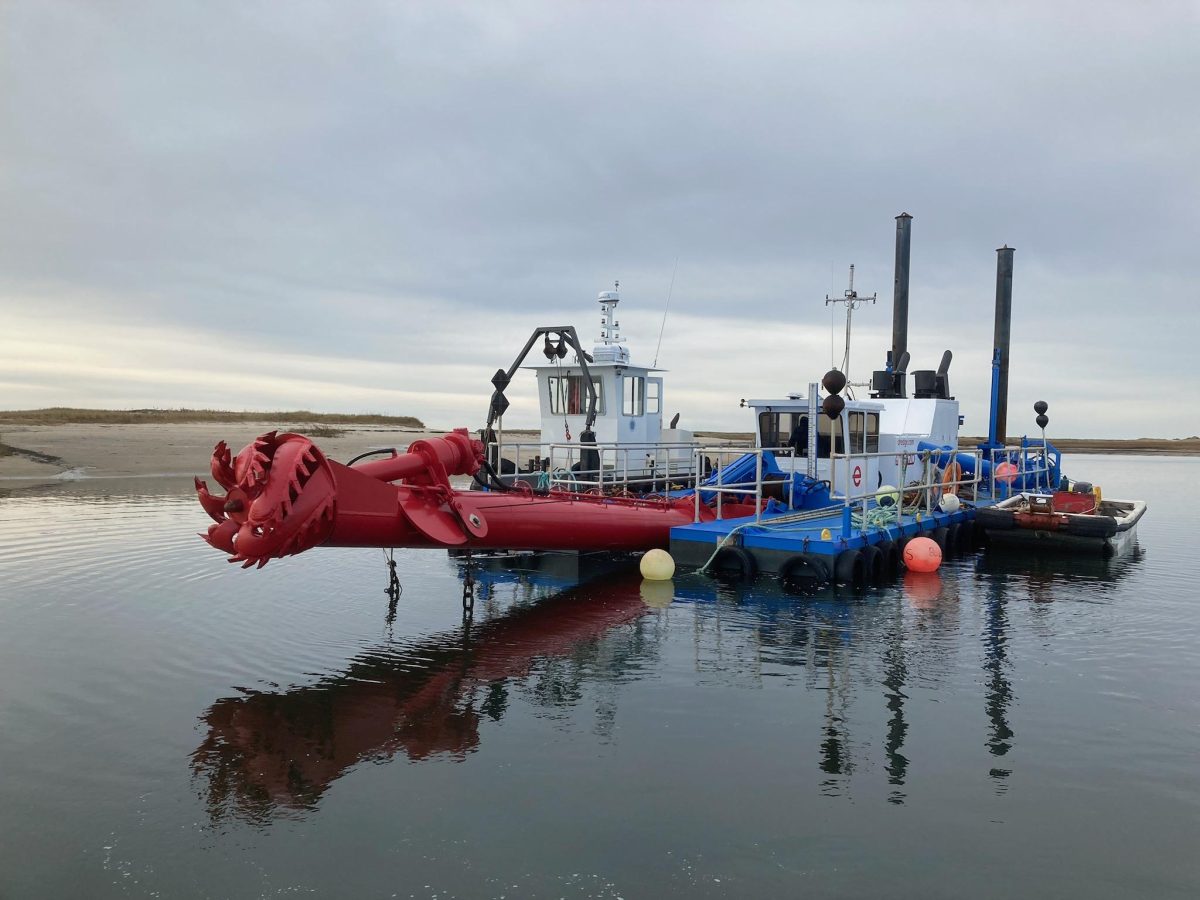
The Codfish II doing some work in Truro.
By Doreen Leggett
Known as much for its shifting sands as 66 miles of coastline, Chatham relies on dredging and town officials believed they had permits in hand to do the required work.
“We thought we were approaching the finish line, but we were not,” said Greg Berman, Chatham’s director of natural resources. “We are hitting our heads against the wall.”
Communication delays with regulatory agencies meant they discovered last-minute they weren’t going to get a comprehensive dredging permit. The town barely had time to re-direct essential projects out of the larger permit application.
More than 50 people, in person and online, from multiple federal and state agencies – U.S. Army Corps of Engineers, U.S. Fish and Wildlife, MA Department of Environmental Protection and Division of Marine Fisheries among them – and representatives from Senators Ed Markey, Elizabeth Warren and Rep. William Keating, listened as Berman spoke.
If the Barnstable Country dredge hadn’t been able to get a few days in at Mill Creek, Berman continued, the town would have gone into the season with water quality problems, navigation issues, delays with beach nourishment, and threats to one of the town’s claims to fame.
“That is one of our primary nurseries for shellfish. We have 1.5 million (animals) up in that estuary. We can’t have it sealed off. I think we dodged a bullet this time,” said Berman, who added Chatham spent $330,000 on the endeavor, not including staff time.
Berman’s tale is common across the Cape as towns struggle with dredging delays, and the county’s dredge program suffers financially as well.
The situation became so serious the county, supported by Congressional offices, held its first dredging summit with myriad regulatory agencies late in 2023.
Improvements have been made since. Several towns have received 10-year permits, but there is still work to be done, which is why a second summit was held at the county complex in Barnstable this spring.
“I know that protection of our harbors and waterways is crucial to all facets of life on the Cape and Islands,” said Mark Lannigan, reading a statement from Sen. Markey. “I hear the frustration about the dredging permitting process.”
Dredging delays have been a top concern for recreational boaters and the Cape’s commercial fishing industry, which is worth more than $250 million annually.
Over 28 years, Barnstable County dredges have removed more than 2.5 million cubic yards of material from 300-plus projects on Cape Cod. More than 99 percent of the dredged material went to rebuilding beaches and coastal infrastructure.
The need for dredging continues to grow with impacts from climate change, rising water levels, and changing sand dynamics.
Before these two summits, said Ken Cirillo, director of the county’s dredge program, there were two phone call meetings with regulators, designed to improve what many saw as a flawed, if not broken, process.
“So many years had gone by where there wasn’t a lot of communication between these three legs on the stool – stakeholders, consultants and regulators,” Cirillo said. “It’s not just one agency and it’s not just one problem.”
Lisa Rhodes from the Massachusetts Department of Environmental Protection provided an update on permit streamlining, designed to “reduce process time without reducing protection.”
The project involves developing guidance, coordinating interagency meetings, and creating a complete application checklist.
She said oftentimes applications are incomplete and sent back, which causes major delays.
“We want to do a better job defining what has to go into these applications and make that a lot clearer,” Rhodes said.
Tammy Turley from the Regulatory Division U.S. Army Corps of Engineers told the group about changes projected to save 60-to-120 days per application, which gives a sense of how long this process has been taking.
One way is to increase transparency, so applicants know where they are in the process.
“You will be able to see the status of your application, very excited about that,” she said.
The group was updated on the Barnstable County Dredge Permit Optimization Study, focused on reducing permitting time and costs, as well as improving project scheduling.
The study included stakeholder interviews. Respondents expressed support for a planner at the county who would track schedules for towns, keep in touch with regulators and identify emerging trends in permitting. As of now, dredging responsibilities are under the umbrella of every town’s harbormaster save one.
Cirillo said some fixes, such as training people on new permitting websites, are easy to do. Others will take more time.
“We believe maintenance projects that have been done again and again and again should not be part of the more rigid review of an improvement project,” Cirillo said, adding there are 17 locations dredged every one-to-three years. “That requires a regulatory change.”
The dredge season typically runs from early September through the end of May. Dredging days lost due to weather are inevitable but days lost to Time Of Year (TOY) restrictions (intended to protect spawning fish, endangered shorebirds and horseshoe crabs to name a few) continue to increase. One effort the county has been exploring is adaptive management that can be used to help mitigate the TOY restrictions on a project-by-project basis.
One such initiative is the use of turbidity monitors where the data collected is reviewed by regulators in real time, which can provide flexibility and be used to allow the continuance of dredging into the TOY restriction.
“There just aren’t enough days in the calendar to dredge all the projects that need to be dredged,” Cirillo said, but better process, and communication between stakeholders, would get the county closer to the goal.