
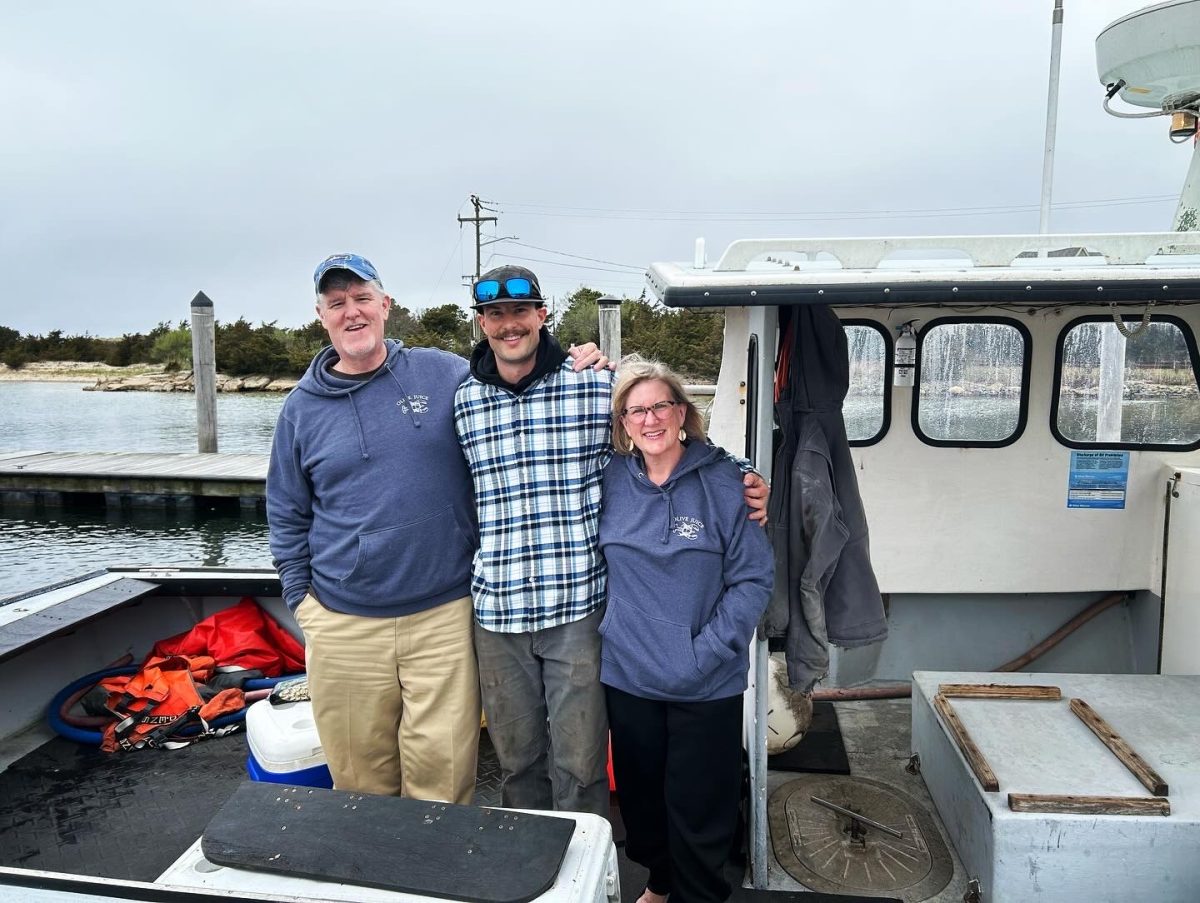
Braden Wilson, middle, stands with his dad Edward and mom Judi on the F/V Olive Juice.
By Doreen Leggett
When Braden Wilson christened his new boat and took a maiden voyage last year in Cape Cod Bay, his mom Judi was standing on the dock in Dennis with a bunch of his friends.
“I was able to say ‘Olive Juice’ when he left the harbor,” Judi Wilson said with a laugh. “I know it’s corny!”
Olive Juice is the name of Wilson’s 31-foot lobster boat and Braden named it after her. She has been saying the words instead of “I love you” ever since her son gave her the “defcon” stare back in middle school; if you mouth the two phrases you can’t tell them apart.
“Everyone names the boat after their mom,” Wilson said with a smile.
Wilson, 30, has been fishing since college, but hadn’t done it growing up and when he started had no plans to pursue it as a career.
Everything has fallen into place, good mentors, captain support in finding a boat, fortuitous timing for a slip at MacMillan Wharf in Provincetown, a loan at the bank, and a supportive wife.
He was also one of the first Cape fishermen to join the Cape Cod Oceanographic Fleet and use a CTD, an instrument encased in a metal cage that measures conductivity (salinity), temperature and depth. The instrument provides information about a rapidly changing ocean so fishermen can fish smarter.
The white cylindrical sensor, which Braden dropped overboard at least twice a trip for several weeks, uploads data from the ocean to a large data base with information from dozens of fishermen. More are in the queue to get involved.
“I’ll be able to look at where I am (this) season compared to previous years,” Braden said.
Pioneered in Rhode Island by Commercial Fisheries Research Foundation and Woods Hole Oceanographic Institution (WHOI), the program has helped fishermen better understand when fish species arrive and leave, where currents will take baby scallops, when cold water pulses bring in more nutrients and fish, or when warm core rings from the Gulf Stream bring in new species or change the timing on when traditional species arrive.
Judi said Braden is data driven, so having oceanographic data at his fingertips is valuable.
Braden, a Nauset High grad, had gone to one of the best colleges in the country, and Judi wasn’t sold on commercial fishing. But she saw how doors opened for him.
“I am kind of spiritual and the path has been provided for him and he has taken advantage of it,” she said.
Braden even started the business with a logo, courtesy of his artist sister, and a matching tattoo – Olive Juice with an anchor.
Temperature and salinity profiles allow Wilson to plan his fishing season in a rapidly changing ocean environment where storms or anomalies in the Gulf Stream can change the location of lobsters in a matter of hours.
“I can project if I am going to have an extra couple of weeks,” he said. “The CTD is bad ass.”
The data is also critical for oceanographers and in expanding the program to Cape Cod, WHOI scientists will get more information on the mysterious Outer Cape Coastal Current.
Old-time fishermen say lobsters are cyclical and there are boom years every six to eight years. Now, looking at the data about the Outer Cape Coastal Current, Braden thinks it may have more to do with the current in Cape Cod Bay.
The Outer Cape Coastal Current’s shifting location, how it impacts fishing, and how the current is affected, for instance by intense rain storms, are all question marks fishermen like Braden hope to help answer.
For his first solo season, Braden did alright. Because the water was unusually cold, lobsters moved into warmer waters closer to shore to molt and spawn, which suited Braden’s smaller boat.
Before he made the jump to captain, he was fishing as a crew member and is also a firefighter in Truro.
“I pack it all in,” he said, laughing. “The brain runs a little fast.”
He wanted to go out on his own. One of the main reasons he was able to make the leap was because of his long-time boss, Glenn Rorro.
“I love the guy,” he said. “That guy made lobstering fun.”
Rorro said on his boat everything was a bet: the weight of the lobsters, how many bugs in a certain trawl, who would scream louder if they were bitten.
“Braden and the other guys were so competitive. I would love to instigate,” Rorro said, looking at a blond eyebrowed and mustached picture of dark-haired Braden — after he lost a bet.
Braden pointed out that they doubled down and Glenn had to get a mohawk.
Rorro helped him find housing when Braden came back to the Cape in 2020 and had no problem when Braden couldn’t be full-time because of his firefighter gig. Other captains might have frozen him out.
Rorro said Braden is the type of guy you want as a son.
“He wants to better himself,” said Rorro. “You can’t hold him back.”
Wilson met Rorro, who is from a well-known fishing family, when he was 21.
He was home for the summer from Colby College, where he was majoring in Spanish and playing football, and Rorro was the uncle of one of his friends.
“They needed a guy,” said Braden, so he hopped on the 57-foot F/V Angela Mary III.
Rorro said he almost didn’t take him because Braden had to go back to school in the fall.
“He is a very solid guy, very intelligent, book smart. The kid can figure out anything if you give him a book,” Rorro said. “And he is aggressive; he is a hustler.”
Braden has mostly lobstered, but gillnetted and also worked on fish weirs. He has a lot of admiration for older captains and fishermen; “absolute savages,” he says.
Lobstering was where he wanted to be.
“I do love it. I don’t know why. It’s not like you are having fun all day,” he said. “But I am getting up in the morning and going fishing; it doesn’t feel like work.”
His love for the ocean has persevered through a few tough times, including the sinking of Angela Mary III in 2022.
The boat capsized off Race Point on May 17, the second day of the season, the crew picked up by a tow boat.
Rorro said Braden saved his life that day. Rorro didn’t have time put on his survival suit, so he had the crew throw him some buoys and Braden told him to grab on to his feet and swam him out to the survival raft, which had drifted away.
Judi doesn’t deny that she worries.
“It is dangerous, I know that, but I also know he loves it,” she said.
Braden was in his second year of teaching Spanish and coaching football at a prep school in Connecticut when he had an epiphany.
“I loved sports, I loved kids, but teaching Spanish out of a textbook for the next 27 years … I’m not wired that way,” Braden said.
He and his wife Christine, who was his high school sweetheart, decided to make the leap back home. She got a job as a dental hygienist and he worked on boats and went through the fire academy, landing a job in Truro.
Braden said it isn’t unusual for lobstermen to do more than one thing. Since regulations keep the season to eight months or so, and weather keeps small boats off the water at times, many bang nails or pursue other fisheries.
The fire department helps pay his mortgage (he recently bought his grandmother’s house in Dennis) and the department’s shift schedule allows him to run the boat.
Braden was able to meet a lot of captains and one, Mike Rego of F/V Miss Lilly, helped him find a boat.
The boat belonged to Bob Mallory, who was on the water right up until the end. Rego introduced Wilson to Mallory’s widow.
“She was an absolute Godsend,” Braden said.
Then he had to find dockage. He was on a couple of lists; the one in Sesuit Harbor, close to where he lives, had a wait of 30 years.
“I was in a massive pickle for awhile,” he said. “I literally had to send up a prayer.”
A space opened in Provincetown where he is happy to be, first finger pier on the left.