
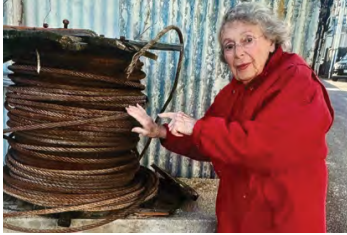
Helen Valentine pointing to a bail of cable wire at Taave’s Boat Yard
By Helen Valentine
Before draggers, schooners dotted our harbor. Double-ended dories were used to row captain and crew from moorings to wharfs. Schooners operated by sail only.
Then came the 1940s, 50s, 60s and 70s, the decades of draggers, also called Side Trawlers or Eastern Trawlers. Alarms would go off at 3 to 4 a.m. every morning, all over town. Later, when telephones came into play, captains phoned the telephone operator. She plugged in, by memory, a call to each crew’s home number.
At the wharf, there was not much conversation, more like, “Think we’ll go. What’s the weather? Who changed boats? Who died? Where was the fire?” No mention of world affairs, town politics, or economy. Down the “ladder” (boards nailed across two poles on the wharf), men climbed to boats.
After unloading, the boat would get stocked for the next trip. A phone call to the oil company would set up fuel delivery.
Likewise, a call to the ice company. The ice came from local ponds, cut in winter and stored in straw. It arrived in blocks. Eventually, that got replaced by an ice machine in a truck, ice shredded into the hold to keep the fish fresh.
One more very important task; food. A list was dropped off at Fisherman’s Market on Bradford St, and it would be delivered. Cold meats would be placed in the “ice box” with a small door open in the galley, or kitchen, which opened up to the hold, stocked with ice.
The previous day, the catch was shipped out, packed into baskets and later years boxes, marked, sized, and weighed on the wharf by the captain and fish buyer. It was then loaded onto trucks for a midnight run to Fulton Fish Market in New York City, Boston, sometimes Pennsylvania. Jimmy Enos and driver John Fay would drive.
While they were steaming into port, the crew also mended nets on deck. Any “rim racked” nets had to be mended on the crew’s day off, Friday. Cable wire kept tow cables on the trawl doors and net at even lengths, used to hoist heavy net and doors up and down. If any wire cable needed to be mended, the cable would be stretched down the length of the wharf and checked for wear and tear and kinks. If needed, it would be “spliced” by an expert splicer. Marks every 25 fathoms were put into the cable using a Marlin spike. The “splicer” had to use this tool to loosen the tangle of wires wrapped around each other.
The engineer changed the engine oil and inspected. Food and ice aboard, the cook brewing coffee and probably offering flipper dough from the Portuguese Bakery, breakfast started. Ready to shove off!
Ah, but not as simple as just letting the lines go and steaming away. If you were the first boat “in” the previous day and tied to the wharf, there could be multiple boats “tied up” alongside you, “daisychaining.” The crew from boats on the outside had climbed over all the closer boats to get to the wharf. And for the first inner boat to get free, it meant loosening the lines of the other outside boats and then retying them once you slipped out.
There was no GPS, no navigational aids. The captain knew the way from lifelong experience. The crew also knew where they are headed depending on the season. The captain knew when and where fish would be: flounder, yellowtails, blackbacks, haddock, cod. He would also have some idea of the price per pound for each fish. The going rate could be 10 cents for cod and haddock, whiting 6 to 8 cents per pound or 1½ cents for “round” (not cleaned). Every head and tail had to be cut. Not cleaned would mean the fish still had their heads, tail and guts intact.
Lobsters were considered “trash fish.” The crew took them home for their own consumption, to share with friends or sell at local restaurants. Cash from the sale of lobsters was divided among the crew.
The net (made of a specially coated cotton) had to be rigged. The mouth was 60 feet wide, bottom rings sewn along one edge. This chain scraped along the bottom and stirred up any fish buried in the sand. In order to keep the nets spread out, they were attached to heavy “doors.” These doors were hoisted over the side by the winch; in earlier days, this was done by hand. These doors weighed 700-800 pounds, each with a three- to four- inch strip of iron called “the shoe” welded around the door. The shoe would keep the wood of the doors from wearing out. Wide wings on each side of the net created a funnel for fish to swim in and get caught using the forward speed of the boat. Everything would be forced into the bag at the end of the net.
If an area had rocky or unstable bottom, rollers called “cartwheels” were threaded through the net. These wheels, made of hard pine, had a three-inch hole cut out of the center for net and gear, rimmed with three-inch strips of rubber. Like a car tire, they rolled over obstacles on the bottom.
While the net dragged, first breakfast and then lunch was prepared. A favorite of the crews was smoked shoulder. A lunch of fish was not a daily occurrence. A good cook could draw crew to a boat; some captains awarded a small extra to the cook.
Then it would be time to “haul back.” Before the modern winch was developed, the net was pulled in by hand, an arduous task. With the net bag hoisted high, a slip knot at the end of the net was pulled. Tying the slip knot before the net entered the water was the most important procedure on board. If done properly, the bag held the catch! If not, no catch! On occasion, if the bag was too full, pressure made it almost impossible to release. In that case, the net would have to be sliced open, then repaired.
Everything in the bag tumbled on deck to be sorted, sized and separated. All debris would be pushed through the scuppers. Once sorted and sized, fish were put into baskets, or wooden boxes. They would be stored in the hold full of ice chips. The net was checked for holes or rips that might need to be “laced up” until permanent repairs made on a day off.
After inspection, the net went back into the water. Day boats fished from early morning until late afternoon. After the last drag of the day, or when the hold was full, the trip home began, net and doors back in place. The deck was left spick and span for the next day’s trip.
The fish buyer, from his office on the wharf, could see “his” boats coming around Long Point, those loyal to him. Once a boat tied up, a scale was brought. The captain and buyer weighed and marked each box by species, less 10 percent for water. The box was iced down, lid nailed down, hauled aboard a waiting truck. Truck drivers wasted no time unloading, in and out quick.
The crew had some idea of their pay based on their hauls and the estimated price, but it would never be exact until the buyer’s quote; a check to the captain may include a 3 to 5 percent addition for loyalty. The crew would gather at the captain’s house to “settle up.” Once food, oil, ice and supplies such as gloves, pitch forks, rope, cable twine, or any new electronics were deducted, the crew got paid, generally evenly divided including the captain.
As fisherman Anthony Joseph said, “It was not always smooth sailing. The net may have gotten tangled up below. The doors may have twisted. The engine may have needed repairs. Injuries may have occurred. If the seas were too rough, you may have to return home and there would be no pay that day.
“Challenges were all considered (part of) a day’s work.”
The above is an edited version of Helen Valentine’s story in the 2024 Provincetown Portuguese Festival Booklet. Valentine, 94, was married to George, proud owner of the F/V New England that sank at MacMillan Pier. He continued fishing on other Provincetown fishing vessels.