Floating Offshore Wind in the Gulf of Maine
Recent News: Gulf of Maine Offshore Wind Auction and Lease Sale (10/29/2024)
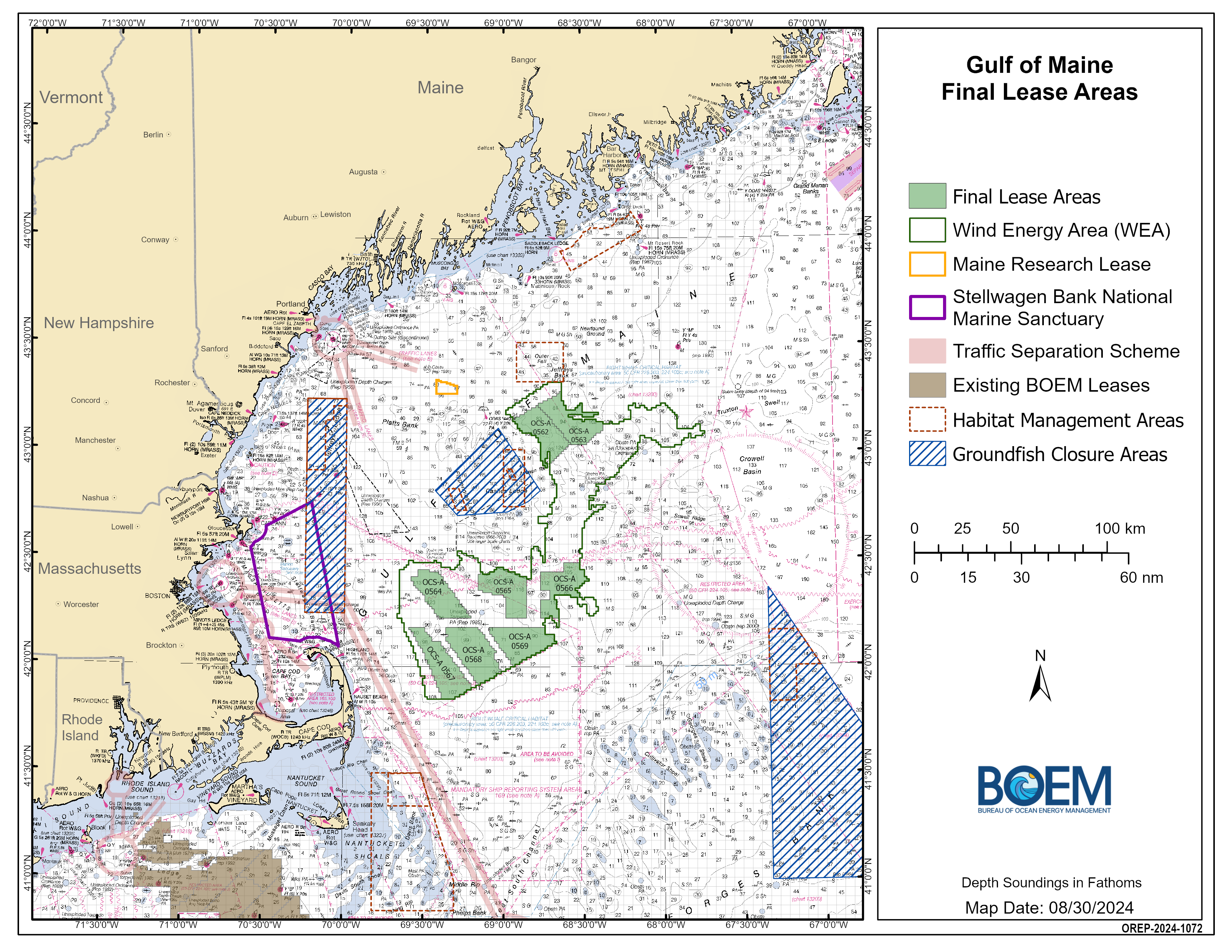
- On October 29, 2024, the Department of Interior announced the results of an offshore wind energy lease sale on the Outer Continental Shelf (OCS) in the Gulf of Maine. The auction resulted in two provisional winners on 4 lease areas (OCS-562, OCS-564, OCS-567, and OCS-568). OCS-564, OCS-567 and OCS-568 are the three lease areas closest to Cape Cod.
- OCS-564: $4,928,250 / 98,565 acres = $50/acre
- OCS-567: $5,889,000/ 117,780 acres= $50/acre
- OCS-568: $6,244,850/ 124,897 acres= $50/acre
From BOEM press release: “Today, the Biden-Harris administration completed its sixth offshore wind lease sale by offering areas in the Gulf of Maine – the first commercial sale for floating offshore wind on the Atlantic Coast. The sale, conducted by the Bureau of Ocean Energy Management (BOEM), resulted in two provisional winners on four lease areas and over $21.9 million in winning bids….Through today’s sale, Avangrid Renewables, LLC won Lease OCS-564 at $4,928,250, which consists of 98,565 acres and Lease OCS-568 at $6,244,850, which consists of 124,897 acres. Both lease areas are approximately 29.5 nautical miles (nm) from Massachusetts. Invenergy NE Offshore Wind, LLC won Lease OCS-562 at $4,892,700, which consists of 97,854 acres and is approximately 46.2 nm from Maine and Lease OCS-567 at $5,889,000 which consists of 117,780 acres is approximately 21.6 nautical miles (nm) from Massachusetts.”

Offshore Wind Position and Comment Letters
On October 23, 2024 the Fishermen’s Alliance Board of Directors approved a position statement associated with floating offshore wind (below).
We are a commercial fishing advocacy organization that has worked for 35 years to protect the livelihoods of commercial fishermen, the coastal communities they depend on, and the marine environment. We see the aggressive rush to industrialize our ocean with thousands of offshore wind turbines on the fishing grounds adjacent to Cape Cod as a pivotal moment for the health of our industry. We oppose offshore wind development on fishing grounds, until it can be shown not to have a negative impact on our ocean environment or our fishing communities. We are concerned about the harm to the ocean environment, as well as negative impacts to commercial fishing operations and seafood production. As wind development looms on the horizon, we will work to make sure small fishing businesses are not just part of the discussion, but that every decision contributes to a healthy ocean and a robust and prosperous fishing industry. It is our job to provide fishermen with the opportunities to get their voices heard in the process.
As it relates to our Mission:
We aim to create a space for open dialogue, resource sharing, and education related to the development and operations of new and proposed floating offshore wind projects in the Gulf of Maine.
We strive to provide a voice on issues impacting our constituents related to the development and operations of new and proposed floating offshore wind projects in the Gulf of Maine and empower them to engage in the process. This will be accomplished by directly collaborating with key agencies including the National Marine Fisheries Service, the Bureau of Ocean Energy Management, fishery management councils, and state agencies, as well as the commercial fishing industry, offshore developers, scientists, universities, and other stakeholders, to address offshore wind development in our region. Our goal is to promote and protect our marine environment, fisheries and coastal blue economy.
While this process continues to play out, with limited staff resources, we intend to focus on the following six priorities:
- Enhance Advocacy and Engagement: Actively represent membership interests and boost participation in offshore wind discussions and/or negotiations. Strategically engage in effective advocacy for Offshore Wind accountability through science-based arguments, thorough decommissioning plans and requirements for leases, thorough offshore wind planning timelines, meaningful public input opportunities, and comprehensive impact analyses (e.g., economic, environmental, cost-benefit).
- Coordinate Efforts: Collaborate with local, and state advisory groups, Responsible Offshore Development Alliance (RODA), MA Fisheries Working Group, to streamline advice, avoid duplication and improve coordination on offshore wind development to mitigate conflicts.
- Support and Disseminate Research: Advocate for funding to support scientific research on offshore wind impacts on wildlife, fisheries, and habitats. Ensure that this data is publicly accessible to guide mitigation and inform community efforts.
- Inform and Educate: Gather and distribute relevant information to the fishing community and the public about floating offshore wind, addressing industry needs and concerns. Share opportunities for fishermen to financially benefit from offshore wind including surveys, debris recovery, and fisheries mitigation funds. Foster transparency and broad engagement with the Cape Cod community through various channels like social media, websites, and meetings.
- Facilitate Dialogue: Act as an advisor between offshore wind developers and fishermen to discuss our concerns, provide fishermen with the opportunity to get their voices heard in the process, empower fishermen to negotiate, and implement effective fisheries mitigation strategies.
- Promote Community Benefits: Advocate that future Community Benefit Agreements (CBAs) and Power Purchase Agreements (PPAs) reflect the specific needs of members and promote long-term community benefits.
For more information please contact Aubrey Church, Fisheries Policy Director: aubrey@capecodfishermen.org
Below you will find letters associated with proposed offshore wind in the Gulf of Maine:
- Letter to BOEM regarding Proposed Sale Notice in the Gulf of Maine – June 27, 2024
- Letter to BOEM on Environmental Assessment of Wind Energy Area in the Gulf of Maine – April 15, 2024
- Statement from 17 Gulf of Maine fishing associations regarding BOEM’s recent announcement of Wind Energy Area. – March 2024
- Letter to BOEM regarding draft Wind Energy Area in the Gulf of Maine – November 16, 2023
- Letter to BOEM regarding commercial wind energy leasing in the Gulf of Maine – June 9, 2023
- Letter from New England Fishery Management Council, which CEO John Pappalardo serves on, and Mid-Atlantic Fishery Management Council regarding wind energy
- Letter of concern on the wind development process from Responsible Offshore Development Alliance, RODA – April, 2021
Fishermen’s Alliance involvement in OSW
- Fishermen’s Alliance is a member of the Responsible Offshore Development Alliance
- We are a member of the MA Fisheries Working Group on Offshore Wind Energy that is comprised of commercial fishermen, and representatives from different ports and sectors, recreational fishermen, scientists and state and federal agencies.
- Strategic Advisor on an offshore wind project in partnership with New England Fishery Management Council (NEFMC) and Gulf of Maine Research Institute. This project was funded by Department of Energy: “Fostering Capacity for Fishing Communities to Engage Effectively and Constructively in Offshore Wind Development in the Gulf of Maine”
- Objective 1: Build the capacity of Gulf of Maine fishing communities to engage in offshore wind (OSW) development. This involves identifying fishing community needs, developing resources, and providing opportunities for informed participation and dialogue about OSW processes.
- Objective 2: Enhance stakeholders’ ability to engage in discussions about community benefit agreements and power purchase agreements related to OSW development. This includes facilitating workshops to co-design future scenarios and developing strategies to ensure sustainable seafood harvesting and climate resilience for long-term fishing community success.
- Member of the Vineyard Wind Innovation Fund Advisory Panel.
- Massachusetts Innovation Fund (also referred to as the Vineyard Wind Innovation Fund) provided as a part of Vineyard Wind’s Compensatory Mitigation Plan. The purpose of the Fund is to support programs and projects that ensure safe and profitable fishing continue as Vineyard Wind and future offshore wind projects are developed in the North Atlantic waters. The primary goals of the DMF innovation are to provide support to programs and projects through grants to:
- Conduct studies on the impacts of offshore wind development on fishery resources and the recreational and commercial fishing industries.
- Provide grants for technology and innovation upgrades for fishery participants (and vessels) actively fishing within a wind energy area.
- Massachusetts Innovation Fund (also referred to as the Vineyard Wind Innovation Fund) provided as a part of Vineyard Wind’s Compensatory Mitigation Plan. The purpose of the Fund is to support programs and projects that ensure safe and profitable fishing continue as Vineyard Wind and future offshore wind projects are developed in the North Atlantic waters. The primary goals of the DMF innovation are to provide support to programs and projects through grants to:
Gulf of Maine Floating Offshore Wind: Auction is set for October 29, 2024
On September 16, 2024 the Interior Department announced the Final Sale Notice for the first offshore wind energy auction in the Gulf of Maine. The Final Sale Notice (FSN) published in the Federal Register on September 17, 2024.
For example here is a lease for OCS A-0564. For all leases please visit BOEM website here.
What does a lease do?
- Offers the exclusive right to the lessee to submit plans to the Bureau of Ocean Energy Management (BOEM) that propose work on the lease.
- Survey Plans, Site Assessment Plans (SAP), and Construction and Operation Plans (COPs)
- NO construction authorization
- The lease is broken down into sections, highlights include:
- Addendum A- location and activities
- Addendum B – Lease Term and Financial Schedule
- lease length, rent and operating payments
- Addendum C – Lease Specific Terms, Conditions and Stipulations
Addendum C Highlights
- Reporting- Enhanced Engagement
- Communciation Plans for fisheries, Tribes and agencies.
- Progress Report required every 6 months providing:
- Summary of engagement with all affected ocean users, Tribes, stakeholders (including underserved communities)
- Efforts to invest or direct benefits to, OR avoid, minimize, or mitigate conflict with ocean users, Tribes, and stakeholders
- Planned next steps to engage with ocean users, Tribes, and stakeholders
- Progress reports will be posted on BOEM website
New or Modified Lease Stipulations
- Baseline Monitoring – NEW
- New stipulation requiring 3 years of Passive Acoustic Monitoring (PAM) data collection within lease areas, including data standards and sharing requirements.
- Habitat Impact Minimization Measures- NEW
- To maximum extent possible, lessee must avoid or minimize bottom-disturbing activities likely to be harmful to any identified sensitive resources (e.g., corals, sponges).
- Habitat Engagement Opportunities – NEW
- Allows, BOEM to host meetings and require lessees to attend. Purpose would mainly be to introduce new lessees to Tribes, and stakeholders, explain next steps in the process, and minimize the engagement burden on those communities.
- Transmission Planning- NEW
- To the extent practicable or feasible, lessee must consider the use of shared cable corridors, regional transmission sytsems, meshed systems, or other mechanisms for transmission facilities propose in a COP
- Surface Structure Layout and Orientation – MODIFIED
- Only relevant for leases sharing a boundary (0562-63). Requires 2 common lines of orientation for navigation/search and rescue. If lessees fail to do that, they must incorporate a setback from the boundary. In response to comments, BOEM increased setback from 1 nm to 1.25 nm (2.5 nm total), and required no surface/subsurface occupancy in the setback area. Now matches conditions of corridors between southern lease areas.
Auction Format: 2 regions; 2 leases per bidder
- Bidder can only win 2 leases
- 1 in the North, 1 in the South
- or 2 in the South
- can not win both lease areas in the North
Bidding Credits
- Maintain original proposal of offering two bidding credits, with minimal changes:
- 12.5% bidding credit for a Workforce Training and/or Supply Chain Development
- 12.5% bidding credit for a Fisheries Compensatory Mitigation Fund
Understanding the Renewable Energy Authorization Process
Currently we are approaching the Lease Auction (Set for October 29th)
- BOEM will hold Lease Auction (10/29)
- Leasing Phase:
- BOEM will award Lease
- Then Lessee (developer) will submit and BOEM will review survey plans (typically takes 1 year)
- Lessee will then submit a SAP (Site Assessment Plan), and BOEM will conduct a SAP decision
- Then we get to Site Assessment Phase:
- Lessee conducts site assessment and surveys (typically 5 years)
- Lessee will submit COP (construction operations plan)
- BOEM will review the COP and determine sufficiency
- BOEM will then conduct environmental and technical reviews (0-2 years)
- BOEM will conduct COP decision
- Then Construction Phase:
- Lessee submits and Bureau of Safety and Environmental Enforcement (BSEE) reviews plan and FDR/FIR (Facility Design, Fabrication and Installation Report)
- Lessee Installs project (1-2 years)
- It is ancitipated that construction likely would not start in the Gulf of Maine until mid 2030s given the timeline below
- Operations Phase:
- BSEE enforces operational safety, environment and compliance (0-30 years)
- Decommissioning Phase:
- BSEE oversees decommissioning activites (1-2 years)

Bureau of Ocean Energy Management (BOEM) Gulf of Maine
- BOEM’s website has a Gulf of Maine Project page that has information on project overview, environmental review, proposed sale notice details, commercial leasing history, research lease and resources
- On October 29, 2024, the Department of Interior announced the results of an offshore wind energy lease sale on the Outer Continental Shelf (OCS) in the Gulf of Maine. The auction resulted in two provisional winners on four lease areas and over $21.9 million in winning bids. Avangrid Renewables, LLC won Lease OCS-564 at $4,928,250, which consists of 98,565 acres and Lease OCS-568 at $6,244,850, which consists of 124,897 acres. Both lease areas are approximately 29.5 nautical miles (nm) from Massachusetts. Invenergy NE Offshore Wind, LLC won Lease OCS-562 at $4,892,700, which consists of 97,854 acres and is approximately 46.2 nm from Maine and Lease OCS-567 at $5,889,000 which consists of 117,780 acres is approximately 21.6 nm from Massachusetts.
- On September 16, 2024, BOEM announced the final areas and sale notice for the Gulf of Maine offshore wind leases. The Final Sale Notice was published in the Federal Register on September 17th. The auction will take place on October 29, 2024. More information can be found here. Final Sale Notice can be read here.
- On September 6, 2024, BOEM announced the availability of its final Environmental Assessment (EA) of the Wind Energy Area (WEA) located in the Gulf of Maine. Press release here.
- Prior Virtual Meetings regarding Proposed Sale Notice
- Previous Slides for Commercial Fishing Industry (June 6, 2024)
- Presentation slides and PowerPoint deck from the 7/14/24 Cape Cod information session in Eastham, MA
- Environmental Assessment Virtual Meeting Room – includes resources about the Environmental Assessment (EA) including links to virtual meeting recordings, the draft EA and appendices, and the Federal Register notice
Mapping Tools
- Northeast Ocean Data Portal Data Explorer
- Interactive Map that NCOSS has created you can view here
Offshore Wind Resources and Hubs
- Gulf of Maine Research Institute Offshore Wind Resource Hub
- Gulf of Maine Proposed Sale Notice Lease Areas
- Gulf of Maine Spatial Suitability Model Guide
- Proposed Sale Notice Guide
- Electromagnetic Fields (EMFs): What do we know about them?
- Draft Wind Energy Areas Guide
- Fisheries Working Group on Offshore Wind Energy (Mass.gov)
- MA Division of Marine Fisheries Offshore Wind
- MA Coastal Zone Management’s new Offshore Wind Page, with guidance and policy documents on Offshore Wind.
Other Community Events and Meetings:
Upcoming Meetings:
- Stay tuned as upcoming meetings get posted
- The next meeting of the Fisheries Working Group on Offshore Wind Energy will be on January 24, 2025 from 9 a.m.-12 p.m.
Past Meetings:
- October 18, 2024 (In-person): MA Fisheries Working Group on Offshore Wind Energy (9:30 AM- 12:30 PM), in Gloucester.
- Town of Chatham Select Board Meeting, October 8th (agenda item D: Gulf of Maine Offshore Wind Project Presentation by BOEM) – starts 2:29:05 -3:20:01.
- September 27, 2024 (VIRTUAL): Joint MA Habitat Working Group and Fisheries Working Group on Transmission Planning (9:30 AM-12:00 PM)
- September 11, 2024 (5-630 PM), or September 12, 2024 (1-2:30PM) – MA Interagency Offshore Wind Council Public Information Meetings – The Interagency Offshore Wind Council (IOWC) is holding two virtual public information meetings. The purpose of these public information meetings will be for interested parties to learn about the progress of the IOWC, outreach efforts to date, draft Stategic Plan recommendations, and timeline for completion. There will be opportunity for brief public comments (2-3 min per person). Register here. Comment period begins September 4th, and the comment deadline is September 18th by 5pm.
- August 14, 2024: Wellfleet Shellfish Advisory Board, Agenda: Discussion on Wind Turbines (CCCFA presentation starts around 1 hr 17 min, and goes till approximately 1 hr 48 min). PDF packet of materials here.
- August 7, 2024: 4:00-5:30 PM Barnstable County Assembly of Delegates Regular Meeting
- Agenda Item #8: Update from the U.S. Department of the Interior’s Bureau of Ocean Energy Management (BOEM) on Gulf of Maine Wind Energy Areas
- Agenda Item #14: Communications from Members of the Public
- Gulf of Maine Offshore Wind Update (26 minutes it begins- 1hr 25 min). Youtube Recording of Meeting here
- August 7, 2024: Nantucket Select Board Meeting (recording) regarding Vineyard Wind Update (starts at 15 min)
- July 19, 2024: MA Fisheries Working Group on Offshore Wind Energy
- Agenda
- Presentations (please see slides on Stellwagen Bank Marine Sanctuary and Offshore Wind – starting slide 25)
- Meeting Summary
- July 17, 2024: Gulf of Maine Proposed Sale Notice Meeting (Eastham, MA). Meeting summary here. GOM Offshore Wind Eastham PowerPoint presentation here.
Understanding Community Benefits
Community Benefit Agreements (CBAs) are a mechanism that provides benefits to communities associated with offshore wind development. Benefits can take different forms (e.g., workforce development programs, compensation for lost gear, preserving recreational beach access) and can be delivered in multiple ways (e.g., direct payments to local government, community funds). CBAs can include agreements made with fishing communities under power purchase agreements (State-level), between offshore wind developers and communities (independent), and as a result of fisheries mitigation for bidding credits (federal).
For the Gulf of Maine Proposed Sale Notice, the bidding credits for lease sale are designed to “support workforce training programs for the floating offshore wind industry; develop a U.S. domestic supply chain for floating offshore wind manufacturing, assembly, or services; and establish and provide funds for a Fisheries Compensatory Mitigation Fund to compensate for potential adverse impacts to commercial and for-hire recreational fisheries in the Gulf of Maine resulting from offshore wind development” (BOEM). While CBAs are part of bidding credits at the time of lease sales, which is expected to take place by end of 2024, the details of these agreements are only outlined at the time of the sale. Detailed plans are made throughout the site assessment, construction and operation process and will take place throughout the next several years (after lease auction but prior to the start of construction).
Below are some helpful resources:
- Office of Energy Efficiency and Renewable Energy (Energy.gov), Wind Energy Community Benefits Guide
- U.S. Department of Energy: Guide to Advancing Opportunities for Community Benefits through Energy Project Development
- Offshore Wind Development and the Community Benefit Agreement with Vineyard Wind (example), Frequently Asked Questions
- Berkeley Law: Center for Law, Energy and the Environment: Offshore Wind and Community Benefits Agreements in California
- Berkeley Law: Offshore Wind and Community Benefits in California CBA examples document (page 11-12 help explain the ideal CBA process mapped onto BOEM offshore wind timeline)
Some Publications and Scientific Papers Related to OSW
- Congressional Research Service 2024: Potential Impacts of Offshore Wind on the Marine Ecosystem and Associated Species: Background and Issues for Congress
- Dorrell et al. 2022: Anthropogenic Mixing in Seasonally Stratified Shelf Seas by Offshore Wind Farm Infrastructure
- Friedland et al. 2023: Forage Fish Species Prefer Habitat within Designated Offshore Wind Energy Areas in the U.S. Northeast Shelf Ecosystem
- Galparsoro et al. 2022: Reviewing the ecological impacts of offshore wind farms
- Methratta et al. 2020: Offshore Wind Development in the Northeast US Shelf Large Marine Ecosystem
- Maxwell et al. 2022: Potential impacts of floating wind turbine technology for marine species and habitats.
- National Academies of Sciences, Engineering, and Medicine. 2023. Potential Hydrodynamic Impacts of Offshore Wind Energy on Nantucket Shoals Regional Ecology: An Evaluation from Wind to Whales.
- NOAA Technical Memorandum NMFS-NE-291. 2023: Fisheries and Offshore Wind Interactions: Synthesis of Science
- RWSC: Integrated Science Plan for Offshore Wind, Wildlife, and Habitat in U.S. Atlantic Waters. Chapter 3 is about Marine Mammals
Recent Media
- The Provincetown Independent: November 7, 2024: 4 Offshore Wind Leases Area Sold, low sale price affects initial fisheries compensation
- Cape and Islands (CAI): November 4, 2024: Buyers paid rock-bottom prices for offshore wind leases off Cape Cod. Why? Some say the election
- WBUR: October 16, 2024: What Harris or Trump will mean for offshore wind in the Northeast
- The New York Times: September 12, 2024: Broken Blades, Angry Fishermen and Rising Costs Slow Offshore Wind.
- The Provincetown Independent: July 24, 2024: BOEM hears mostly opposition at a meeting in Eastham
- Cape and Islands (CAI): July 18, 2024: In a packed room in Eastham, residents call for ‘reset’ on Outer Cape offshore wind
- The Provincetown Independent: July 17, 2024: Leaders Ask BOEM for Time and Information
- Cape Cod Times: July 16, 2024: Wondering about wind farm plans east of Cape Cod? There’s a public meeting coming up
- Cape and Islands (CAI): June 20, 2024: Floating turbines: A look at offshore wind technology for the Outer Cape
- Cape Cod Times: June 29, 2024: A Million acres of ocean for offshore wind: ‘Wow, that’s awfully close to Cape Cod’
- Cape Cod Times: June, 27, 2024: As new wind lease areas are eyed off Cape Cod, leaders seek ‘a seat at the table’
- The Provincetown Independent: May 8, 2024: U.S. Proposes 8 Wind Energy Areas in Gulf of Maine
- Cape and Islands (CAI): May 3, 2024: Feds reveal Outer Cape locations for offshore wind
- Cape Cod Times: March 18, 2024: Feds designate new offshore wind power area off Massachusetts, Maine and New Hampshire